ACHR News
search
Ask ACHR NEWS AI
cart
facebook twitter instagram linkedin youtube
  • Sign In
  • Subscribe
  • Sign Out
  • My Account
ACHR News
  • NEWS
    • Breaking News
    • New HVAC Products
    • Featured Products
    • Manufacturer Reports
    • HVAC Data
    • Legislation
    • ACHR NEWS Centennial
  • RESIDENTIAL
    • Air Conditioners
    • Furnaces
    • Residential Heat Pumps
    • Ductless
    • Residential IAQ
    • Testing, Monitoring, Tools
    • Components & Accessories
  • COMMERCIAL
    • Air Handlers
    • Rooftop Units
    • Chillers and Cooling Towers
    • Commercial Heat Pumps
    • Boilers and Hydronics
    • VRF/Ductless
    • Commercial IAQ
  • REFRIGERATION
    • Refrigerants
    • Refrigerant Regulations
    • Leak Management
  • CONTRACTOR PRO
    • Geothermal
    • Homeowner Study
    • VRF and VRV Ductless
    • Unitary Trends
  • EDUCATION
    • Training and Education
    • Business Management
    • Service and Maintenance
    • Continuing Education
    • Market Research >
      • HVAC Brand Awareness Report
      • VRV, VRF, VRVZ Report
      • Unitary Trends Report
      • Water Heat Professionals Report
    • Webinars
    • Sponsor Insights
    • eProducts Info
    • White Papers
  • EVENTS
    • HVAC Contractor Forum
    • Industry Events and Webinars
  • MEDIA
    • Videos
    • AHR Expo 2025 Videos
    • Podcasts >
      • ACHR News Podcast
      • HARDI Podcasts
      • AHR Expo Podcasts
      • ACCA Podcasts
    • Interactive Spotlights
    • Quizzes
    • eBooks
    • HVAC Talkback
  • HVAC GROUP
    • ACHR NEWS >
      • Current Issue
      • Digital Edition
      • Subscribe
    • Distribution Trends
    • SNIPS NEWS >
      • Join SNIPS NEWS
    • Engineered Systems News >
      • Join ES News
    • HVACR Directory
    • Contests
    • Newsletters
    • Contact
    • Advertise
    • My Account

How To Run Quick Checks On Temp Transducers

February 6, 2002
Graphical multimeters like the Fluke 867B can display large amounts of information. (Courtesy of Fluke Corp.)
If your refrigeration processes use temperature transducers such as thermocouples, resistance temperature detectors (RTDs), or thermistors, then it is important to be able to quickly see if they’re good or bad. This article describes some quick-and-dirty tests for the most common temperature transducers.

Calibration and troubleshooting are two very different requirements. Calibration maintains product quality; troubleshooting affects product quantity. Calibration happens on a schedule; troubleshooting happens in emergencies. Calibration must be precise; troubleshooting must be fast.

When a production line is down, speed is of the essence. The failed component must be isolated and replaced ASAP. With a precision multimeter, you can perform quick, go/no-go checks on most temperature transducers, and while these tests tell nothing about transducer accuracy, they will tell you if a transducer has failed.

Sometimes that’s exactly what you need.

There are three common transducers for measuring temperature: thermocouples, RTDs, and thermistors.
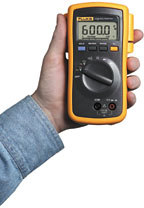
The Fluke 110 multimeter can be used to check for the presence of terminal shorts on thermocouples. (Courtesy of Fluke Corp.)

THERMOCOUPLES

Thermocouples are unpowered transducers that generate a very low voltage. The voltage is generated by the Seebeck effect, by which a potential is created when dissimilar metals are in contact with each other. The voltage across the junction of the two metals is proportional to the temperature of the junction.

The junction of the metals may be sheathed in various configurations, or it may be exposed. The type of thermocouple describes the metals used to make the junction. For example, a J-type thermocouple uses iron in one wire and a copper/nickel alloy in the other.

The higher the temperature, the higher the voltage — although it is somewhat misleading to use the terms “high” and “voltage” in this context. The voltage across a common, J-type thermocouple is about 1.0 millivolt at a room temperature of 68?F. The voltage at body temperature (99?) is about 1.9 millivolts.

There are two steps to checking thermocouples:

1. Check for a short on the terminals.

Looking for quick answers on air conditioning, heating and refrigeration topics? Try Ask ACHR NEWS, our new smart AI search tool. Ask ACHR NEWS →

2. Make sure voltage tracks temperature.

The first test is easy and can be performed with any quality multimeter, such as the Fluke 110. Simply put the meter in ohms or continuity mode. On a good thermocouple, you should see a low resistance reading. If you see more than a few ohms, you probably have a faulty thermocouple. If the reading at room temperature is close to 110 W, then you have an RTD on your hands — read on.

The second test requires a meter that can measure down to tenths of millivolts (0.0001 V). A meter that can measure hundredths of millivolts (0.00001 V) makes it even easier to do this check:

Connect the meter to the terminals of the thermocouple. Grabbing the end of the thermocouple should cause the voltage to increase slightly. As you release the junction, the temperature should drop.

Graphical multimeters (GMMs) afford another level of convenience in this application. They provide a large display that can convey large amounts of information at a glance. Min-max recording allows you to connect the meter, walk over to the tip of the thermocouple, warm it for a few seconds, and walk back to the meter to check the results.

Typical values for a good thermocouple are shown in Figure 1. This shows that it took 37 sec to warm the tip. Of course, if you had to walk to the end of the transducer, this time would be longer.

Figure 1. Typical values for a good thermocouple.

RTDs

RTDs operate on the principle that the resistance of any conductor changes with temperature. As the temperature of a conductor rises, the molecular structure gets shaken up, thus impeding electron flow. So, the higher the temperature, the higher the resistance.

Most RTDs consist of a platinum wire coil with a nominal resistance of 100 W at the freezing point (or, for the purists, the triple point) of water. Resistances other than 100 W at 32? are less common, but do occur. It helps to know what the resistance should be.

Sometimes copper or another metal is substituted for the platinum. For example, in some electric motors and transformers, an extra set of copper windings function as an RTD, indicating over-temperature conditions within the motor. In these special applications, and with metals other than platinum, you will probably find freezing-point resistances other than 100 W.

To measure an RTD or any resistance, the measurement system drives a current through the device and measures the voltage drop.

Checking RTDs is even easier than checking thermocouples. But once again, it takes a precision multimeter to perform the test. You will require a meter that is capable of indicating changes of tenths of an ohm, and will want a meter that measures to hundredths. The absolute value of the resistance is not important, but you need to be able to track small changes.

RTDs can have two, three, or four leads. In a two-wire configuration, simply connect the meter across the leads and measure the resistance. The resistance of a platinum wire RTD should be about 110 W (plus or minus 20%) at room temperature. If you grab the tip of the RTD, you should see the resistance increase. The resistance should gradually settle back after you release the tip.

Three-wire RTDs are commonly used when a measurement system is made up of resistance bridges. The wires that connect the tip to a measuring device have a temperature-dependent resistance of their own (all metals do). The extra wire helps the bridge balance out the effects of lead resistance. When checking a three-wire RTD with an ohmmeter, all you need to know is that two of the three wires should be shorted. Usually the shorted wires are the same color. Between any of the shorted wires and the third wire, the transducer should act just like its two-wire counterpart. That is, at room temperature, the meter should read about 110 W for a platinum wire RTD. Resistance should increase slightly as the temperature at the tip increases.

Four-wire RTDs are less common than the other types. If you do come across one, it should have two shorted pairs of wire. Again, the shorted wires are generally the same color. The resistance between different-colored wires should have a reasonable value at room temperature and should increase if you heat the tip.

Figure 2. Plot of resistance over time for a briefly heated thermistor.

THERMISTORS

Thermistors work in a way opposite to RTDs. This is because semiconductors act oppositely to metals. Semiconductors tend to conduct more electrons at higher temperatures. Thermistors, which are made of semiconductor material, tend to exhibit a lower resistance with higher temperatures.

There are a variety of thermistors, but two-wire thermistors are the most common for general-purpose temperature measurement. Checking a thermistor involves performing ohm measurements. With an ohmmeter, you should be able to watch the resistance of the transducer stabilize at room temperature and drop as the tip of the transducer is heated.

Thermistors generally have a large change in resistance per degree of temperature. Because of this, just about any meter can be used to quickly test a thermistor’s response. Graphical multimeters can take advantage of this property in a unique way. Figure 2 shows a plot of resistance, over time, for a thermistor that was heated briefly.

Temperature transducers usually fail in a big way. Rather than drifting, they usually just stop working.

While there can be no substitute for regular calibration and certification, in a pinch a precision a digital multimeter (DMM) can work for you as a solid troubleshooting tool.

Pereles works for Fluke Corp., P.O. Box 9090, Everett, WA 98206; 800-443-5853; www.fluke.com (website).

Publication date: 02/11/2002

Share This Story

Looking for a reprint of this article?
From high-res PDFs to custom plaques, order your copy today!


Recommended Content

JOIN TODAY
To unlock your recommendations.

Already have an account? Sign In

  • HVAC-enrollment

    The Trades Are Back: HVACR Programs See Nearly 30% Enrollment Spike

    A new wave of future technicians is entering the pipeline.  
    News
    By: Matt Jachman
  • 2025 Top 40 Under 40

    2025 Top 40 Under 40 HVACR Professionals List

    The 11th annual Top 40 Under 40 list highlights those...
    HVAC Light Commercial Market
    By: Hannah Belloli-Oster
  • LG Ductless Mini-Split Systems

    The 9 Types of Heat Pumps

    As the U.S. moves toward electrification, heat pumps are...
    Air Source Heat Pumps
    By: Joanna R. Turpin
Subscription Center
  • Create an Account
  • Start a Subscription
  • Manage My Account
  • Sign Up for Newsletters
  • Visit Customer Service
  • Update Preferences

More Videos

Sponsored Content

Sponsored Content is a special paid section where industry companies provide high quality, objective, non-commercial content around topics of interest to The News audience. All Sponsored Content is supplied by the advertising company and any opinions expressed in this article are those of the author and not necessarily reflect the views of The News or its parent company, BNP Media. Interested in participating in our Sponsored Content section? Contact your local rep!

close
  • Piggy Bank
    Sponsored byWatercress Financial

    Energy Prices, Inflation, and HVAC: What Today’s Homeowners Care About

  • Refrigerated Food
    Sponsored bySolstice Advanced Materials

    R-455A Refrigeration: A Cold Storage Solution for the Future

  • Airex Rooftop Units
    Sponsored byAirex Manufacturing Inc

    Consolidating Roof Penetrations: A Growing Trend in Multifamily HVAC Design

Popular Stories

HVAC-Price-Increase-graphic

HVAC Price Increase List: June 2026

Trump-Section-232.jpg

Trump Reduces Section 232 Tariffs on HVAC Equipment to 15%

R410A-Refrigerant-Cylinder.jpg

Refrigerant Recovery is a Revenue Opportunity

Heat-pump-cutaway.jpg

PFAS Rules and A2L Building Codes Continue to Evolve

Kroger.jpg

Kroger to Spend $100 Million to Reduce Refrigerant Leaks

View The ACHR NEWS
Centennial Anniversary Timeline

The ACHR News Timeline Chart
Submit a Letter
Submit a letter to our editors.

Events

November 6, 2025

Next-Gen Data Center Cooling: HVAC Innovation and Real-World Solutions

On Demand As AI workloads and high-density computing push traditional cooling methods to their limits, the data center industry is accelerating the adoption of next-generation HVAC technologies.

June 17, 2026

Decarbonization Without Disruption

This webinar will explore practical HVAC decarbonization strategies that minimize disruption while maximizing long-term performance and ROI.

View All Submit An Event

Poll

Summer Staff

Are you fully staffed for the summer season?
View Results Poll Archive

Products

BNI Mechanical/Electrical Square Foot Costbook, 2026 Edition

BNI Mechanical/Electrical Square Foot Costbook, 2026 Edition

See More Products
A2L Refrigerants - Free Webinar - May 21, 2026

Related Articles

  • piping a hot water zone

    How to Run a Hot Water Zone Off a Steam Boiler

    See More
  • How to Run a Condensate Zone Off a Steam Boiler

    See More
  • OSHA Ramps Up Scrutiny on Temp Worker Safety

    See More

Related Products

See More Products
  • front cover only.jpg

    How to Market Your HVAC Business

  • quick guide.png

    Quick Guide to Refrig Cycle, Refrigerants, Components

  • The ACHR News - December 15 2025

    ACHR NEWS December 15, 2025, Issue

See More Products

Related Directories

  • measureQuick®

    measureQuick is an application that technicians use to display measurements from arrayed smart tools, run equipment diagnostics, view just-in-time education and resources, generate easy-to-read homeowner-facing PDF reports and more.
  • Howe Corp.

    Howe manufactures flake ice making equipment for use with virtually any refrigerant including natural such as R-744, and R-717, Ice storage bins, Condensing units for our ice flakers.
  • measureQuick® (Software/Video)

    measureQuick is an application that technicians use to display measurements from arrayed smart tools, run equipment diagnostics, view just-in-time education and resources, generate easy-to-read homeowner-facing PDF reports and more.
×

Sign Up. Stay Informed.

The #1 trusted source for the HVACR industry since 1926

SUBSCRIBE
  • RESOURCES
    • Advertise
    • Contact Us
    • Advisory Board
    • Classifieds
    • Submit a Letter
    • Directories
    • Store
  • ACCOUNT CENTER
    • Create an Account
    • Start a Subscription
    • Manage My Account
    • Sign Up for Newsletters
    • Visit Customer Service
    • Update Preferences
  • SERVICES
    • Marketing Services
    • Reprints
    • Market Research
    • List Rental
    • Survey/Respondent Access
  • STAY CONNECTED
    • LinkedIn
    • Facebook
    • Instagram
    • YouTube
    • X (Twitter)
  • PRIVACY
    • PRIVACY POLICY
    • TERMS & CONDITIONS
    • DO NOT SELL MY PERSONAL INFORMATION
    • PRIVACY REQUEST
    • ACCESSIBILITY

Copyright ©2026. All Rights Reserved BNP Media, Inc. and BNP Media II, LLC.

Design, CMS, Hosting & Web Development :: ePublishing