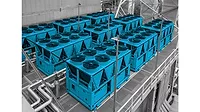
Geothermal Plant Utilizes Special Cooling Technology
Today, the utilization of geothermal resources has expanded. While people still bathe in shallow pools heated by the Earth, engineers have created technologies that allow facilities to search miles below the Earth’s surface to seek out geothermal energy.
One such development is the Mammoth Pacific geothermal facilities located in the California Sierra Nevada Mountains and fueled by geothermal fluid from the Casa Diablo Hot Springs. Built in 1984, the plant generates 32 megawatts (net) of renewable electricity that is sold to Southern California Edison. This is enough power for approximately 32,000 homes.
“Our earth’s interior provides heat energy from nature,” said Bob Sullivan, general manager at Mammoth Pacific. “This heat, called geothermal energy, yields warmth and power that we can use to generate electricity, without polluting the environment.”
THE GEOTHERMAL PROCESS
Geothermal power plants use steam, heat, or hot water from geothermal reservoirs to provide the force that spins the turbine generators and produces electricity. The used geothermal water is then returned down an injection well into the reservoir to be reheated, to maintain pressure and to sustain the reservoir.“We pump water ranging in temperatures from 300 - 400?F to the surface through the production well, where it is passed into a heat exchanger,” said Sullivan. “Our facilities consist of 12 production wells and nine injection wells. A total of eight single-stage, radial-flow gas expanders are used in the process.”
The facilities pump the hot water from more than 300 feet underground. In this binary system the water is passed through a heat exchanger, where its heat is transferred into a second (binary) liquid, called isobutane, that boils at a lower temperature than water.
When heated, the isobutane flashes to vapor, which, like steam, expands across and spins the turbine blades, which in turn generates electricity. The vapor is then recondensed to a liquid and is reused repeatedly. In this closed-loop cycle, there are no emissions to the air and no fuel is required. The isobutane vapor runs through large fin fan condensers that reject heat from the vapor and return it to a liquid state and the process continues through another cycle.
Fin fans are air-cooled heat exchangers that are similar to those found in condensing units for commercial and residential air conditioners. They draw large amounts of ambient air across their fins, thereby rejecting the heat from the isobutane. Instead of dissipating heat into water and then transferring that heat to the air, as with shell-and-tube heat exchangers and wet cooling tower systems, and air-cooled fin fan dissipates heat from a fluid directly into the air.
Looking for quick answers on air conditioning, heating and refrigeration topics? Try Ask ACHR NEWS, our new smart AI search tool. Ask ACHR NEWS
BENEFITS OF GEOTHERMAL ELECTRICITY
Geothermal power plants, like wind and solar power plants, are called “renewable” technologies because they do not burn fossil fuels to generate power. As a result, geothermal facilities are an environmentally sound way to produce electricity, and they add to our nation’s fuel diversity so that we are not too dependent on fuels.“Manufacturing electricity with geothermal energy helps to conserve precious fossil fuels, such as natural gas, oil and coal,” said Sullivan. “In addition, geothermal energy creates none of the emissions associated with combustion power plants.”
Geothermal power plants are designed to run 24-hours-a day all year because they sit right on top of their fuel sources. They are resistant to disruption of power generation due to weather, natural disasters, and interruption in fuel availability.
Last summer, Mammoth Pacific sought ways to improve efficiencies and generate more power. Facility management decided to conduct a pilot program to improve energy production using evaporative cooling systems to enhance the cooling effectiveness of the large fin fan condensers.
“Our goal was to regain power at the plant by using materials to filter water to cool the fin fans,” said Sullivan. “During the research phase of our project, we discovered that the Munters Systems Division offered evaporative cooling technology that could meet our power increase needs.”
EVAPORATIVE COOLING INSTALLATION
The Mammoth Pacific geothermal facilities are air-cooled and the efficiency changes depending on the ambient temperatures. As the air heats up during the summer, the air coolers become less efficient. Evaporative cooling systems are designed to substantially reduce the ambient air temperatures during these hot summer days.The principle of evaporative cooling is quite simple. Water is applied to the top of the media and allowed to trickle down. It spreads out over the extensive surface and mixes with the air, which is passed through the corrugations. When the water evaporates, it requires energy to pass from the liquid to the gaseous stage. The water vapor absorbs this heat from the air, thereby lowering the temperature of the air as the relative humidity is increased.
However, in order to utilize evaporative cooling systems, Sullivan realized that they would have to pump additional water to the plant. The water is necessary for the evaporative cooling schemes to lower the ambient air temperature surrounding the condensers at the plant.
“To pump the tertiary treated water to the facilities, we built a 2½-mile long pipeline to provide us with up to 1.15 million gallons of water per day for industrial cooling purposes,” said Sullivan. “Up to 600 gallons of water comes through the pipe every minute. In another effort to protect our natural resources, the water we receive from the Mammoth Community Water District is ‘recycled’ wastewater.”
Sullivan tested two different Munters evaporative cooling systems for use at the Mammoth plant. One system featured a misting system that sprayed small droplets of water onto Munters MI-T-Fog® media pads.
With MI-T-Fog, water droplets are collected onto the pads, creating the evaporative cooling process. The proprietary paper used in the MI-T-Fog product makes the media pad efficient even on hot summer days.
The second system selected was a more conventional evaporative cooling system using Munters GLASdek® media pads. Using GLASdek, water is distributed over the pad as air is drawn through the media, hence cooling the air towards the wet bulb temperature. GLASdek Evaporative Cooling Media were developed for applications requiring UL 900 Class II fire rating or compliance with NFPA codes, an important factor when dealing with flammable liquids such as isobutene.
The Munters’ evaporative cooling units were installed in July. With Munters cooling the condensers, Sullivan hoped to increase the plant’s productivity by as much as 25%.
THE RESULTS
With the pilot program complete, Sullivan has been able to ascertain the benefits received from the installation of the Munters evaporative cooling system.“We improved our power output by as much as 20% and averaged 10-15% more power with the addition of the evaporative cooling units during the test,” said Sullivan. “Without the cooling systems, we previously couldn’t condense the isobutane to liquid as efficiently so power would drop. By using coolers in front of the fin fans, the ambient temperature dropped by as much as 25¿F.
“This has been a very successful project and we are pleased with the results. We started working on this project in March and we had to move quickly with the energy shortage emergency in California. This was an opportunity to get additional power on line this summer when the state really needed it.”
Sullivan added; “The conventional pad system has proven to be a superior evaporative cooling system. We are considering adding these Munters evaporative cooling units to our remaining fin fan coolers.”
Publication date: 01/14/2002
Looking for a reprint of this article?
From high-res PDFs to custom plaques, order your copy today!