ACHR News
search
Ask ACHR NEWS AI
cart
facebook twitter instagram linkedin youtube
  • Sign In
  • Subscribe
  • Sign Out
  • My Account
ACHR News
  • NEWS
    • Breaking News
    • New HVAC Products
    • Featured Products
    • Manufacturer Reports
    • HVAC Data
    • Legislation
    • ACHR NEWS Centennial
  • RESIDENTIAL
    • Air Conditioners
    • Furnaces
    • Residential Heat Pumps
    • Ductless
    • Residential IAQ
    • Testing, Monitoring, Tools
    • Components & Accessories
  • COMMERCIAL
    • Air Handlers
    • Rooftop Units
    • Chillers and Cooling Towers
    • Commercial Heat Pumps
    • Boilers and Hydronics
    • VRF/Ductless
    • Commercial IAQ
  • REFRIGERATION
    • Refrigerants
    • Refrigerant Regulations
    • Leak Management
  • CONTRACTOR PRO
    • Geothermal
    • Homeowner Study
    • VRF and VRV Ductless
    • Unitary Trends
  • EDUCATION
    • Training and Education
    • Business Management
    • Service and Maintenance
    • Continuing Education
    • Market Research >
      • HVAC Brand Awareness Report
      • VRV, VRF, VRVZ Report
      • Unitary Trends Report
      • Water Heat Professionals Report
    • Webinars
    • Sponsor Insights
    • eProducts Info
    • White Papers
  • EVENTS
    • HVAC Contractor Forum
    • Industry Events and Webinars
  • MEDIA
    • Videos
    • AHR Expo 2025 Videos
    • Podcasts >
      • ACHR News Podcast
      • HARDI Podcasts
      • AHR Expo Podcasts
      • ACCA Podcasts
    • Interactive Spotlights
    • Quizzes
    • eBooks
    • HVAC Talkback
  • HVAC GROUP
    • ACHR NEWS >
      • Current Issue
      • Digital Edition
      • Subscribe
    • Distribution Trends
    • SNIPS NEWS >
      • Join SNIPS NEWS
    • Engineered Systems News >
      • Join ES News
    • HVACR Directory
    • Contests
    • Newsletters
    • Contact
    • Advertise
    • My Account

An Argument for the Use of Coalescing Units
November 25, 2000
In the best of applications, conventional-centrifrugal separators are 80% to 85% efficient in the removal of oil.


Coalescent filter matrix is capable of separating 99.99% of all aerosols in the refrigerant mass flow.
Refrigeration contractors are uniquely positioned to improve the long-range reliability and efficiency of refrigeration systems.

New refrigerants mean that many systems will be reexamined, redesigned, or replaced. This provides an opportunity to change components that critically affect overall system efficiency but are often overlooked.

Some of these components have new features to match the refrigerant improvements. The oil separator is a case in point.
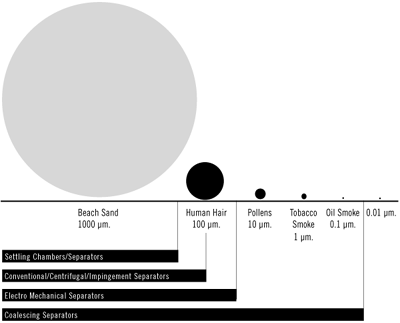


This order of magnitude illustrates the relative size of aerosol particulate present in the refrigerant mass flows; 85% of all oil leaving the compressor is in the 5- to .5-micron range.

HIGH DAMAGE POTENTIAL

Yes, oil is essential to refrigeration. But oil must be confined to where it is needed. Since oil and refrigerant gas are miscible — or mutually attractive — the gas can carry oil throughout the system, with devastating results.

To be more specific, oil’s sole purpose in a refrigeration system is to lubricate the compressor. Inadequate lubrication will eventually cause a compressor to seize up or burn out. Oil will, however, harm other system components and so must be confined to the compressor.

Unavoidably, all compressors pump oil into their systems, the amount being determined by several factors:

  • Compressor design and configuration;
  • System design and operating conditions;
  • Miscibility of given oils and refrigerants; and
  • Compressor age and wear.
  • In most systems, the pumping rate of oil to refrigerant can average from 3% to 15% of the total mass, with some systems having 25% to 75% of the mass flow as oil.

    Oil and refrigerant in the condenser and liquid receiver will more readily mix in the high temperature phase of the refrigeration cycle. Lower temperatures in the evaporator cause the oil and refrigerant to mix less readily, forcing the oil to precipitate and accumulate in the evaporator, thereby robbing the compressor of its vital lubrication.

    From the condenser to the metering device, refrigerant oils are soluble with liquid refrigerant. But, oil and refrigerant vapor do not mix readily. So, from the evaporator to the compressor suction inlet, oil and refrigerant are not very mixable. Oil can be circulated through the system only if gas velocities are kept high enough to carry the oil along the piping and heat exchanger tubes. The ability to retrieve or flush the oil from the evaporator or other locations depends on:

  • The miscibility of the oil being used;
  • The type of refrigerant;
  • The system conditions (temperatures and pressures); and
  • The velocity of the refrigerant through the evaporator and piping layout.
  • A refrigeration system should have velocities high enough to carry the oil through the system and back to the compressor. These high velocities provide good oil return, but also cause pressure drop. This pushes the system to work harder to produce a given amount of refrigeration effect, requiring more energy or larger equipment — and rising costs. The oil is forced around the system, but the lubricant’s insulating effects reduce heat transfer efficiency.

    Excessive oil in the system initiates many problems. Worst case is a system with oil trapped in the evaporator and a higher load demand, with increasing refrigerant velocity. The higher speed may return all the oil to the compressor at once, causing an oil liquid slug and ruining the compressor.

    Looking for quick answers on air conditioning, heating and refrigeration topics? Try Ask ACHR NEWS, our new smart AI search tool. Ask ACHR NEWS →

    It was once believed that oil helped refrigerant make better contact and adhere longer to the wall of heat exchangers (condensers and evaporators), thus improving heat transfer. Actually, a thin film of oil carried by the refrigerant coats the inside of the system, acts as an insulator, and isolates the refrigerant from direct contact with the heat exchanger, retarding heat transfer efficiency.

    In the condenser, temperatures are higher, so the oil film will be thinner. However, it can still measurably increase head pressure and temperature. Colder temperatures in the evaporator will thicken the film to the point where the oil is too viscous to flow. Lower heat coefficients in the evaporator lower evaporating temperature and pressure. What happens in the condenser and evaporator directly affects compressor capacity and efficiency.

    To make up for the heat transfer losses, a system must have larger condensers, evaporators, compressors, and other components. Systems not compensating for the loss of efficiency will have longer compressor run times, different pressure control settings, and more required defrost periods, all wasting energy.

    To sum up, oil’s undoubted benefit to the refrigeration system is in constant danger of being offset by its potential for causing serious problems — problems which can cause down time for the refrigerating system, higher operating costs, and, ultimately, spoilage of stored goods.


    COMBATING THE OIL PROBLEM

    The oil separator is a device specifically designed to remove oil from where it can harm the refrigerating system and to return it to the compressor, where it is needed. Although there are several types of separators, let’s focus on the two that seem likely to dominate the field in the near future.

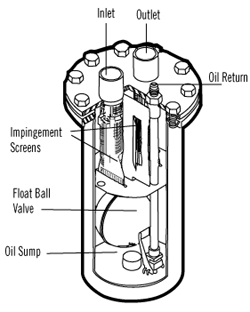
    Conventional “impingement” separators (Figure 1) are most commonly used today.

    These units rely on centrifugal force and the expansion of gasses to remove oil. Superheated and oil-laden refrigerant gas enters the separator shell, where the oil passes through an inlet screen and is separated from the gas by adhering to the screen. Gravity pulls the oil to the separator’s sump, from which a float valve meters it back into the compressor.

    A drawback to this type of unit is its reliance on centrifugal force to accomplish separation. Centrifugal force only works effectively on relatively large oil droplets. This means that smaller droplets remain in the gas and are recirculated through the system.

    It’s likely that, under actual operating conditions, conventional separators will function in the 80% to 85% range.

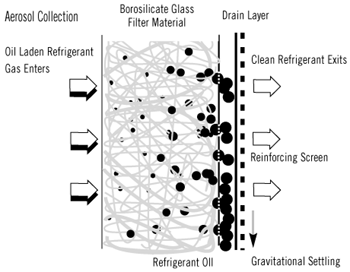
    The second type of separator, the coalescing unit (Figure 2), operates through a filter of exceptionally pure, extremely fine glass fibers, which form a capturing matrix. This matrix excites the oil molecules, causing them to collide with each other and form larger droplets, which are forced to the filter’s outer drain layer. Gravity then pulls the droplets into the sump.

    These units achieve their efficiency by capturing the small oil droplets and a large percentage of atomized oil vapor.

    Coalescing units are capable of delivering between 95% to 99%-plus efficiency, depending on the grade of filter core used and the attention paid to design details.

    Coalescent units cause less pressure drop than conventional separators. They are designed to maintain efficiency over a system’s entire load range rather than becoming less efficient with lower loads.


    CLEANING WITH COALESCENTS

    The new refrigerants have made system cleaning even more important than when CFCs were the mainstay refrigerants. The replacement refrigerants (HFCs) and oils (POEs) are even better solvents than their predecessors.

    So, it is significant that coalescing units capture solid contaminants to 0.3 microns, cleaning the system and preventing it from fouling metering devices. Equipped with accessible filters, coalescent units work well during system start-up. And, they are effective during burnout, capturing the vast majority of resulting carbonized oil, winding lacquer, and metal shavings.

    On average, a properly designed and sized coalescing oil separator has five times the filter area of the standard liquid line filter-drier and five times the filtering area of the suction filter that would be used on a system of the same capacity.

    Arbiture is with Temprite, 1555 Hawthorne Lane, West Chicago, IL 60185; 630-293-9594 (fax).

    Publication date: 12/04/2000

    Share This Story

    Looking for a reprint of this article?
    From high-res PDFs to custom plaques, order your copy today!


    Recommended Content

    JOIN TODAY
    To unlock your recommendations.

    Already have an account? Sign In

    • HVAC-enrollment

      The Trades Are Back: HVACR Programs See Nearly 30% Enrollment Spike

      A new wave of future technicians is entering the pipeline.  
      News
      By: Matt Jachman
    • 2025 Top 40 Under 40

      2025 Top 40 Under 40 HVACR Professionals List

      The 11th annual Top 40 Under 40 list highlights those...
      HVAC Residential Market
      By: Hannah Belloli-Oster
    • LG Ductless Mini-Split Systems

      The 9 Types of Heat Pumps

      As the U.S. moves toward electrification, heat pumps are...
      HVAC Residential Market
      By: Joanna R. Turpin
    Subscription Center
    • Create an Account
    • Start a Subscription
    • Manage My Account
    • Sign Up for Newsletters
    • Visit Customer Service
    • Update Preferences

    More Videos

    Sponsored Content

    Sponsored Content is a special paid section where industry companies provide high quality, objective, non-commercial content around topics of interest to The News audience. All Sponsored Content is supplied by the advertising company and any opinions expressed in this article are those of the author and not necessarily reflect the views of The News or its parent company, BNP Media. Interested in participating in our Sponsored Content section? Contact your local rep!

    close
    • Piggy Bank
      Sponsored byWatercress Financial

      Energy Prices, Inflation, and HVAC: What Today’s Homeowners Care About

    • Refrigerated Food
      Sponsored bySolstice Advanced Materials

      R-455A Refrigeration: A Cold Storage Solution for the Future

    • Airex Rooftop Units
      Sponsored byAirex Manufacturing Inc

      Consolidating Roof Penetrations: A Growing Trend in Multifamily HVAC Design

    Popular Stories

    Outdoor-condensing-units.jpg

    EPA Removes R-410A Installation Deadline

    Trump-Section-232.jpg

    Trump Reduces Section 232 Tariffs on HVAC Equipment to 15%

    HVAC-Price-Increase-graphic

    HVAC Price Increase List: June 2026

    cooling-habits.jpg

    50 Percent of Americans Have Skipped HVAC Maintenance

    ACHR NEWS Editor Chris Gray Presenting HVAC Minute 5-18-2026

    HVAC Manufacturers Fight Pricing Lawsuits

    View The ACHR NEWS
    Centennial Anniversary Timeline

    The ACHR News Timeline Chart
    Submit a Letter
    Submit a letter to our editors.

    Events

    November 6, 2025

    Next-Gen Data Center Cooling: HVAC Innovation and Real-World Solutions

    On Demand As AI workloads and high-density computing push traditional cooling methods to their limits, the data center industry is accelerating the adoption of next-generation HVAC technologies.

    June 9, 2026

    Before You Go All In on AI: Set Up Your Business to Actually Win

    In this webinar, we'll walk you through exactly what to get in place before you add AI to your business. You'll leave with a clear picture of where you stand today and a practical action plan to set yourself up for real results.

    View All Submit An Event

    Poll

    EPA Decision

    Are you happy the EPA decided contractors can continue to install R-410A equipment?
    View Results Poll Archive

    Products

    BNI Mechanical/Electrical Square Foot Costbook, 2026 Edition

    BNI Mechanical/Electrical Square Foot Costbook, 2026 Edition

    See More Products
    A2L Refrigerants - Free Webinar - May 21, 2026

    Related Articles

    • An Argument for Direct Mail in the HVAC Industry

      See More
    • Tips for the Installation and Use of Backup Generators

      See More
    • Arkema's booth at AHR Expo 2019. - The ACHR News

      Arkema Supports the Use of R-32 for Air Conditioning Applications

      See More

    Related Products

    See More Products
    • math.jpg

      Math for the Technician

    • solidworkscourse2.gif

      SolidWorks for the Sheet Metal Guy - Course 2: Hole Patterns and Notches

    • solidworkscourse1.gif

      SolidWorks for the Sheet Metal Guy - Course 1: Part Creation

    See More Products

    Related Directories

    • International Training Institute for the Sheet Metal and Air Conditioning Industry-ITI

      ITI supports sheet metal union apprenticeship and advanced career training by developing and producing standardized sheet metal curriculum for union members.
    ×

    Sign Up. Stay Informed.

    The #1 trusted source for the HVACR industry since 1926

    SUBSCRIBE
    • RESOURCES
      • Advertise
      • Contact Us
      • Advisory Board
      • Classifieds
      • Submit a Letter
      • Directories
      • Store
    • ACCOUNT CENTER
      • Create an Account
      • Start a Subscription
      • Manage My Account
      • Sign Up for Newsletters
      • Visit Customer Service
      • Update Preferences
    • SERVICES
      • Marketing Services
      • Reprints
      • Market Research
      • List Rental
      • Survey/Respondent Access
    • STAY CONNECTED
      • LinkedIn
      • Facebook
      • Instagram
      • YouTube
      • X (Twitter)
    • PRIVACY
      • PRIVACY POLICY
      • TERMS & CONDITIONS
      • DO NOT SELL MY PERSONAL INFORMATION
      • PRIVACY REQUEST
      • ACCESSIBILITY

    Copyright ©2026. All Rights Reserved BNP Media, Inc. and BNP Media II, LLC.

    Design, CMS, Hosting & Web Development :: ePublishing