I’ll Take Some Fries – Hold the Smoke
Restaurant owners and managers have expressed concern that banning smoking will have a negative impact on their already narrow profit margins. The objective of this study is to determine the effect that NC building code ventilation standards have on indoor air quality (IAQ) in restaurants that permit smoking.
The results of the study show that ventilation can significantly improve air quality by diluting tobacco smoke and other indoor contaminants.
UP TO SNUFF?
Air quality measurements and customer surveys were conducted in restaurants in Guilford, Wake, and Mecklenburg (NC) counties. The results show that restaurants that meet the state ventilation standards have much better overall air quality than restaurants that do not meet state ventilation standards.Unfortunately, one-third of the restaurants tested have poor ventilation and do not meet the state building code standards.
In addition, the smoke levels in the nonsmoking section of restaurants that have separate air conditioning systems for smoking and nonsmoking dining areas are two-thirds lower than in restaurants where one air conditioning unit serves both dining areas.
Customer survey data show that 100% of the customers seated in the nonsmoking sections of restaurants with good ventilation and separate air conditioning systems responded positively about the quality of the air. In fact, the smoke levels measured in the nonsmoking sections of these restaurants were below the sensory perception level of the adults who participated in this study.

Bottom Line Effects
The statewide utility cost for restaurants is estimated to be $0.3 billion per year. While most owners understand that increased ventilation results in higher utility bills, very few are aware of the advantages of heat recovery or variable ventilation technologies.One exception is the Green Valley Grill in Greensboro, which has heat recovery. The air conditioning supplies 100% outside air to the bar and the designated smoking area, and 60% outside air to nonsmoking areas.
Customer air quality surveys in both the nonsmoking dining area and smoking dining area were 100% positive. According to the owner, the higher initial cost of heat recovery is offset by lower utility bills and high customer satisfaction.
Looking for quick answers on air conditioning, heating and refrigeration topics? Try Ask ACHR NEWS, our new smart AI search tool. Ask ACHR NEWS
Test Particulars
Tests were conducted in 18 restaurants in order to determine the air quality in each, and to assess the factors that affect air quality the most. The three factors considered in this study were:1. The amount of ventilation or outdoor air delivered to the dining areas by the air conditioning system;
2. The impact of having separate air conditioning units for the nonsmoking and smoking sections; and
3. The effect of a physical separation between the smoking and nonsmoking sections.
The restaurants that participated in this study included Libby Hill Seafood Restaurant (two locations), Lucky 32, Green Valley Grill, Applebee’s (four locations), Longhorn Steak House, Anton’s Italian Restaurant, the Atrium Restaurant, Oakcrest Family Rest-aurant, Bianca’s Italian Rest-aurant, Swenson’s, Fuddruker’s, and Texas Steak House.
Air quality was determined by monitoring the concentration of smoke particles in the air at several locations in the smoking and nonsmoking sections (simultaneously) of each restaurant.
The test instruments were real-time particle counters which had been calibrated for tobacco smoke. The instruments automatically recorded data every 60 sec. They were placed 4 to 5 ft above the floor in locations where smokers would not exhale directly into the instrument.
Tests were conducted for three hours on Friday or Saturday evenings during peak customer occupancy and high smoking activity. The “smoke rating” for the nonsmoking section and the smoking section of each restaurant was calculated from the highest 90-min sequence of recorded data for all the instruments in that dining section (90 min is also the maximum time a dining customer would typically spend in a restaurant).
Importance Of Ventilation On CO2
Ventilation is important because outside air is capable of diluting tobacco smoke and other indoor air pollutants. One way to assess the ventilation in a crowded building is to measure carbon dioxide (CO2) levels.CO2 levels in buildings have been used for many years as a surrogate measure of ventilation. Building occupants exhale high concentrations of CO2, and without ventilation, indoor CO2 levels can build up to 5,000 parts per millions (ppm), a level encountered in submarines.
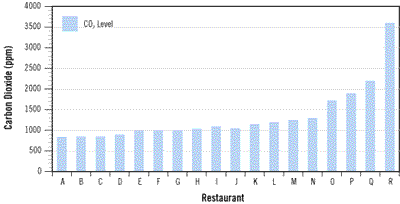
The state building code requires that heating and air conditioning systems be designed to bring in enough outside air to control CO2 levels to approximately 1,000 ppm when a building is fully occupied.
While ventilation improves IAQ, it creates a higher load on hvac equipment and increases utility bills during hot- or cold-weather conditions. It is common practice for service technicians to close outside air dampers, especially on older units, when the air conditioning system is unable to provide adequate cooling.
When this occurs, indoor pollution tends to build up during the evening and the air can become hazy with smoke.
In order to evaluate ventilation, carbon dioxide measurements were taken every 30 min in the smoking and nonsmoking sections of each of the tested restaurants.
If the maximum readings were below 1,000 ppm, the ventilation exceeded that required by the state code and low smoke levels were expected. In contrast, if the maximum readings significantly exceeded 1,000 ppm, the ventilation was poor, and smoke levels were expected to be high.
Figure 1 shows the carbon dioxide levels recorded in the eighteen restaurants during peak occupancy conditions. Recall that 1,000 ppm is the maximum allowed by state code.
Rate Our Service
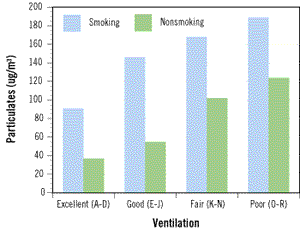
The ventilation in restaurants A, B, C, and D could be classified as “excellent.” Restaurants E, F, G, H, I, and J have “average” ventilation, while K, L, M, and N are “fair.” “Poor” ventilation was observed in restaurants O, P, Q, and R.Figure 2 shows the 90-min average smoke (particulate) results for the smoking and nonsmoking sections for the restaurants in each ventilation category.
As shown in Figure 2, restaurants A, B, C, and D have “excellent” ventilation and the measured smoke levels in the air in the smoking section and the nonsmoking section are lower than any of the other groups.
As ventilation decreases, the smoke levels increase in both the smoking and nonsmoking sections of the restaurant. Restaurants O, P, Q, and R have “poor” ventilation and the measured smoke levels are clearly the highest.
Previous studies in a Greensboro restaurant indicate that nonsmoking adult customers do not respond negatively to smoke (particulate) concentrations of 100 ug/m3 or less. However, at smoke concentrations above 200 ug/m3, the air becomes visibly smoky and nonsmokers begin to express dissatisfaction with the quality of the air.
One A/C Unit Or Two?
When the same air conditioning system serves the smoking and nonsmoking sections, smoke from the smoking section is circulated to the nonsmoking section.In order to keep smoke concentrations at their lowest possible level, a separate air conditioning unit serving the smoking section and another air-conditioning unit serving the nonsmoking section is preferred.
Figure 3 shows the average air quality results, measured in the nonsmoking section, for those restaurants that have separate air conditioning units and those that do not. Approximately 75% of the restaurants tested had separate air conditioning units for the smoking and nonsmoking sections.
As shown in Figure 3, the level of smoke in the nonsmoking section was three times higher in those restaurants that did not have separate air conditioning units. In fact, the smoke levels in the nonsmoking section of restaurants without separate air conditioning units were nearly as high as the smoke levels in some of the smoking sections.
When smoke levels exceed 100 ug/cu m, some customer dissatisfaction with air quality should be expected.
The smoke level in those nonsmoking sections served by separate air conditioning units averaged 40 ug/m3 (a low of 23 ug/m3 and a high of 65 ug/m3). Approximately half of this amount results from tobacco smoke; the other half consists of dust and other particles normally found in the air in any restaurant.
One hundred percent of the nonsmoking customers surveyed expressed satisfaction with the air quality in the nonsmoking dining areas.
Separate Areas
The third factor investigated as part of this study was the impact that separation between smoking and nonsmoking sections had on air quality. Separation between the smoking section and the nonsmoking section was defined as a structural partition, a wide aisle, or a buffer zone.However, separation between smoking and nonsmoking areas can be effective only when the areas are served by separate air conditioning units. When there is adequate separation, smoke is prevented from drifting from smokers’ tables toward nonsmokers.
Most larger restaurants had separation and separate air conditioning units. The few smaller restaurants included in the test had neither separation or separate air conditioning units. Therefore, the data were inconclusive.
Nonetheless, conversations with nonsmokers reveal that dining discomfort often occurs when they are seated in close proximity to smokers.
The Survey Says
Customer surveys were distributed to diners in 10 of the 18 tested restaurants. The survey form was distributed to a random sample of customers after they had finished their meal.Approximately 25 survey forms were distributed in the smoking and nonsmoking sections in each of the ten restaurants. Since the purpose of the survey was to determine the response from nonsmokers, the survey forms completed by smokers were excluded from the analysis.
As stated earlier in the report, 100% (55 responses) of the nonsmokers seating in a well-ventilated, nonsmoking section served by a separate air conditioning unit indicated that the air was not hazy with tobacco smoke, and they were not bothered by the amount of smoke in the air.
In poorly ventilated restaurants with a single air conditioning unit serving both smoking and nonsmoking sections, customer satisfaction decreased to approximately 85% (16 responses).
While the physical separation between the smoking and nonsmoking dining areas appeared to have little impact on air quality, several nonsmoking diners commented that they were annoyed just seeing someone smoking inside the restaurant. In these cases, a visual barrier between the smoking and nonsmoking sections could have eliminated annoyance.
Conversations with other diners revealed extreme annoyance when people smoked in the restrooms or in the entry lobby. Cigar smoking was also noted as highly objectionable. In two of the smaller restaurants, the majority of smoke was generated by the wait staff who would smoke in the dining area while on break.
It is estimated that enforcement of the state ventilation code by local inspectors would affect approximately 7,000 restaurants statewide. Most of the older restaurants would have to replace antiquated air conditioning systems. The newer restaurants would only have to open their outside air dampers.
In either case, unless heat recovery technologies were installed, energy consumption would increase in these restaurants by 15% to 25%. On a statewide basis, this anticipated increase in utility bills is estimated to be $15 million per year.
Summing Up
Results from this statewide study indicate that there is a dramatic difference in the air quality of the restaurants tested. Ventila-tion rates that meet or exceed the state code have a significant, positive impact on air quality.Also, air quality in the nonsmoking section is significantly better in those restaurants that have a separate air conditioning system for the nonsmoking section. Seven of the 18 restaurants tested had tobacco smoke levels in the nonsmoking section that were below the sensory perception level of nonsmokers.
Customer surveys indicate that restaurants with high ventilation rates, separate air conditioning systems, and separation between smoking and nonsmoking diners have air quality that is acceptable to 100% of the respondents.
Since ventilation is important for the dilution of indoor contaminants, and since air conditioning service technicians often close outside air dampers, it is recommended that each restaurant wishing to maintain good ventilation install a carbon dioxide sensor.
This is the easiest way that management can determine the ventilation rate in the restaurant. However, contractor and technician education is also highly advisable.
The other benefit, of course, is improved air quality and customer satisfaction.
Rojeski and Turner are both at North Carolina A&T State University; Gonzalez is with North Carolina State University; and Mobley is with the University of North Carolina-Charlotte.
Looking for a reprint of this article?
From high-res PDFs to custom plaques, order your copy today!


