1976: Legionella Rears Its Ugly Head
Dubbed “The Killer Fever,” the bacteria sickened 221 people and killed 34 in the first documented public outbreak of Legionnaire’s Disease
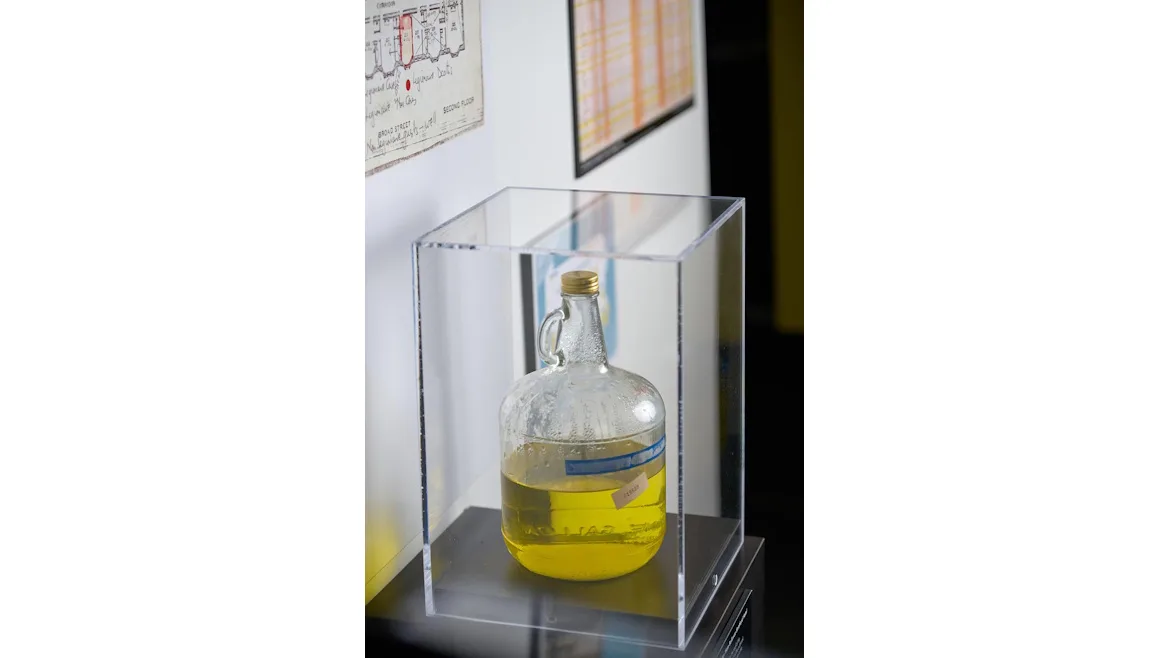
CONTAMINATED: This jug of chiller water was taken from the Legionella-contaminated cooling towers of the Bellevue-Stratford hotel in Philadelphia.
Anyone who works in HVAC knows about Legionella — the bacteria that grows in dirty air conditioning systems and cooling towers and spreads through the air.
Back in 1976, it was a mysterious and terrifying new disease. No one knew what caused it.
It started in July 1976, when the CDC began receiving reports of a weird respiratory illness in Pennsylvania. The Pennsylvania division of the American Legion was holding a convention at the Bellevue-Stratford hotel in Philadelphia, and on the second day, two of the attendees got sick. Then, Legionnaire after Legionnaire started falling ill.
It started out like a cold but soon progressed into pneumonia-like symptoms: fever, coughing, chest pain, and difficulty breathing. A few weeks later, 221 people were sick, and 34 had died.
The Pennsylvania State Health Department called in the CDC, which sent out a team of Epidemic Intelligence Service Officers to investigate the precise cause of the outbreak. They figured out that most of the people affected had attended the American Legion convention.
At first, it was thought to be swine flu, since there had been an outbreak of H1N1 influenza earlier that year at Fort Dix. That was quickly ruled out, but after weeks of lab-testing materials from the conference, tracking where each sick person ate and slept, and interviewing conference attendees, all they could surmise was that the pathogen was airborne.
As a result, speculation ran wild. Newsweek dubbed it “The Killer Fever.” People panicked as the mass media breathlessly covered the investigation, hypothesizing that it was Soviet terrorism, a CIA experiment, fumes from photocopy machines, an alien attack, or even a hoax to gin up support for swine flu vaccinations.
Looking for quick answers on air conditioning, heating and refrigeration topics? Try Ask ACHR NEWS, our new smart AI search tool. Ask ACHR NEWS
It was not until six months later that the true cause was ascertained. Long after the investigation had ended, CDC microbiologist Dr. Joseph McDade revisited the lab cultures and was able to isolate a new bacterium. He named it Legionella pneumophila, after its connection to the American Legion convention.
While Legionella bacteria are naturally occurring and existed before the advent of a/c, this was the first documented instance of people falling sick and dying from it, and the first time it was connected to cooling towers. Legionella bacteria thrive in warm water, between 77-113°F. Experts concluded that this newly-identified pathogen had colonized the cooling towers and contaminated the air-conditioning system at the Bellevue-Stratford, where the convention had several hospitality suites. They surmised the a/c had carried the bacteria into the hospitality suites, where it infected the people present.
The CDC announced its findings on January 18, 1977. By this point, so much time had passed that a link could not be proven definitively — the system had long since been shut down and cleared. However, antibodies to Legionella were later found in blood tests of people who’d contracted the disease — an indicator it was indeed the cause of the outbreak, despite some at the time calling it a “modern myth.”
On display at the David J. Sencer CDC Museum is a glass jug of greenish-yellow chiller water taken from the Bellevue-Stratford Hotel’s cooling system during the outbreak investigation. Despite the nationwide attention, there was no immediate “cooling tower standard” passed. As more cases of Legionnaires’ disease cropped up and were identified during the 1970s and ‘80s, engineers started emphasizing routine cleaning and inspection of cooling towers. Water treatment companies also became much more common in commercial HVAC because untreated towers were recognized as a public health risk.
ASHRAE Guidance 12, “Minimizing the Risk of Legionellosis Associated with Building Water Systems,” was published in 2000 as a best-practice document. It was not until 2015 — nearly 40 years after the Bellevue-Stratford outbreak — that ASHRAE Standard 188 was put in place, requiring qualifying buildings to have a formal water management program to verify maintenance is being performed.
The 1976 outbreak fundamentally changed the perception of HVAC systems. Before then, cooling towers were largely viewed as heat-rejection equipment. After the discovery of Legionnaires', they also became recognized as part of the infrastructure that keeps indoor air safe to breathe.
Looking for a reprint of this article?
From high-res PDFs to custom plaques, order your copy today!