'It Doesn't Seem Like Much Is the Same Except That It's Still HVAC'
Veteran contractor discusses the industry's shift from swamp coolers and mechanical controls to smart systems, licensing, and industry pride
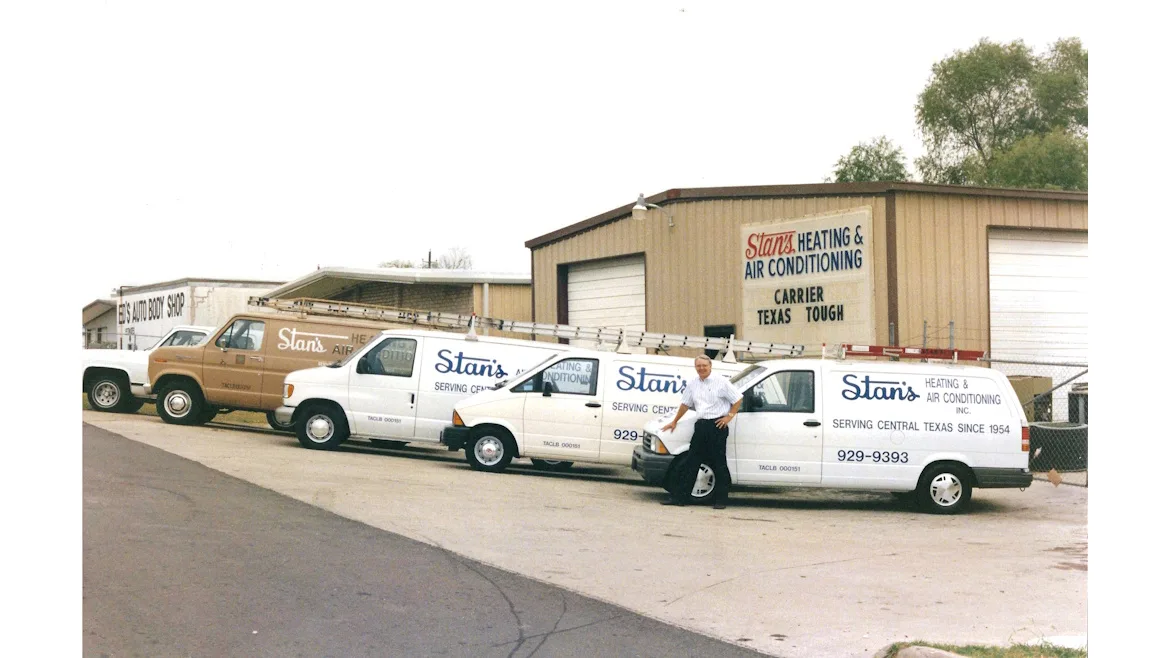
MEMORY LANE: Stan's Heating & Air Conditioning opened in 1954.
“It doesn’t seem like much is the same except that it is still HVAC.”
That’s Stan Johnson’s take on working in HVAC in the ‘60s and ‘70s versus today. The retired contractor — former owner of Stan’s Heating & Air Conditioning in Austin, Texas — got his start in HVAC before he was old enough to shave. His dad had started the company a few years before, in 1954. Young Johnson helped out during the summer.
“Now, a 10-, 11-, 12-year-old ‘helping’ is in quotation marks, but I was riding around with the trucks and carrying toolboxes, and I was pretty proficient with a screwdriver — taking panels off air conditioners and that sort of thing, back in the day when panels were held together by 100 screws instead of instead of flip joints like they are now,” he said.
He did service and installation work in high school and college, then became a schoolteacher, served in the Army, and worked for Houston Lighting and Power Company, where he learned Manual J and became convinced of the importance of proper sizing.
He moved his young family to the Lake Jackson and Freeport area, but his wife hated it and said, “I’m not staying.” The very next day, Johnson’s dad called him with a job offer.
“I think to this day that there was collusion, but nobody’s ever admitted it,” he said. He took the job and worked alongside his father for 20 years, then took over the company and ran it until 2011. He was one of the original Service Nation owners, chaired ACCA Mix Groups, and in retirement stayed active in the industry as a consultant.
ACHR NEWS caught up with Johnson for some perspective on what’s changed in HVAC through the decades, and what’s stayed the same.
Looking for quick answers on air conditioning, heating and refrigeration topics? Try Ask ACHR NEWS, our new smart AI search tool. Ask ACHR NEWS
ACHR NEWS: What were the most common problems you ran into in the field, back in the ‘70s?
SJ: In the ‘60s in Texas, we still were not a central air conditioning economy. We were still swamp coolers and window units … even in Austin, which had a pretty humid climate. The commercial business was about the only place we really had central heating and air.
In the ‘70s, when I came back, we were really getting rolling in central heating and air, and there were a couple of problems. One of the problems was the other contractors weren't doing load calculations. They’d say, “Oh, Stan’s is undersizing your air conditioning.” The fact was, we were sizing them correctly, which would control humidity in the house and make the temperature more even, but people were afraid of it. Sizing was 500 square feet per ton, no matter what.
The other problem was contractors were slow to learn the importance of cleaning out the refrigeration lines before they connected them. They didn't pull vacuums on systems. I can remember the first vacuum pump we had, back in the ‘60s. My father actually built it because you couldn't buy vacuum pumps. Engineers would specify our company because they knew we had vacuum pumps that other contractors didn't.
ACHR NEWS: Any new technologies or regulations that you saw that contractors resisted at first, but later they embraced it?
SJ: The ‘70s, ‘80s, and ‘90s was the evolution of construction, and it forced the issue with air conditioning sizing. Suddenly houses had double-pane glass instead of single-pane glass, and suddenly, they had R-11 insulation in the walls and R-19 insulation in the attic, and houses that they were putting 5-ton systems in wouldn’t run enough. The humidity in the houses [was] 80% … because they didn’t run a load calculation, and it didn’t work right.
The first real revolution was a revolution in how to select equipment — it really was a wakeup call for the industry. As technology advanced through the ‘80s and ‘90s, we saw more and more changes. We started seeing tinted glass. We saw better installation. We saw house sealing for the first time, where they were going in and caulking and sealing the walls and the pilot lights, tidying up air leakage. When that stuff started happening, the air conditioning industry wasn't prepared, and we had to learn that.
You started seeing QI standards by the late ‘90s, and we got pretty heavy into that. I worked with ACCA to write the national QI standards now used pretty much across the country for quality installation. Of course, there was pushback on that, too — people saying, "Oh no, don't tell us what to do.” Well, it was needed, because up to that point in the 1990s, people still weren't doing manual D’s, which is duct sizing. They were doing equipment sizing right, but then they’d go put in a duct system on the cheap. Man, I started bringing that on board and enforcing it. It really improved the product.
ACHR NEWS: Do you think today's technicians are solving different kinds of problems, or the same problems but with different tools?
SJ: They're solving mostly the same problems with equipment that has changed completely, with tools that have changed completely, with training that has changed completely. That was air conditioning, and today this is air conditioning, and they were two different air conditionings.
Back in the day, in the ‘60s and ‘70s, all controls were mechanical. If you had a heat pump, you had timers on them that didn't ‘sense’ anything. They just told the heat pump when to cycle off — after 45 minutes or whatever. We were taking individual mechanical components out, like a clock timer, and testing them to see if they were working right.
Today, that's all become printed circuit boards that sense triggers and know what the pressure is in the system and tells the heat pump when it needs to change its variable stages, which didn't exist back then, either. I can remember when we put the first two-speed systems in. A company called Fedders came out with the two-stage air conditioning system, and the system consisted of two compressors in the same cabinet, and they came on at the same time.
This was in the ‘70s, and this is how bad engineering was: One side of the A coil was one of the stages, and the other side of the A coil was the other stage, which meant that when the system was installed and the airflow went through the coil, same pressure on both sides, and … the left side of the house would be cool, the right side of the house would be hot.
The engineers couldn't figure that out. But my father was a really, really, really good technician that a lot of people called on for this kind of stuff. We took and built units ourselves in our shop — we actually recircuited them where we had half of each stage on each side of the A coil. We'd have two condensers on one furnace and coil, and that's that two stages. They were too expensive to sell very many of, but we did sell some, and then the manufacturers finally realized that, yes, this is a problem, and so by the late ‘70s we were seeing two-stages that really worked.
ACHR NEWS: Anything that hasn’t changed?
SJ: The complaining hasn't changed. The biggest problem is still hiring good technicians to install this, and what they're going to be paid, and what you're paying for equipment, and we're too much controlled by the weather. Or if you're a new construction contractor, you're too much controlled by the current economy and interest rates.
I think more contractors today realize that they’ve got to learn a little bit more before they get into the business. Used to be, the big thing was firemen — that worked at the fire station — would work in air conditioning service on their day off. Those little out-of-the-back-of-your-truck operations, I don't see those much anymore. I had people that worked for me that went out and started their own businesses, and every one of them was technically qualified to do the work. But the same problem that existed back then is still a problem with small contractors: They're not businessmen. It prevents them from getting the level of growth they want. The only difference today is the size of the tickets are bigger.
ACHR NEWS: Tell us about what working in the trades was like.
Back in the day, if you were looking for a job to work in the field, air conditioning was the last choice. We had trouble filling our ranks because they could go make more someplace else.
I think the industry has caught up with the other trades [more] than it used to be. One of the answers to that was when we got licensing. Another was when we had to be more technically aware. The more technical we became, the higher the wages went. I always wanted to be the highest paying contractor, but I wanted to catch up with the other trades and get us more money, too, and I think some of that's been accomplished over the years. Since I left, I think it's even got better. I was talking to the president of my old company a month or two ago, and he makes more money than I ever made the company, and I'm proud of him.
We need to be proud of our industry. I don't think that pride existed as much back then, and it’s come a long way. In the ‘50s, heating and air conditioning was still done by plumbing contractors. They would sell the job — and this was this was true as late as early 1961, ’62 — and put in the furnace, hire a sheet metal contractor to put in the ductwork, and then they just hooked up the heater, and it blew air. So people … you know, plumber, plumbing contractor, heating contractor, so what?
When air conditioning came along, the plumbing contractors couldn't figure out the technical side of air conditioning, and that led to the growth of the air conditioning industry that really took place in the started taking place in the late ‘60s … when you first started seeing actual air conditioning in houses.
I think people today are proud to be air conditioning contractors, air conditioning employees, air conditioning technicians. I think that's changed as people become more aware of how much it's affected our lives. They're proud of the industry they're in today, and that didn't exist 50 years ago.
Looking for a reprint of this article?
From high-res PDFs to custom plaques, order your copy today!