Guest Column
Could Today's HFC Relief Lead to Tomorrow's Refrigerant Shortages?
New Technology Transitions Rule delays compliance, extends HFC usage, and complicates the refrigerant landscape

DELAYS: As EPA pushes key refrigeration deadlines to 2032, retailers must weigh near-term equipment flexibility against future refrigerant availability, serviceability, and cost risks.
Along the road to federal refrigerant rulemaking in the U.S., the HVACR industry has navigated its share of twists and turns. The most recent ruling from the Environmental Protection Agency (EPA), which revised its 2023 Technology Transitions Rule, marks another significant shift in direction.
The updated ruling delays several compliance timelines until 2032 and updates the global warming potential (GWP) limits for refrigerants used in the retail food and cold storage sectors. In doing so, it creates a complex mix of short and long-term implications for the entire HVACR industry.
On the surface, it provides a measure of relief for food retailers who haven’t yet selected a new strategy for lower-GWP refrigeration equipment. This will give these retailers the option to install new hydrofluorocarbon (HFC)-based equipment with a GWP below 1,400 (likely R-448A/449A) for another five to six years. Although this may be a lower first-cost option in the short term, these economic benefits may be temporary.
In the medium to long term, installing new HFC systems through 2032 will likely result in unintended servicing challenges and increased refrigerant prices due to HFC refrigerant shortages that could occur throughout the system lifecycle, potentially up to 20 years or more.
These potential shortages stem from the next phasedown of U.S. HFC supplies under the American Innovation and Manufacturing (AIM) Act, which will further reduce supplies by 50% in 2029.
Global HFC Phasedown
Per the AIM Act (and consistent with the Kigali Amendment to the Montreal Protocol), HFC production and consumption in the U.S. will be reduced by 70% of baseline levels in 2029. With available HFC supplies dramatically reduced, price increases and refrigerant shortages are likely, especially if larger-charged systems remain at 1,400 GWP.
In a recent EPA memo analyzing the economic and environmental impacts of reconsidering the Technology Transitions Rule, the EPA recognized the potential long-term consequences of increasing demand for HFCs, stating: “Additional demand for HFCs could result in tighter supply and higher HFC prices for downstream consumers.”
Looking for quick answers on air conditioning, heating and refrigeration topics? Try Ask ACHR NEWS, our new smart AI search tool. Ask ACHR NEWS
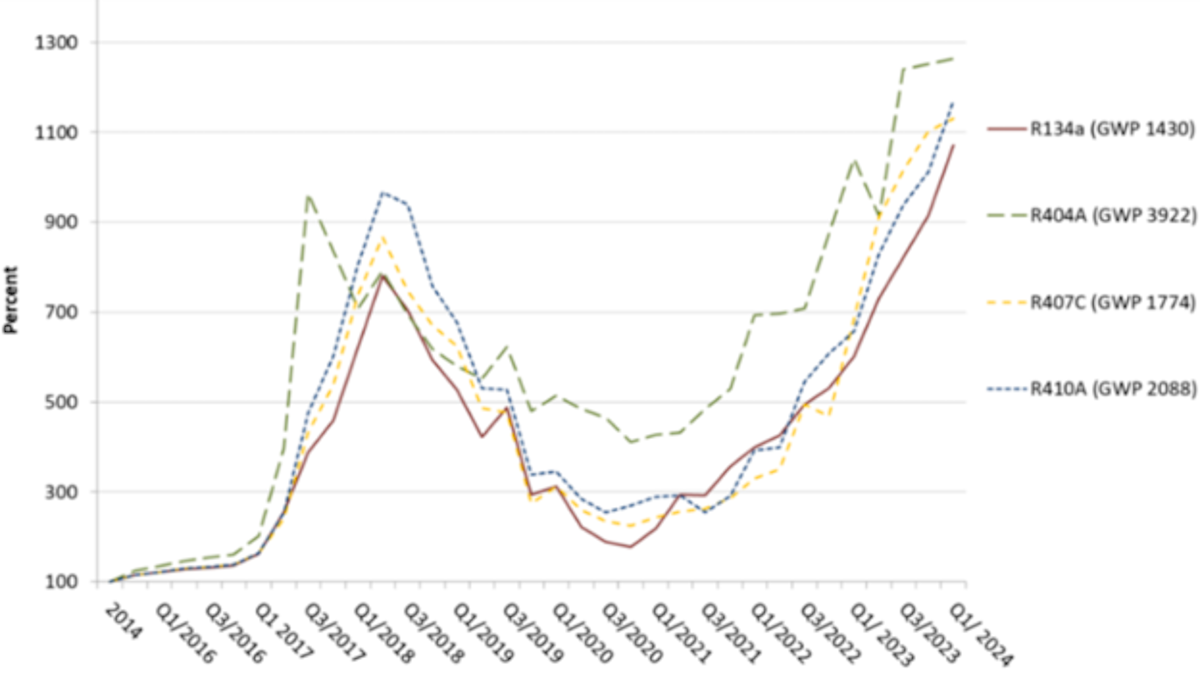
In other countries where the HFC phasedown has already occurred, this has proven true. Since quotas were reduced in Europe, legacy HFC refrigerant prices rose by over 1,000%.
Courtesy of Copeland
Figure 1: Progression of price increases in the EU since the introduction of HFC quotas in 2014.
In Australia, HFC prices nearly tripled over a few years amid continued supply shortages. Notably, the smaller, independent retailers were the least equipped to absorb these supply reductions and pricing shocks.
What’s happening now in Australia could be an indication of things to come in the U.S. When their government introduced legislation in 2017 to phase down high-GWP refrigerants, it assumed the industry would gradually transition to newer, lower-impact alternatives. However, stakeholders continued to buy and use equipment with legacy refrigerant technologies, which ultimately led to today’s shortfalls.
In addition to rising costs, the EPA memo also suggested that the increased demand for HFCS would outpace available consumption allocations, which began in 2022, stating: “Our analysis also indicates that the demand for HFCs would exceed the amount available to allocate beginning in 2029 if no other actions are taken.”
In the U.S., the HFC phasedown culminates in an 85% reduction in 2036.
Lower-GWP Progress and Readiness Continue
Although the federal refrigerant transition may be delayed by federal policy, it is still imminent — 2032 is just a few years away. And in states with their own HFC rules, such as California, Washington, and New York, retailers still must comply with existing refrigerant mandates.
From a practical, real-world standpoint, many retailers are already well down the path of implementing lower-GWP refrigerant technologies. Many large and small chains have pledged to meet sustainability goals, targets, and commitments; these will continue to drive their transitions to lower-GWP refrigerants, regardless of the changing regulatory timelines.
Today, sustainable solutions are readily available for self-contained refrigeration, condensing units, centralized, and distributed architectures.
Many of these technologies — such as CO2 and R-290 — have been adopted for more than a decade and continue to advance to address a wide range of application scenarios. A2L solutions have recently emerged, yet offer lower-GWP options and scalability across a wide range of architectures. Many food retailers are already successfully leveraging these existing technologies and will continue to do so.
Increased adoption, technological advancements, and production economies of scale continue to make first costs more competitive for lower-GWP systems, with potentially lower lifecycle costs due to increased system efficiencies and the certainty of future refrigerant availability.
Beyond first costs, retailers need to evaluate long-term serviceability and operating costs throughout the lifecycle, both of which will be impacted by refrigerant availability and cost.
Preparing for Service Challenges
Considering the next step in the global HFC phasedown in 2029 and the simultaneous state and federal requirements to use reclaimed HFC refrigerants above a certain GWP threshold or in specific sectors, extending the use of HFCs in new systems through 2032 raises questions about their long-term availability.
- Will enough R-448A/449A supplies be available to satisfy increased demand for the next two decades?
- Will it even be possible to find reclaimed HFC refrigerant needed for service?
- How much will the price of these refrigerants rise?
Moving forward, refrigerant leak detection and recovery efforts will need to be practiced and enforced much more rigorously to preserve HFC supplies, with increased documentation and record-keeping required for compliance.
Remember that centralized, direct-expansion refrigeration systems leak on average at 20% annually. Not only does this have significant environmental consequences — including the high global warming potential — but it will also become increasingly expensive to replace refrigerant charges in these systems.
Refrigerant leak detection, reclaim, and recovery strategies will no longer be optional in a world where HFC supplies are limited, and production of virgin HFC refrigerant is banned. Retailers using these systems will need a plan to maintain adequate supply levels for servicing.
Broader Implications for the HVACR Industry
Extending the installation of new HFC equipment (below 1,400 GWP) in commercial refrigeration until 2032 could introduce unintended long-term consequences for other sectors, including the residential and light commercial HVAC sector.
With a GWP of 1,387, R-448A has roughly a 90% higher GWP than available low- or ultra-low-GWP alternatives. Extended use could deplete the available quota at a much higher rate, tightening overall HFC supplies and potentially affecting the residential HVAC sector.
This could increase the likelihood of another refrigerant transition in a/c, which would include fluid options that introduce new capacity, pressure, and flammability challenges.
The EPA’s memorandum shared this concern, stating: “The EPA expects that greater demand for HFCs in the affected subsectors will have indirect effects on HFC prices and usage, including for other subsectors not directly affected by this rulemaking. The reason for this is the finite and decreasing amount of HFC production and import, which is governed by the AIM Act phasedown schedule provided in subsection (e).”
Don’t Risk Potential Future Disruptions
Because of the increased potential for HFC supply disruptions and price increases over time, the sooner retailers can transition to lower-GWP CO₂, R-290, or an A2L, the better their chances are of avoiding operational instability in the future.
Of course, for those with a sustainability mandate, the decision to move forward has already been made and will continue in earnest.
For retailers ready to pursue sustainability targets or avoid HFC-related complications, lower- and ultra-low-GWP equipment is available today to help them make the transition. Copeland has more than a decade of experience working with retail and manufacturing partners to develop the next generation of CO2 (R-744), R-290, and A2L equipment technologies.
These proven, reliable, and viable compression technologies and controls solutions — for self-contained, distributed, and centralized architectures — are ready to help retailers of all sizes and store formats make a successful refrigerant transition.
New EPA Technology Transition Rule: Compliance By Sector
The ruling revised the permissible GWP limits for refrigerants used in key food retail and adjacent cold storage sectors.
Retail food, supermarket racks (new equipment):
- January 1, 2027: 1,400 GWP limit
- January 1, 2032: 150 to 300 GWP limit (depending on charge size)
The rule delays moving to the 150-300 GWP limit for 5 years, allowing the use of HFCs such as R-448A/449A in the interim. The rule also allows supermarket systems to increase system cooling capacity up to 15% (e.g., adding a new display case) without being considered an installation of a new system.
Note: The 150 GWP limit applies to larger systems with refrigerant charges of 200 pounds or more; the 300 GWP limit applies to systems with refrigerant charges of 200 pounds or less. These refrigerant charge thresholds could influence a retailer's decision between large, centralized architectures and smaller, distributed, or self-contained systems to stay under the 200 lb. limit.
Retail food, condensing units (new equipment):
- July 27, 2026: 1,400 GWP limit
- January 1, 2032: 150-300 GWP limit (depending on charge size)
The rule delays moving to the 150-300 GWP for nearly 6 years, allowing the use of HFCs such as R-448A/449A in the interim.
Cold storage warehouse equipment (new equipment):
- July 27, 2026: 700 GWP limit.
- January 1, 2032: 150-300 GWP limit (depending on charge size)
The rule delays moving to the 150–300 GWP limit for six years, allowing the use of HFCs such as R-513A in the interim.
Looking for a reprint of this article?
From high-res PDFs to custom plaques, order your copy today!


