1950s: Rotary Compressors Transform HVAC Equipment
Slimmer, more efficient systems led to widespread a/c adoption

STREAMLINED COMFORT: Thanks to developments like rotary compressors, HVAC equipment manufacturers could advertise slimmer units to homeowners.
Advancements in technology, such as modern-day inverters, continue to shape the HVAC industry, but one development set the stage for widespread refrigeration and air conditioning: rotary compressors.
In 1917, a refrigeration patent (U.S. 1245179A) from John C. Bertsch described vapor-compression refrigeration in a rotary compressor. In 1920, patent U.S. 1,362,757 from Douglas Henry Stokes was a precursor to vane/rolling-piston development in refrigeration.
It was 1924 when General Electric introduced the first domestic refrigerator with a hermetically sealed motor and compressor. In the 1920s, compressors used belt-driven and shaft seals, often resulting in leaks. Direct-drive compressors resulted in smaller compressor sizes due to operating at 1,740 rpm, according to ASHRAE documents, though they couldn’t be used for room a/cs due to safety code limitations on refrigerant charge sizes.
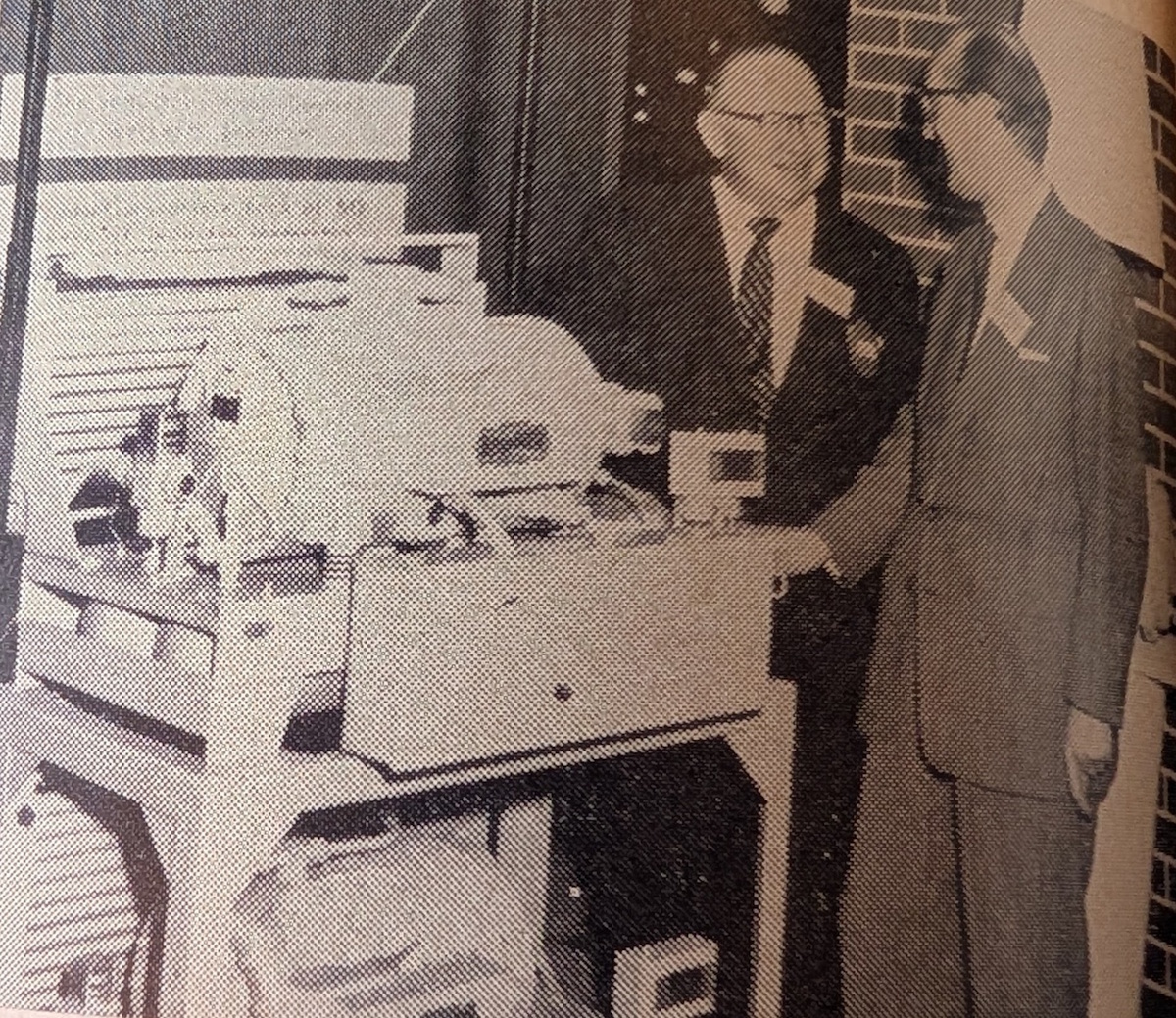
DEBUTING COMPRESSORS: A photo from the 1957 Air Conditioning & Refrigeration News archives shows a “new, compact” 7½-hp “Brunner-Metic” compressor on display at an expo. (Staff photo)
At the time, piston-driven compressors were the norm, but they resulted in bulkier equipment, and technical difficulties and limitations made a/cs and refrigerators unaffordable to most homeowners.
In 1934, a modern screw-compressor foundation was patented in Sweden by Alf Lysholm. In 1941, Westinghouse sold the first hermetically sealed and compact self-contained window air conditioners.
By 1950, a prototype of the screw compressor landed in the Worthington Pump Corp. in Massachusetts, with a tester noting it was noisy and required mechanical speed increasers to be used in refrigeration. Improvements were made, making it more suitable for air conditioning and refrigeration.
That same year, a patent (U.S. 2,504,841) was submitted by inventor Fredrick Jones, assigned to U.S. Thermo Control, that featured multi-cylinder, rotary-piston pumps adapted for elastic fluids. This demonstrated the power of compact, lower-vibration rotary compression and miniaturization.
Looking for quick answers on air conditioning, heating and refrigeration topics? Try Ask ACHR NEWS, our new smart AI search tool. Ask ACHR NEWS
By the 1950s, the HVAC industry found ways to commercially apply rotary compressor technology into hermetic, mass-produced equipment. It wasn’t a wholesale transition to rotary compressors, but it did alter marketing and packaging. Advertisements went beyond trade journals to home magazines like House & Home, speaking directly to postwar consumers.
The streamlined technology and postwar economy created a boom in a/c unit sales, with 1953 articles from the Air Conditioning & Refrigeration News reporting room units being purchased by “nearly all income groups.” More than 1 million room units were produced that year, though only 800,00 were sold.
According to Toshiba’s website, in 1953, the company released Japan’s first 1-horsepower window room air conditioner. Daikin claims to have brought both a rotary compressor and the first heat pump to market in 1957 and 1958 in Japan.
Meanwhile, larger commercial operations began engineering work that would later make screw chillers viable compared to reciprocating and centrifugal machines.
Overall, ASHRAE describes two major categories of compressors: positive displacement and dynamic. Rotary falls into the former category. Positive displacement increases refrigerant vapor pressure by reducing the volume of the compression chamber through work applied to the compressor’s mechanism. These can include reciprocating, rotary (rolling piston, rotary vane, single screw, twin screw), and orbital (scroll, trochoidal).
Dynamic compressors increase refrigerant vapor temperature by continuous transfer of kinetic energy from the rotating member to the vapor. It then converts this energy into a pressure rise. Centrifugal compressors operate using this principle.
Looking for a reprint of this article?
From high-res PDFs to custom plaques, order your copy today!