ACHR News
search
Ask ACHR NEWS AI
cart
facebook twitter instagram linkedin youtube
  • Sign In
  • Subscribe
  • Sign Out
  • My Account
ACHR News
  • NEWS
    • Breaking News
    • New HVAC Products
    • Featured Products
    • Manufacturer Reports
    • HVAC Data
    • Legislation
    • ACHR NEWS Centennial
  • RESIDENTIAL
    • Air Conditioners
    • Furnaces
    • Residential Heat Pumps
    • Ductless
    • Residential IAQ
    • Testing, Monitoring, Tools
    • Components & Accessories
  • COMMERCIAL
    • Air Handlers
    • Rooftop Units
    • Chillers and Cooling Towers
    • Commercial Heat Pumps
    • Boilers and Hydronics
    • VRF/Ductless
    • Commercial IAQ
  • REFRIGERATION
    • Refrigerants
    • Refrigerant Regulations
    • Leak Management
  • CONTRACTOR PRO
    • Geothermal
    • Homeowner Study
    • VRF and VRV Ductless
    • Unitary Trends
  • EDUCATION
    • Training and Education
    • Business Management
    • Service and Maintenance
    • Continuing Education
    • Market Research >
      • HVAC Brand Awareness Report
      • VRV, VRF, VRVZ Report
      • Unitary Trends Report
      • Water Heat Professionals Report
    • Webinars
    • Sponsor Insights
    • eProducts Info
    • White Papers
  • EVENTS
    • HVAC Contractor Forum
    • Industry Events and Webinars
  • MEDIA
    • Videos
    • AHR Expo 2025 Videos
    • Podcasts >
      • ACHR News Podcast
      • HARDI Podcasts
      • AHR Expo Podcasts
      • ACCA Podcasts
    • Interactive Spotlights
    • Quizzes
    • eBooks
    • HVAC Talkback
  • HVAC GROUP
    • ACHR NEWS >
      • Current Issue
      • Digital Edition
      • Subscribe
    • Distribution Trends
    • SNIPS NEWS >
      • Join SNIPS NEWS
    • Engineered Systems News >
      • Join ES News
    • HVACR Directory
    • Contests
    • Newsletters
    • Contact
    • Advertise
    • My Account
HVAC ContractingNewsTechnicalIndoor Air QualityGuest ColumnHumidification and Dehumidification

Guest Column

An HVAC Technician’s Guide to Humidity

How humidity, dew point, and air temperature interact to create — or prevent — moisture problems
By Lianna Schwalenberg
Picture1-Lianna.jpg
Courtesy of Lianna Schwalenberg

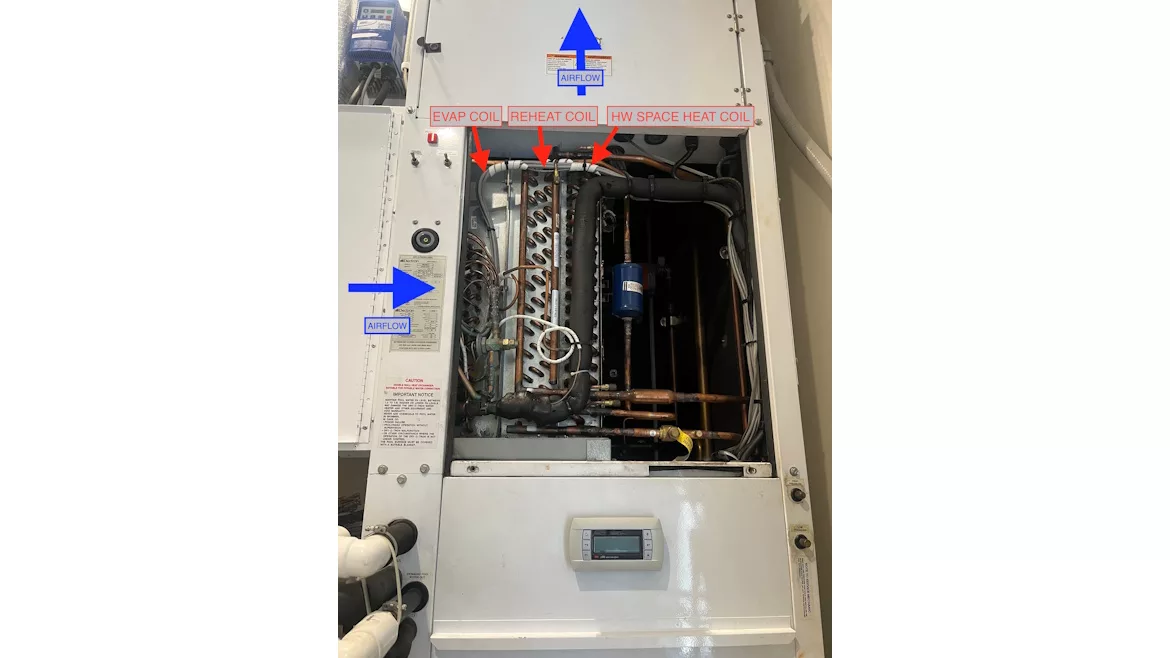
DEHUM: The basic operating principle of a dehumidifier is to remove water vapor from the air without overcooling the space.  

April 20, 2026

Humidity, aside from temperature, is perhaps the most important property of air that an HVAC system can control. Willis Carrier is often credited as the father of modern air conditioning, yet his groundbreaking invention was not a modern air conditioner. It was a dehumidifier intended to solve moisture-related issues at a paper printing company in New York. To effectively fix and prevent issues related to moisture, all service technicians should have a basic understanding of humidity. 


What is Humidity and How is it Measured?  

Water is one of the many constituents of air. It exists in liquid form, such as in clouds and fog, and also in gas form, typically referred to as water vapor. Humidity is defined as the amount of water vapor in the air, and can be expressed either in absolute or relative terms.   

Absolute humidity is the actual amount of water vapor in the air, often expressed in grains of moisture per pound of air. It can also be expressed as a percentage of total volume. For example, climate monitoring data has found that in tropical regions, where water vapor concentration is highest on Earth, water vapor makes up about 4% of the total volume of air.   

When it comes to weather forecasting, as well as HVAC systems that control indoor humidity, the more appropriate way of expressing humidity is in relative humidity. Defined as the amount of water vapor present in the air compared to what that air can hold, relative humidity is a useful measurement for predicting how comfortable the air will be. The range for relative humidity where people are most comfortable is 30-60%.   


The Heat Content of Air and How it Determines Relative Humidity  

While it may be abstruse to think about, it is useful to consider the fact that air has weight. As molecules that make up the air gain or lose heat, the air changes in density. Because heat is defined as fast molecular movement, warmer air, made up of fast-moving molecules, is less dense and, as such, weighs less than colder air. This is where the phrase “warm air rises” comes from. Cold air, made up of slower molecular movement, is denser and thus tends to sink below and displace warmer air.   

When air is less dense, such as with hot air, it has more “space” for water vapor. When air is denser, such as with cold air, it cannot hold as much water vapor. An interesting consequence of this physical process is that winter air will typically have a higher relative humidity than summer air, or higher than what one would expect. This is not to say that winter air has more moisture than summer air. Instead, it has high moisture content compared to what it is capable of holding. Warm air in summer is capable of holding more water vapor, so its relative humidity is typically lower than winter air.  

Another, somewhat counterintuitive, outcome of the physics of humidity is that dry air is denser and heavier than moist, humid air. This is because water molecules themselves are less dense than nitrogen and oxygen molecules, the main constituents of air.  

Looking for quick answers on air conditioning, heating and refrigeration topics? Try Ask ACHR NEWS, our new smart AI search tool. Ask ACHR NEWS →

With air conditioning and refrigeration, moisture is removed from the air and exits through the drain pan. In well-insulated spaces, mechanical cooling can even dry out the space, if the compressor is able to run long enough. Because the outdoor air has so many sources of moisture (lakes, rivers, ponds, etc.), winter air is more capable of maintaining higher relative humidity. In this regard, relative humidity does not necessarily reflect comfort. Yet it does explain why it is often recommended to use a humidifier during winter. When warming up cold air, the only way to maintain a comfortable range of humidity is to mechanically add water vapor into the air, such as with a whole-home humidifier mounted on the ductwork above the furnace.  


What Causes Condensation?  

Saturation is a useful concept to understand when it comes to condensation. Saturation, in the context of humidity, is the point at which air is holding the maximum amount of water vapor it can possibly hold for the temperature it is at. Condensation occurs whenever water vapor in the air comes in contact with surfaces that are colder than the dew point of the surrounding air. The dew point of air is the temperature at which the air becomes oversaturated with water vapor, causing the water vapor to “fall out of,” or condense from, the air. Another way to express dew point temperature is the temperature at which air is at 100% relative humidity.   

Early in the morning, there may be dew on the grass or water droplets on cars parked outside because the air was warm and contained water vapor the previous evening, but then these surfaces became cold overnight, causing water from the air to condense onto these colder surfaces.   

Condensation is what happens on the evaporator as it removes heat from air. Immediately after the evaporator coil, the air is actually at dew point, 100% relative humidity, though as it mixes with the warmer air in the space, the relative humidity drops.   


Preventing Condensation  

Condensation will not happen if the air is dry, nor if surfaces are above the dew point temperature of the surrounding air. Therefore, the only two ways to remove and prevent condensation are to decrease the dew point of the air or raise the temperature of the surface. For example, in pool room dehumidification, the air diffusers should always be aimed at the windows to create a “window wash” on glass surfaces. This is why heavy drapes drawn across cold windows can trap airflow and exacerbate condensation problems.

For service technicians troubleshooting situations like sweaty ductwork, the quickest and easiest solution for lowering the dew point is to first determine where the moist air is coming from. Often, it is the warm outside air or air from the attic that infiltrates into the conditioned space.  

Outside air can leak into a space from poor insulation, but it can also infiltrate when the house is in a negative pressure, such as when exhaust fans are running all the time.   


How Dehumidifiers Work   

After eliminating sources of infiltration, the dew point temperature of air can be lowered using mechanical dehumidification. Air conditioning is a type of dehumidifier; however, the compressor usually shuts off when the space cooling set point is met, before an effective amount of water vapor is removed.  

The basic operating principle of a dehumidifier is to remove water vapor from the air without overcooling the space. Dehumidifiers are designed to have longer compressor runtimes by immediately, after the evaporator coil, adding heat (“reheat”) back into the space. The cold evaporator coil, paired with the reheat coil work together to “wring out” as much moisture as possible without changing the temperature of the air.   

KEYWORDS: dehumidification humidifiers humidity

Share This Story

Looking for a reprint of this article?
From high-res PDFs to custom plaques, order your copy today!


Lianna schwalenberg
Lianna Schwalenberg is an HVAC service technician at The K Company, located in Akron, Ohio. She specializes in residential service, but helps out with maintenance and repairs in commercial settings as needed.

Recommended Content

JOIN TODAY
To unlock your recommendations.

Already have an account? Sign In

  • HVAC-enrollment

    The Trades Are Back: HVACR Programs See Nearly 30% Enrollment Spike

    A new wave of future technicians is entering the pipeline.  
    News
    By: Matt Jachman
  • 2025 Top 40 Under 40

    2025 Top 40 Under 40 HVACR Professionals List

    The 11th annual Top 40 Under 40 list highlights those...
    HVAC Contracting
    By: Hannah Belloli-Oster
  • LG Ductless Mini-Split Systems

    The 9 Types of Heat Pumps

    As the U.S. moves toward electrification, heat pumps are...
    News
    By: Joanna R. Turpin
Subscription Center
  • Create an Account
  • Start a Subscription
  • Manage My Account
  • Sign Up for Newsletters
  • Visit Customer Service
  • Update Preferences

More Videos

Sponsored Content

Sponsored Content is a special paid section where industry companies provide high quality, objective, non-commercial content around topics of interest to The News audience. All Sponsored Content is supplied by the advertising company and any opinions expressed in this article are those of the author and not necessarily reflect the views of The News or its parent company, BNP Media. Interested in participating in our Sponsored Content section? Contact your local rep!

close
  • Piggy Bank
    Sponsored byWatercress Financial

    Energy Prices, Inflation, and HVAC: What Today’s Homeowners Care About

  • Refrigerated Food
    Sponsored bySolstice Advanced Materials

    R-455A Refrigeration: A Cold Storage Solution for the Future

  • Airex Rooftop Units
    Sponsored byAirex Manufacturing Inc

    Consolidating Roof Penetrations: A Growing Trend in Multifamily HVAC Design

Popular Stories

Refrigerants-and-gauge.jpg

HVAC Industry Warns of Counterfeit Refrigerants Entering U.S. Supply Chain

U.S. Supreme Court building

95% Furnace Efficiency Rule to Get New Hearing

Midea-training.jpg

HVAC Workforce Crisis Expands Beyond Technicians to Instructor Shortages

Data_Center_facility.jpg

HVAC Manufacturers Respond to Growing Data Center Backlash

HVAC Minute retail refrigeration system

EPA Final Rule’s Impact on R-410A Deadlines

View The ACHR NEWS
Centennial Anniversary Timeline

The ACHR News Timeline Chart
Submit a Letter
Submit a letter to our editors.

Events

November 6, 2025

Next-Gen Data Center Cooling: HVAC Innovation and Real-World Solutions

On Demand As AI workloads and high-density computing push traditional cooling methods to their limits, the data center industry is accelerating the adoption of next-generation HVAC technologies.

June 23, 2026

HVAC Duct Sealing Mastics: Why Selection Matters

In this webinar we will detail what HVAC material buyers and technicians need to know when selecting duct mastics, including matching mastic to substrate, alternatives to liquid mastic, and where UL 181 Listings fit into real world installations.

View All Submit An Event

Poll

Summer Staff

Are you fully staffed for the summer season?
View Results Poll Archive

Products

BNI Mechanical/Electrical Square Foot Costbook, 2026 Edition

BNI Mechanical/Electrical Square Foot Costbook, 2026 Edition

See More Products
HVAC Duct Sealing Mastics: Why Selection Matters - Free Webinar - 6/23/2026

Related Articles

  • R-32

    An HVAC Technician’s Guide To R-32

    See More
  • Digital Manifold

    An HVAC Technician’s Guide to R-454B

    See More
  • Piercing valve

    A Technician’s Quick Guide to Non-Invasive System Checks

    See More

Related Products

See More Products
  • MariaCoverOnly.jpg

    Maria's Restaurant - Technician’s Guide & Workbook

  • TGW_Entry Level_cover.jpg

    Technician’s Guide & Workbook for Entry Level Tech's

  • TechGuide_Cover_Only.png

    Technician’s Guide & Workbook for Duct Diagnostic & Repair

See More Products

Events

View AllSubmit An Event
  • October 30, 2025

    The HVAC Contractor’s Guide to AI-Driven SEO

    On Demand We will provide a clear, actionable roadmap for HVAC contractors to enhance their online visibility, dominate local search results, and adapt to the new era of AI-driven customer inquiries. Learn how to turn clicks into profitable calls and secure your position as the go-to HVAC provider in your area.
View AllSubmit An Event
×

Sign Up. Stay Informed.

The #1 trusted source for the HVACR industry since 1926

SUBSCRIBE
  • RESOURCES
    • Advertise
    • Contact Us
    • Advisory Board
    • Classifieds
    • Submit a Letter
    • Directories
    • Store
  • ACCOUNT CENTER
    • Create an Account
    • Start a Subscription
    • Manage My Account
    • Sign Up for Newsletters
    • Visit Customer Service
    • Update Preferences
  • SERVICES
    • Marketing Services
    • Reprints
    • Market Research
    • List Rental
    • Survey/Respondent Access
  • STAY CONNECTED
    • LinkedIn
    • Facebook
    • Instagram
    • YouTube
    • X (Twitter)
  • PRIVACY
    • PRIVACY POLICY
    • TERMS & CONDITIONS
    • DO NOT SELL MY PERSONAL INFORMATION
    • PRIVACY REQUEST
    • ACCESSIBILITY

Copyright ©2026. All Rights Reserved BNP Media, Inc. and BNP Media II, LLC.

Design, CMS, Hosting & Web Development :: ePublishing