A Technician’s Quick Guide to Non-Invasive System Checks
How to troubleshoot without gauges

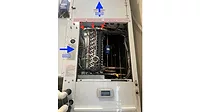
INDICATOR: The mere presence of a piercing valve is actually evidence that the charge has leaked out at some time during the past. (Courtesy of Lianna Schwalenberg)
While using gauges to measure refrigerant pressure is the most reliable and conclusive way to thoroughly diagnose most problems in air conditioning, heat pumps, and refrigeration, it is not the only way, and sometimes technicians may find themselves working on a system that has no pressure access ports. There are solutions such as a temporary piercing valve or a sweat access tee. However, before considering these options, the technician might consider methods for approximating whether the charge is correct. Noteworthy to mention here, an indication that the charge has leaked out is, in fact, the presence of a piercing valve. Piercing valves, such as Supco’s “bullet” valve, typically rely on an O-ring gasket and are less reliable for permanently sealing a system from leaks long-term than a brazed joint.
Likewise, checking charge with a non-invasive method can be beneficial when there is concern about losing any charge or damaging Schrader cores, especially during routine maintenance. This article will outline three common methods for checking refrigerant charge without hooking up gauges. Of course, technicians should always first verify air flow or water flow before assuming the charge needs to be checked. This means that all the fans are running, both coils are clean, and the pumps, if applicable, are running.
1. Design Temperature Difference (DTD)
Both the evaporator and condenser coils have their own design temperature differences between the air entering the coil and the saturated refrigerant temperature, which is roughly the temperature of the middle of the coil. The design temperature differences can be found on job submittals or published by manufacturers, but technicians in the field are often relying on rules of thumb.
Evaporator Temperature Difference
The design temperature difference of the evaporator is how much colder the middle of the evaporator is from the return air (or the box temperature in refrigeration). The industry rule of thumb for the DTD of a comfort cooling evaporator is 35° (with a tolerance of 5°), for systems that require 400 CFM per ton. For example, if the return air is 72°, then the middle of the evaporator, corresponding to the vapor saturation temperature, should be 37°. Next, if the system has a fixed orifice, the technician can calculate the target superheat if they know the indoor wet bulb temperature and outdoor dry bulb temperature. This means, if the vapor saturation is 37° and the target superheat is 15°, then the suction line temperature should be 52°. After hooking up a temperature clamp on the suction line, if the line is significantly colder than 52°, the evaporator might be flooded, and if the line is significantly warmer than 52°, the evaporator might be starved.
When the line is colder than expected, this means the refrigerant has not superheated to the expected amount and might be partially in the liquid state. A very cold suction line can indicate an overcharge. When the line is warmer than expected, this means the refrigerant has fully evaporated earlier than expected, perhaps indicating an undercharge. Of course, there is more investigation the technician must do, but without gauges, there is an interesting amount of data one can gather simply from the suction line temperature.
For TXV systems, measuring the suction line temperature may not be the most reliable way to check charge, as the expansion valve is designed to feed or starve the evaporator as needed to maintain a constant superheat.
Looking for quick answers on air conditioning, heating and refrigeration topics? Try Ask ACHR NEWS, our new smart AI search tool. Ask ACHR NEWS
To recap:

Condenser Temperature Difference
The design temperature difference of the condenser is how much warmer the middle of the condenser is from the ambient air temperature, or the temperature of whatever medium the condenser is rejecting heat into. This is the same thing as CTOA, which is the condensing temperature over ambient. The condenser temperature difference for residential comfort cooling can be determined by its SEER rating, which corresponds to a specific CTOA. Table 1 provides figures for determining the design temperature difference between the liquid saturation temperature and the ambient air temperature. Next, the technician will need to obtain the design subcooling, which is often stamped on the data tag. For example, if the outdoor temperature is 80°, the system is a 13 SEER, and the target subcooling is 10°, the liquid line temperature should be 90°. After hooking up a temperature clamp on the liquid line, if the line is significantly colder than 90°, then the condenser might be flooded, and if the line is significantly warmer than 90°, then the condenser might be starved.
When the line is colder than expected, this means the refrigerant has completely condensed earlier than expected, perhaps indicating an overcharge. When the line is warmer than expected, this means the refrigerant did not subcool to the expected amount and might be partially in the vapor state. A very warm liquid line can indicate an undercharge. Again, there is an interesting amount of data one can gather simply from the liquid line temperature.
Table 1. Default CTOA Values (ANSI Standard 310 §8.4.3)
Reported SEER |
Default CTOA Value |
≤ 9 |
30 °F (16.7 °C) |
> 9 and ≤ 12 |
25 °F (13.9 °C) |
> 12 and ≤ 16 |
20 °F (11.1 °C) |
> 16 |
15 °F (8.3 °C) |
To recap:

2. Water/Glycol Temperature Difference
This method for gauge-less troubleshooting is especially useful for troubleshooting water source heat pumps when checking water or glycol flow. Poor water flow will cause the system to blow warm air into the conditioned space, and the technician might immediately feel tempted to check refrigerant charge. Poor water flow is synonymous with a condenser fan not running or a plugged condenser coil – i.e., there is no transfer of heat. Because poor water flow causes one side of the restriction to get hotter and hotter, while the other side of the restriction stays the same, there will be a significantly high temperature difference between the water inlet and water outlet when there is low flow. The rule of thumb for water temperature difference is 10°, which is the same regardless of whether the system is heating or cooling. If the water coil does not have a strainer, one way to remove a restriction in the water side is to isolate the water return line and “blow down” the system water through the coax coil to remove as much debris as possible. Pictured is an example of an extremely high temperature difference caused by a restriction in the water flow. After flushing the sludge out, the temperature difference dropped.

SLUDGE: This sludge was the result of an extremely high temperature difference, caused by a restriction in water flow. (Courtesy of Lianna Schwalenberg)
Little to no water temperature difference when the system is running could be a sign that the refrigerant has leaked out, as apparently no heat transfer is taking place.
3. Look For Oil Spots; Use Bubbles and a Sniffer If Necessary
A second-to-last and most onerous attempt to troubleshoot a system without gauges, before installing an access port, is to inspect for obvious signs of a leak, which are oil stains, extremely low amp draw of the compressor when it is fully loaded, soap bubbles, or signals from an electronic leak detector. More often than not, if a system is leaking, there will be oil left behind around the source of the leak. To see the bubbles best or listen for hissing, the technician could install a piercing valve and bump the pressure up with nitrogen.
Conclusion
As a disclaimer, there is no infallible substitute for using gauges to measure pressure and paint the entire diagnostic picture. However, sometimes the system has no access ports, or you just want to do a really quick check before you grab your gauges, which are all the way back in the truck. There are inspections the technician can consider before completely tearing into the system.
Looking for a reprint of this article?
From high-res PDFs to custom plaques, order your copy today!