Why Daikin Says HVAC Is Now ‘Critical Infrastructure’ in the U.S. Economy
Daikin projects HVAC growth as heat pump shipments reach 3.64 million in 2025
U.S. GROWTH: Daikin highlighted inverter technology advancements, data center cooling expansion, and its role in powering U.S. economic growth at the 2026 J.P. Morgan Industrials Conference.
Daikin presented its U.S. growth outlook at the 2026 J.P. Morgan Industrials Conference in Washington, D.C. on Monday, highlighting trends and new technology that are moving the HVAC industry forward.
Nathan Walker, senior vice president of environmental business development, Daikin Comfort Technologies North America, Inc., delivered the opening remarks on Monday before joining J.P. Morgan analyst Stephen Tusa for a fireside chat alongside Yu Nishiwaki, chief operating officer at Daikin Applied America.
“The U.S. is entering a new era of energy demand driven by AI, electrification, and economic expansion, and HVAC is no longer just a comfort category; it’s critical infrastructure,” said Walker. “Our technology can help the country grow by allowing consumers and businesses to do what they need — heating, cooling, and moving air — with few watts and a smooth load profile.”
Walker outlined three technology levers driving Daikin’s U.S. strategy: proprietary inverter compressors, low-GWP R-32 refrigerant, and heat pump adoption.
Inverters
Walker said Daikin FIT, introduced in 2018, is bringing inverter technology to mainstream ducted residential products. He estimates that about 20% of residential homes in the U.S. are ductless, which are almost exclusively inverters, and that percentage is growing.
He said traditionally, technology that is inclusive of variable-speed inverters has been limited to premium, flagship products. However, since 2018, the market has shifted as Daikin targeted the mid-efficiency range.
Coupled with regulations changes in the past three years that have brought base prices closer to mid-tier pricing, variable speed is much more reasonable from a “good, better, best” standpoint, providing homeowners with savings.
Looking for quick answers on air conditioning, heating and refrigeration topics? Try Ask ACHR NEWS, our new smart AI search tool. Ask ACHR NEWS
“That mid and high efficiency is continuing to expand, and part of that is the introduction of [Daikin FIT] and showing it can be affordable. And the other part of that is it being in the mid-tier,” he said. “When you go from single stage to variable speed, going from base to mid-tier, that value proposition has increased. What you get for that step up is more significant for the dealer and the homeowner.”
Heat Pumps
With mid- and high-efficiency tiers expanding and the opportunity for inverter compression, Daikin is ahead of the curve as consumers trend toward heat pumps and electrification.
“Fixed speed cannot give you what an inverter can as the temperature drops outside at lower ambient conditions,” Walker said. “Once you get below a certain point, you’re going to start relying on the electric resistance heat, which is a really bad outcome for folks wanting to electrify and a bad outcome for consumers and a bad outcome for utilities to turn on that 1.0 COP electric resistance heat.”
According to data from the Air Conditioning, Heating, & Refrigeration Institute, in 2025, 3.64 million heat pumps were shipped, compared to 3.25 million gas furnaces. Similarly, 4.1 million a/c units were shipped last year.
“People have always watched the gas furnace to heat pump ratio about what’s heating homes, but I’ve always watched the heat pumps to a/c ratio,” Walker said. “Over the last three to four years, that has really started to move toward the heat pumps.”
He said the sooner contractors can train their technicians on heat pumps or variable-speed technology, the better prepared they’ll be for the future.
“It’s not terribly different, in terms of how to install it, from some of the legacy technologies,” he said. “As these dynamics shift, I think the contractors that get ahead of curves, as opposed to get behind them, are going to be in a better position.”
Data Centers
As artificial intelligence technology grows, data centers have become big business for the HVAC industry. The March 16 discussion focused on how Daikin's technologies are designed to make comfort and cooling efficient and how that efficiency can create new capacity to support broader U.S. economic growth.
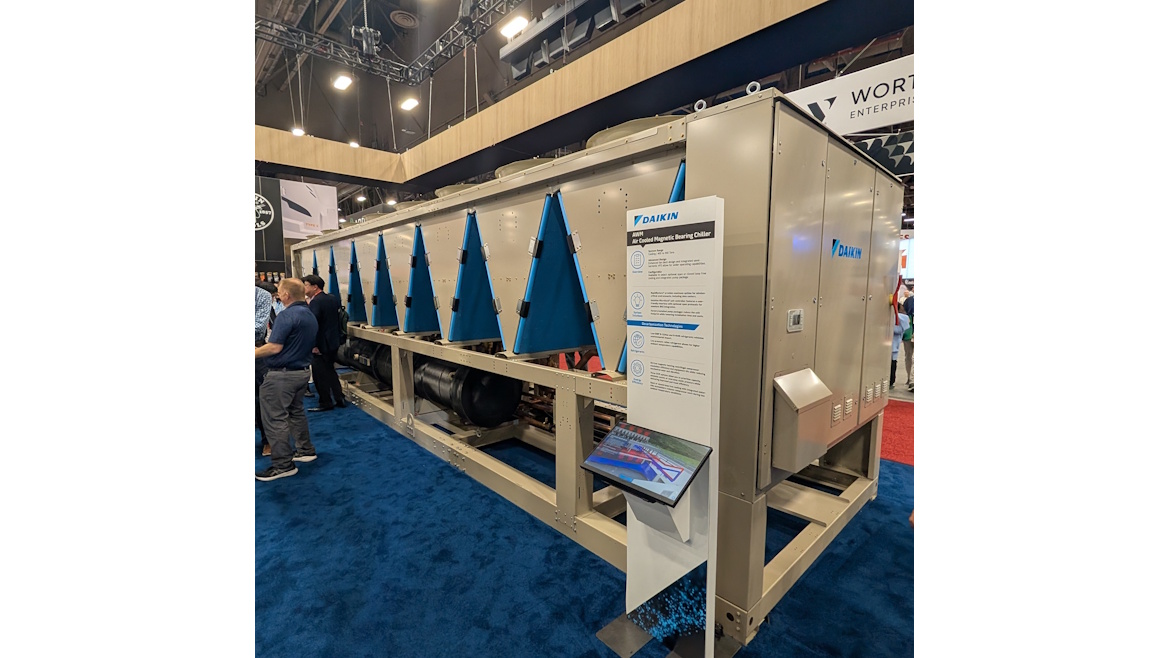
HIGH TEMPS: The AWM’s advanced compressor design, paired with next generation fan technology, provides high performance cooling even in extreme conditions, operating in environments up to 131°F.
The company sees residential efficiency and data center cooling as mutually reinforcing — the more efficient comfort is brought to homes and buildings, the more capacity there is to power the next generation of digital infrastructure.
Nishiwaki discussed Daikin Applied’s North American data center cooling business, expected to more than triple by 2030. Deloitte forecasts AI data center power demand rising thirtyfold from 4 gigawatts in 2024 to 123 GW by 2035.
“We are evolving from an equipment manufacturer into an integrated thermal-infrastructure partner,” said Nishiwaki. “Our teams engage at the pre-design stage — modeling loads, evaluating hybrid architectures, and developing thermal roadmaps that scale with our customers’ compute strategies.”
The industrial conference was one of the first investor-focused external events Daikin has held outside of Japan in the company’s history. Daikin has products in more than 170 countries and $31.6 billion in global fiscal 2024 sales.
“Events like this help us show how Daikin Applied’s capabilities map directly to the infrastructure opportunities investors are tracking most closely,” said Nishiwaki.
Looking for a reprint of this article?
From high-res PDFs to custom plaques, order your copy today!