Ammonia Refrigeration a ‘Century-Proof’ Technology
Proven in early systems, ammonia still meets modern performance and regulatory demands
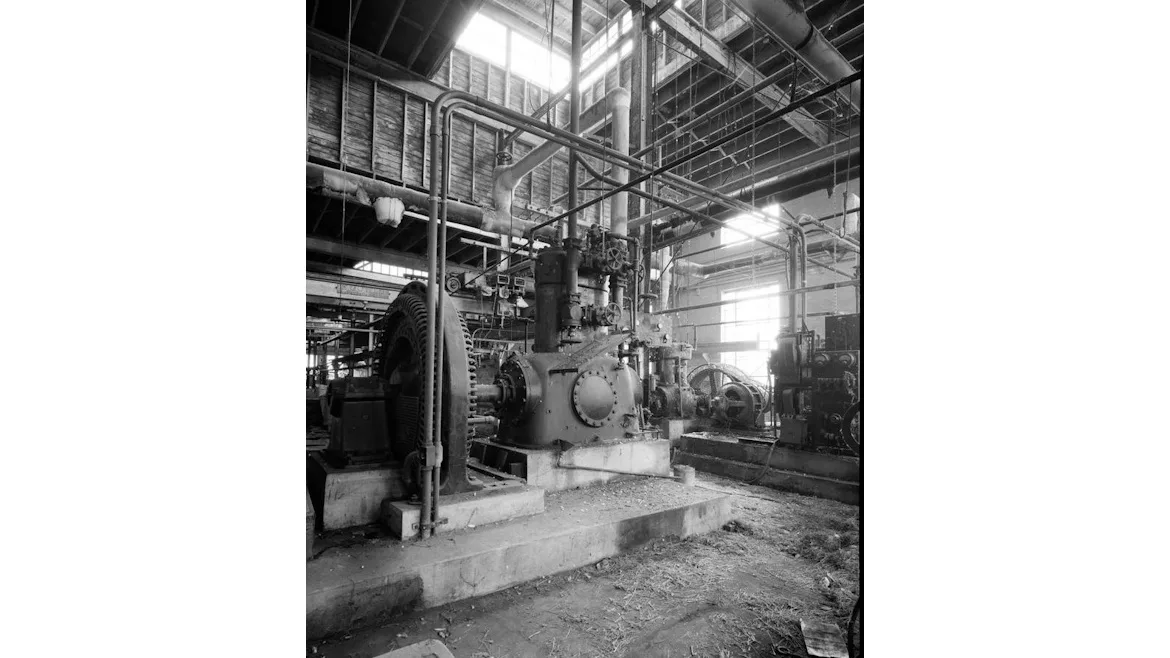
EARLY AMMONIA SYSTEM: A York 14x14 ammonia compressor is shown at the Champion Ice Manufacturing & Cold Storage Co. in Covington, Kentucky.
When Electric Refrigeration News — now The Air Conditioning, Heating & Refrigeration NEWS — debuted in 1926, ammonia was the dominant refrigerant for large-scale refrigeration applications. Leading up to that point, ammonia refrigeration played a key role in the industrial revolution, earning itself, along with other natural refrigerants, a reputation for being a “century-proof” technology.
Spanning the late 1800s, when steam engines gave rise to the first basic mechanical refrigeration systems — to 2026, when natural refrigerants and specialized equipment deliver precise temperature control — the natural refrigeration industry underpins many of the most important advancements of modern life.
Chief among them is the creation of the global cold chain, which feeds the world’s population. And while the cold chain that developed in the 1930s through the 1960s was instrumental in the advancement of food manufacturing in its time, the pressure to maintain and expand that system to feed the world is driving innovation today.
Looking Back
To understand the demands of the worldwide refrigeration systems built on natural refrigerants, one must first understand their past. Before the invention of synthetic refrigerants — and even after — natural refrigerants remained a simpler and more environmentally responsible technology, shaped over time by competition with ozone-depleting and, more recently, PFAS-based synthetics.
The most significant technical and safety milestones in ammonia system design over the past century were driven first by the needs of food production, and later by safety and environmental regulations.
In the late 1800s and early 1900s, industrial ammonia refrigeration was the dominant cooling technology, first used in meatpacking and breweries as well as transportation, where ice was made to ship meat and vegetables in boxcars.
“Ammonia systems were first applicable to food production — primarily by enabling the first cold storage facilities, which laid the foundation for the industry and the beginning of a global cold chain,” said Kent Anderson, president emeritus of the International Institute of All-Natural Refrigeration.
Looking for quick answers on air conditioning, heating and refrigeration topics? Try Ask ACHR NEWS, our new smart AI search tool. Ask ACHR NEWS
Mechanical refrigeration allowed ice to be made anywhere, but it was mostly a localized effort to support meatpacking and breweries. That changed in the 1920s, when electric motors and the advancement of reciprocating compressors made refrigeration plausible on an industrial scale and gave rise to the first big food processing plants.
By the late 1950s, the industry was undergoing another technology change with a shift toward more compact equipment, the development of hermetic motors, and then screw compressors in the mid-1960s.
“These were significant technology innovations, because for the first time, you could deliver large capacity with compact equipment,” said Anderson.
That development led to a proliferation of ammonia systems in cold storage and ushered in an era of mass food production in the 1950s.
“In the 1950s and 1960s, the development of frozen food products changed the entire cold chain,” said Anderson. “Ammonia refrigeration was critical in the manufacture of frozen food and cold storage, and the changes in the way we produced food led to an evolution of the cold chain.”
The ability to produce, process, and store food on a mass scale, in turn, led to another big shift in refrigeration — the widespread use of “freon” refrigerants in grocery stores, trucking, and other parts of the industry.
By the late 1960s and early 1970s, the forces shaping industrial refrigeration were largely operational rather than mechanical. Some food manufacturing and distribution companies began using commercial-grade, factory-built, synthetic refrigerant systems because they were inexpensive and did not require specialists for installation, operation, and maintenance. They were also considered to be safer than ammonia-based systems. However, most large-scale operations continued to use ammonia because it is highly energy efficient and offers advantages such as tolerance for water contamination, easy detection, and low initial refrigerant costs.
Safety And Standards
A series of high-profile incidents involving lethal releases of toxic chemicals gave rise to safety and environmental scrutiny from the newly formed Occupational Safety and Health Administration and the Environmental Protection Agency.
By the late 1970s and early 1980s, the industry’s first formal foundation of a safety framework — in the form of Process Safety Management — had emerged. Then in 1990, ammonia was specifically mentioned in legislation that updated the Clean Air Act, officially regulating the chemical and scooping up industrial refrigeration with it. The result was that refrigeration systems with large quantities of ammonia were then regulated by both OSHA and the EPA under Process Safety Management and Risk Management Programs, respectively.
While IIAR, the ammonia refrigeration industry’s standard-creation and advocacy organization, already existed, it was this language in the 1990 amendment of the Clean Air Act that catapulted the group to the forefront of safety and started a new era in industrial refrigeration: one in which the dominant technology was to be shaped by safety and efficiency.
“The original founders of IIAR saw that a need and an opportunity existed for the industry to define safety,” said Anderson. “One of the most important things IIAR did was develop specific industry guidelines to meet the requirements of broad-based industry regulations. IIAR had a plan everybody could follow. That was a good thing for our industry, and it brought more attention to safety.
“IIAR-2 was first a standard developed to deal with code issues. But because safety became a primary concern, the standard has grown from 10 to over 70 pages, incorporating the best engineering practices for ammonia refrigeration,” he said. “More engineering controls and safety measures were put into IIAR-2 as a voluntary consensus standard, and now, rather than the government arbitrarily applying regulations to the industry, regulators direct companies to follow IIAR-2 and other related IIAR standards.”
The opportunity that IIAR took in the 1990s to become the leader in creating and establishing the industry’s safety standards — which have now grown into a suite of 11 standards — laid another foundation for advancement by defining where and how natural refrigeration systems could be used safely, said IIAR President Gary Schrift.
Environmental Concerns
While all this was happening in the large-scale, ammonia-based industrial refrigeration industry, the synthetic refrigerant industry was undergoing its own evolution. Beginning in the 1960s, scientists noticed that the atmosphere’s ozone layer was shrinking. Evidence eventually led to the understanding that chlorinated refrigerants were the leading cause of ozone depletion.
By the 1990s, CFC and HCFC refrigerants were being phased out worldwide, and regulations on handling and managing these refrigerants were implemented. Soon after, more research revealed that the HFC replacements for CFC and HCFC refrigerants were leading contributors to the greenhouse gas effect.
By the middle of the 2010s, many high-GWP refrigerants began to be phased out, and the synthetic refrigerant industry marketed new HFCs and HFOs with lower-GWP values. Many who had embraced synthetic refrigerants began to turn back to ammonia and other natural refrigerants as it became clear that they were the most reliable alternatives to ozone-damaging CFC and HCFC refrigerants and high-GWP replacements.
“Regulations around risk management, efforts to reduce emissions in general, and the EPA’s phasedown of CFCs and HFCs have created a demand for more advanced, more efficient systems,” said Schrift. “This has highlighted the central role natural refrigerants play as the most viable refrigeration option focused on safety, which has driven innovation over much of the last decade.”
Two of the biggest technology evolutions — a shift to low-charge ammonia refrigeration systems and a focus on the development of CO2 systems — have yielded more advanced systems that, thanks to IIAR’s safety standards, are poised to meet the environmental, regulatory, efficiency, and safety challenges of the future.
This technical versatility has enabled natural refrigerants to move beyond traditional use cases, and they now support complex climate control systems in data centers; contribute to waste heat recovery in district energy networks; and improve thermal management across industrial manufacturing processes.
The industry is already moving toward its next major evolution, said Schrift, who compared the growing concern over PFAS pollution risk posed by new synthetic HFO refrigerants to the realization in the 1970s that synthetic refrigerants were destroying the Earth’s atmosphere.
“As people start to recognize the environmental and regulatory uncertainty that accompany synthetic refrigerants, it will be clearer than ever that ammonia, CO2, and other naturals are the best way forward.”
Fortunately, he said, the industry is prepared.
“Our history has shaped and refined these technologies over almost a century of responding to safety and design challenges, whether because of regulation or because new applications have demanded better solutions,” Schrift said. “The result is that we have a solid foundation for safety, efficiency, and economy. And that foundation enables innovation to happen fast when the world needs us to respond to the biggest human and environmental challenges of the future.”
Looking for a reprint of this article?
From high-res PDFs to custom plaques, order your copy today!