Choosing the Right Whole-House Humidifier
Understanding the technology is key to helping homeowners achieve the best results
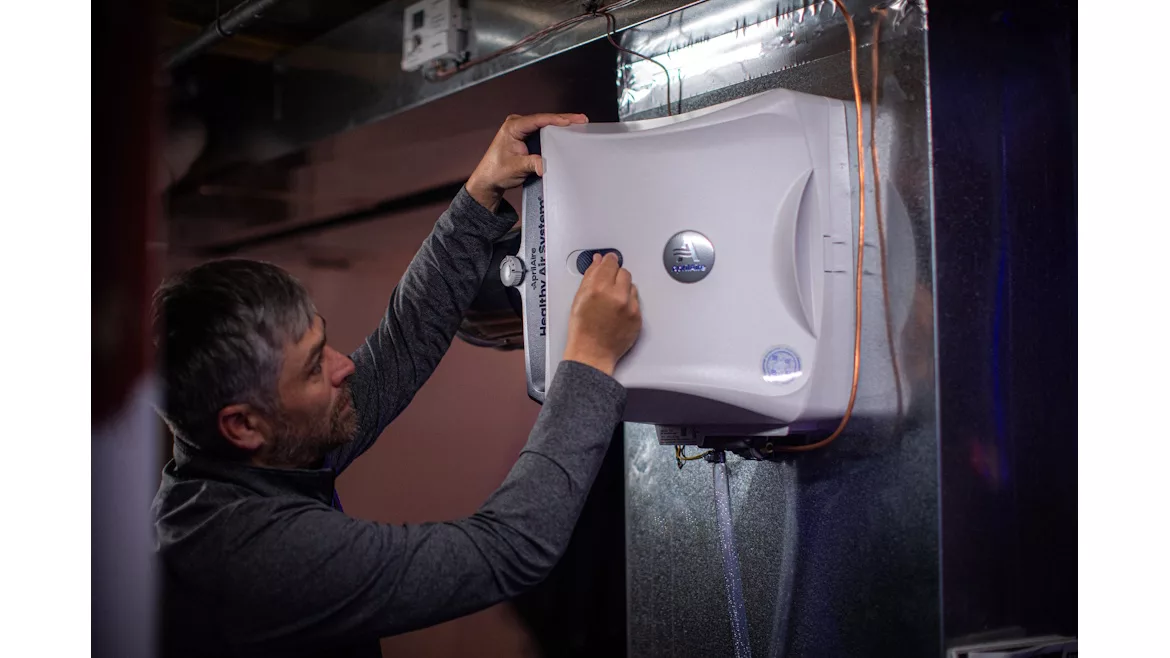
FLEXIBLE INSTALL: The AprilAire 620 bypass humidifier can be installed on either the supply or return plenum.
Dry indoor air isn’t just a winter nuisance — it can affect occupant comfort and health, as well as the home itself. From static shocks and scratchy throats to cracked wood floors and shrinking furniture, low humidity shows up in ways homeowners notice quickly, especially during heating season. That’s why whole-house humidifiers have become an increasingly popular add-on to residential HVAC systems.
Whole-house humidifiers are categorized by how they add moisture to the air: evaporative, steam, and atomizing. Evaporative and steam systems account for most residential installations, and understanding their operation and application can help contractors recommend the right solution.
Evaporative
Evaporative whole-house humidifiers add moisture to indoor air by moving warm air across a water-saturated medium, allowing natural evaporation to occur. While the core principle is the same, evaporative systems generally fall into two categories — bypass and fan-assisted.
Bypass evaporative humidifiers
How it works: Bypass evaporative humidifiers use a humidistat (or a thermostat with humidity sensing) to monitor indoor humidity and activate the humidifier with the HVAC system blower when levels fall below the set point. When activated, a solenoid valve opens to deliver water to a distribution tray, which evenly spreads water across the evaporative water panel, said Nate Hughes, senior engineering manager and technology lead at AprilAire. Excess water flows by gravity to the drain.
“The bypass humidifier is connected between the supply and return plenum, where differential pressure moves air from the supply through the humidifier and to the return while the HVAC system is operating,” he said. “The dry, hot air from the HVAC system moves through the moisture-laden water panel evaporator where natural evaporation takes place, and humidified air carries moisture in vapor form throughout the home.”
Best applications: Bypass-type humidifiers can be used for a wide range of homes, and AprilAire has several sizes and styles available, including the new 620 with HydroCore technology. They are most effective on single-stage gas furnaces, said Chris Howells, senior training manager at AprilAire. While compatible with multi-stage and/or variable-speed systems and heat pumps, he noted that their delivered capacity may be reduced because of lower airflow and cooler supply plenum temperatures. Proper sizing is also critical and should be based on total treated air volume and climate conditions, following AHRI Guideline F.
Looking for quick answers on air conditioning, heating and refrigeration topics? Try Ask ACHR NEWS, our new smart AI search tool. Ask ACHR NEWS
“A common mistake is to only consider areas that have finished square footage, even though the air may all be treated,” he said. “Also important to consider is the run time of heat and fan calls. Rating of evaporative units assumes heating is running all the time, so the humidifier will have reduced output when only the blower fan is running.”
Installation considerations: Because a bypass humidifier — like the AprilAire 620 — relies on the furnace or air handler blower to move air through the unit, it can be installed on either the supply or return plenum, with airflow always traveling from the positive-pressure supply side to the return, said Howells. When selecting a mounting location on the plenum, contractors should consider annual service access, water supply and drain connections, and proper humidifier control placement.
“A common mistake we see is that the humidifier control is mounted on the return plenum downstream or close to the humidifier or bypass duct,” said Howells. “This control placement now measures the humidity coming directly from the humidifier or bypass duct, causing inaccurate control and operation.”
Instead of a separate humidistat, humidifiers can be wired to thermostats with IAQ terminals, allowing the thermostat to control humidity and furnace operation directly, said Kyle Nelson, senior product manager at AprilAire.
“In this scenario, the thermostat is installed in the living space and can measure and control humidity within the home based on the reading at its location instead of in the return duct,” said Nelson. “A Wi-Fi thermostat can also serve as the humidity control, allowing the humidifier to be managed remotely through the AprilAire Healthy Air app.”
Limitations: Because bypass humidifiers rely on the HVAC system to provide heat and airflow, their output decreases during short heating cycles or when only the blower is operating. In these cases, fan-assisted or steam humidifiers may be better alternatives, said Nicole Graeve, senior product manager at AprilAire.
“For optimal output, always consider utilizing a control configured to operate the humidifier during heat and fan calls,” she said. “Features such as blower activation can force the HVAC blower to run when humidity is needed. For variable-speed systems, it is recommended to increase the blower speed during a fan call to increase output and efficiency.”
Fan-Assisted Evaporative Humidifiers
How it works: Fan-assisted evaporative humidifiers use an internal fan to pull warm air from the duct into the humidifier and force it through a water-saturated evaporative pad. As air passes through the pad, moisture evaporates into vapor, and the humidified air is then delivered back into the duct and distributed throughout the home, said Eric Miller, director of sales and marketing at General Filters.
“A fan-assisted humidifier creates additional air velocity through the vapor pad, thus producing humidity output greater than a bypass humidifier, which uses the lower air velocity of the heating source’s blower motor,” he said.
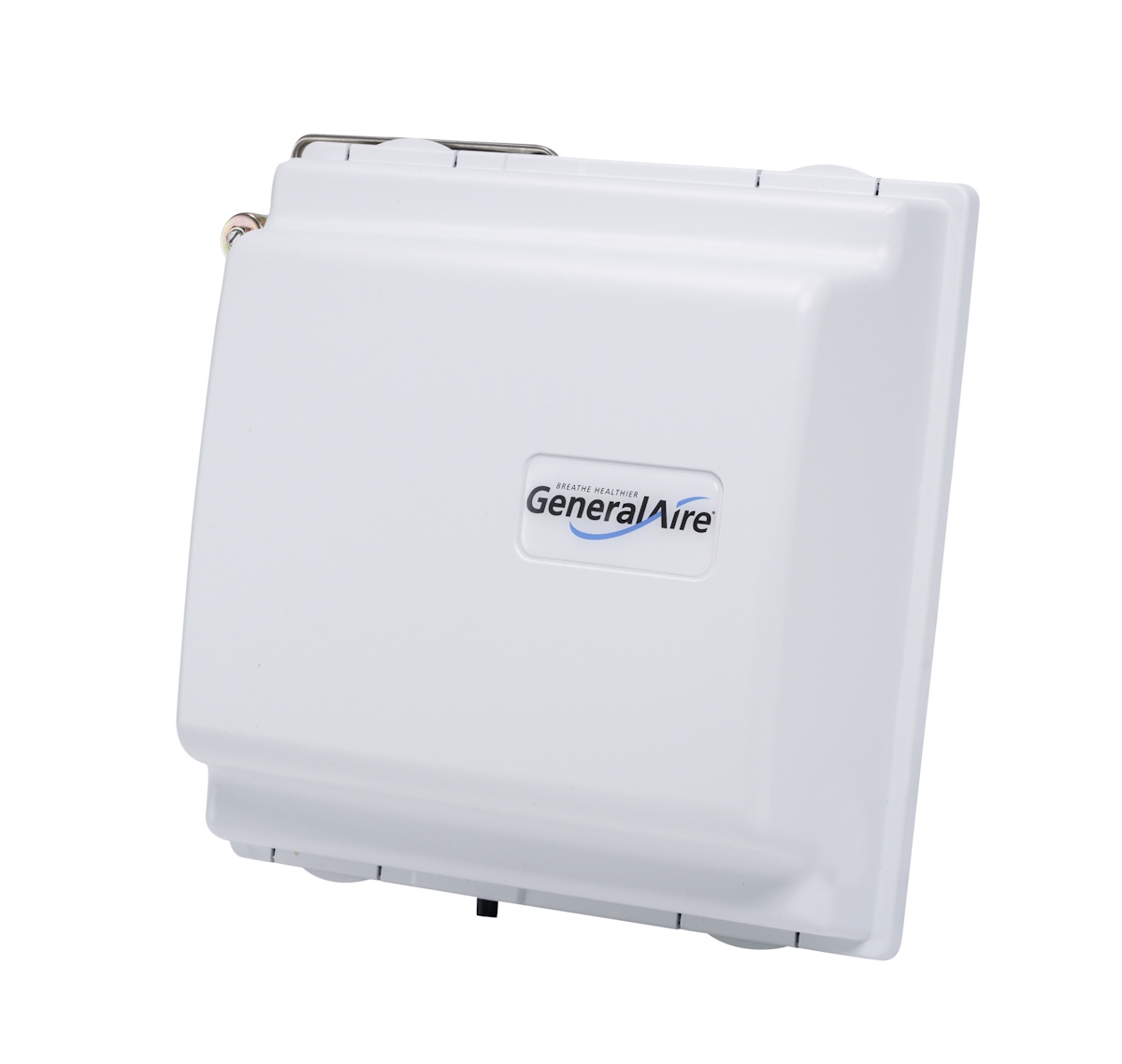
QUIET FAN: The GeneralAire 4400A fan-assisted evaporative humidifier produces up to 19 gallons of humidity per day, thanks to its internal, ultra-quiet crossflow fan. (Courtesy of General Filters)
Best applications: Fan-assisted evaporative humidifiers — such as GeneralAire’s 4400A or 1137 — are well suited for small to larger homes, especially those with extensive wood flooring, cabinetry, musical instruments, artwork, or other hygroscopic materials that require consistent humidity control, said Miller.
“Any climate that creates a demand for humidity within the home is well served by a fan-assisted humidifier,” he said. “Fan-assisted humidifiers can be installed during home construction or retrofitted to existing HVAC systems.”
Installation considerations: Humidity output is influenced by installation location, with best performance achieved when fan-assisted humidifiers are installed on the supply side of the furnace or heat source, where air temperatures are highest, said Miller. When supply-side installation is not possible due to A-coil placement or space limitations, return-side installation may be used, though output may be reduced.
“As with any whole-house humidifier, fan-assisted humidifiers require a level installation, a water drain line, and easy access to the unit for annual vapor pad replacement,” he said.
Controls may be manual or automatic. For example, the GeneralAire 4400A comes equipped with the GFX5, a Wi-Fi-enabled digital control that can be operated as an automatic device (with an external sensor), a manual device, or as a Wi-Fi-controlled device. The 1137 uses manual control.
Limitations: Like all whole-house humidifiers, proper sizing is imperative. This includes considering the total square footage of the basement, ceiling height, the number of fireplaces, and hygroscopic construction features, said Miller. A sizing tool can be used to help select the correct whole-house humidifier.
“It is always better to oversize a whole-house humidifier, especially when using an automatic control, which allows for precise output that can be increased or decreased automatically as humidity demands change,” said Miller.
He added that for larger homes — typically those exceeding 4,500 square feet — a steam humidifier might be a better option.
Steam
How it works: Carrier steam humidifiers generate humidity by boiling water inside a canister using electrodes. When current flows between the electrodes, water boils and turns to steam, which is then injected into the HVAC duct system through a dispersion tube, said Chrystal Jolliffe, IAQ product manager at Carrier.
“This method provides precise humidity control and works independently of heating or cooling calls, so humidity can be maintained year-round,” she said.
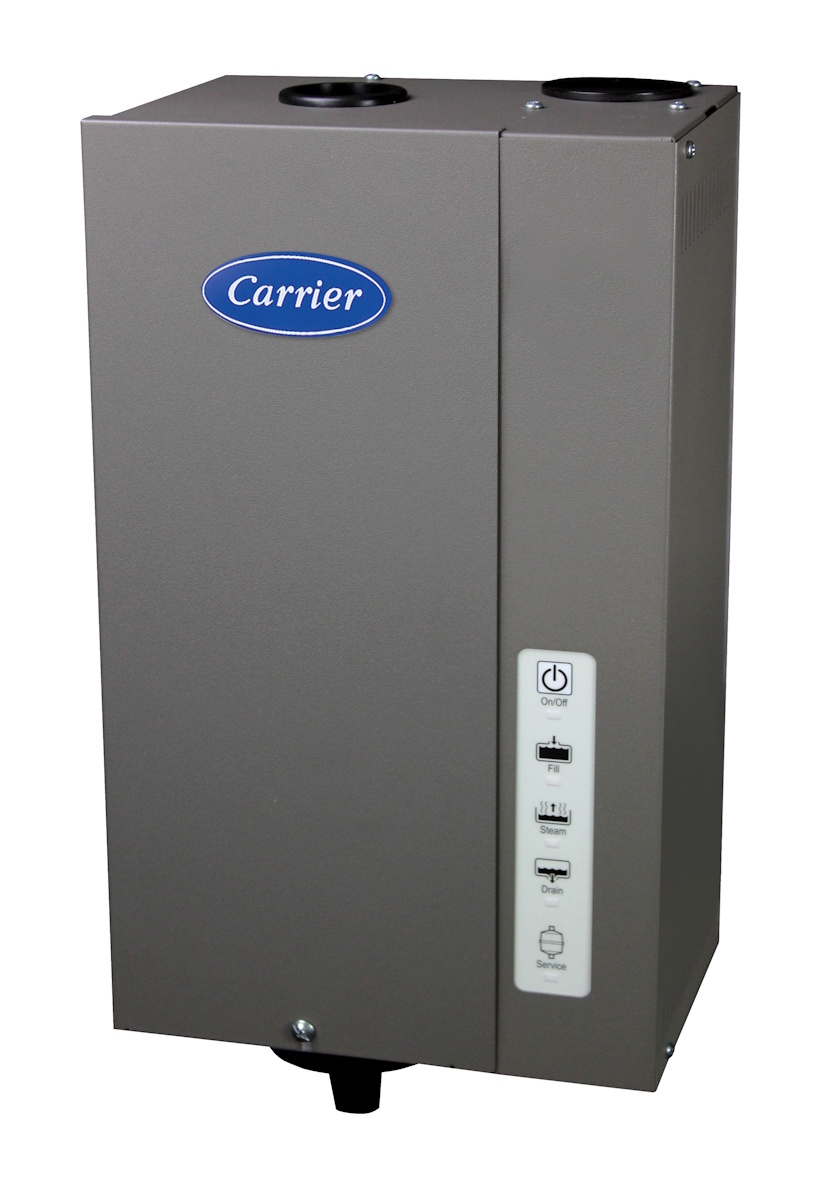
LARGE CAPACITY: Carrier’s Performance steam humidifier has a capacity of up to 34 gallons per day, making it ideal for large homes. (Courtesy of Carrier)
Best applications: Steam humidifiers perform especially well in cold, dry regions like the Midwest and Northeast, where winter air is naturally low in moisture, as well as in larger homes or applications that require more consistent humidity control. Jolliffe added that they can be installed in both new construction and retrofit projects, provided there’s access to ductwork, water supply, and electrical service.
“Steam is the premium solution for more precise control and high-capacity needs,” she said. “For example, Carrier’s Performance steam humidifier (HUMCRSTM) has a capacity of up to 34 gallons per day, which makes it ideal for large homes or any home where more precise humidification is desired.”
Installation considerations: When selecting a steam humidifier, Jolliffe advises contractors to take into consideration the home size and layout; climate and humidity goals; electrical and plumbing access; and integration with HVAC controls.
“Carrier steam humidifiers integrate with Infinity and Carrier Smart Thermostats for automatic humidity control and can be managed remotely through the Carrier SmartHome app for monitoring and scheduling,” said Jolliffe. “Proper setup requires configuring accessory settings in the thermostat and ensuring correct wiring to ACC terminals or HUM contacts.”
When installing a steam humidifier, Jolliffe recommends contractors follow these steps:
- Determine the best mounting location
- Install the steam dispersion tube inside the duct
- Mount the humidifier and install the steam hose
- Connect the water supply and drain line
- Wire to the chosen control
- Wire electrical power and shut-off switch.
“Common mistakes contractors should look out for include incorrect dispersion tube placement, inadequate drainage, or failing to size the unit properly,” she said.
Limitations: Steam humidifiers have a few limitations, including higher upfront costs and the need for a dedicated electrical circuit, which can add installation complexity, said Jolliffe.
“They also need sufficient duct access and clearance for proper steam dispersion, and their performance can be affected by water quality — hard water often shortens canister life,” she said. “In smaller homes or situations where electrical access is limited, or space is tight, evaporative models may be a better choice because they are generally easier to install and less demanding in terms of power and space requirements.”
Looking for a reprint of this article?
From high-res PDFs to custom plaques, order your copy today!


