Beyond PowerPoint: Smarter, Gamified Ways to Train HVACR Technicians
Designing training that techs engage with

HAVE FUN: From hands-on movement to gamified competition, smarter training design can boost retention and confidence in the field.
Training technicians can be … well … less than interesting. And it can get repetitive. That’s because for many HVACR contractors, technician training looks the same as it did 20 years ago: long slide decks, every technician in the same room, and half of those same technicians trying to stay awake after a long day in the field.
But it doesn’t have to be this way.
During PHCC Connect, Danielle Wernert, owner of Upskilled Consulting, shared ways that contractors can keep technicians engaged during training — and even have a little fun.
Her approach centers on four core objectives: designing gamified activities that create buy-in, using multi-sensory learning techniques, capturing attention in the first 60 seconds, and fostering a culture where techs participate rather than sit passively.
Together, those strategies don’t just make training more fun — they help technicians retain more, apply more in the field, and feel more confident in their skills.
Train The Right Techs — Not All At Once
One of the biggest training mistakes is assuming that every technician needs the same level of education.
“Our technicians are not all in the same place, so why are we training them at the same pace?” Wernert said.
Looking for quick answers on air conditioning, heating and refrigeration topics? Try Ask ACHR NEWS, our new smart AI search tool. Ask ACHR NEWS
Technicians typically fall into one of two camps during training: They’ve already heard the material countless times, or the content is beyond their current skill level. Either way, they’re disengaged.
Instead of “shotgunning” content to the entire team, Wernert recommends funneling training to the right audience by identifying skill gaps. Contractors can use self-assessments, onboarding evaluations, or even callback analytics to learn about what their techs know — and what they don’t.
“The goal is to get the right audience in the seat,” Wernert said.
Preparation is equally important — contractors can’t just wing it. That means outlining clear objectives, preparing resources in advance, and determining how the training’s success will be measured.
“What is the purpose of your training? What metrics are you tracking — and that could be what they actually learned from the training, who qualifies for the training, and after the fact: who has actually put it into practice,” Wernert said. “Defining KPIs that correlate to your training can have a really solid impact.”
Make Learning Stick
Not every technician learns the same way. Some are auditory learners, others are visual, and others are kinesthetic.
Rather than forcing technicians to learn one way, Wernert encourages contractors to layer multiple approaches into every session. After all, some technicians entered the trade because they didn’t like taking notes, reading textbooks all night, and doing homework.
“Get rid of ‘death-by-PowerPoint.’ … Our job as trainers and as leaders is to meet our learners where they are — it’s not to define what their learning style is or who they are … usually learning preference is a mix among the group,” Wernert said. “Our job is to use that multi-modality of layering all three of these learning preferences together within the same message, within the same training session.”
Auditory learners. This can be as simple as changing the way the information is delivered. Rather than reading slides verbatim, instructors can ask more questions, talk through concepts, or even incorporate music/rhythms or short verbal cues to reinforce trainee retention.
Visual learners. These learners benefit from seeing information clearly organized. Diagrams, checklists, or simple visuals can better aid technicians in connecting to the concepts
Wernert also suggests replacing blank notebooks with pre-made fill-in-the-blank worksheets that clearly highlight key points without overwhelming technicians. Worksheets help remove the guesswork of deciding what information matters most, but still require technicians to stay engaged to listen for those critical details. By guiding what information needs to be captured, worksheets help technicians focus on learning instead of scrambling to write down every word on a slide.
It can also scratch the kinesthetic itch by encouraging handwritten notes. Writing by hand forces the mind to slow down and process information, engaging multiple parts of the brain at once.
“You’re hearing it, your brain is processing it, and your hand is physically writing it,” Wernert said. “That connection helps with retention much more than typing.”
To support handwritten notes, Wernert recommends setting expectations at the start of training, providing pens and paper, and even a small supply table they’ll see as soon as they walk in to remind them that notetaking is encouraged.
Kinesthetic learning. This is hands-on learning, which is where technicians often thrive the most.
“Learning through movement — when your body is up and moving — you’re making more neural connections in the brain, so you remember things easier,” Wernert said.
This can be as simple as having students stand up to physically move through the steps of a refrigeration cycle, or handling actual parts during discussions, or engaging in role-playing scenarios for customer interactions.
“[Technicians] don’t typically love to role-play, but just because it isn’t everybody’s favorite doesn’t mean it isn’t impactful,” Wernert said.
Group projects are another effective tool. Wernert shared examples of assigning teams different IAQ products to research and then having them present their findings — sometimes through short, humorous videos.
“They became the expert in one IAQ product, and then they taught the rest of the class,” Wernert said — reinforcing their own understanding and making the learning far more memorable.
Gamification
With the right technicians in the room, clear objectives in place, and training designed to engage multiple learning styles, contractors can take the engagement one step further through gamification. Rather than relying on lectures alone, gamified training turns education into an experience — one that encourages movement, collaboration, participation, and even a little friendly competition.
Gamification isn’t about making light of training. Instead, Wernert said, it’s about increasing engagement, improving retention, and creating an environment where technicians are active participants rather than passive ones.
“We want to get them excited, we want to get them participating, and we want to get them remembering the content that we are sharing with them,” Wernert said.
Role-playing is one example of gamifying training. Additionally, Wernert shared a few simple training games that contractors can implement at their next training session, each designed, of course, to support different learning preferences while reinforcing the real-world skills technicians use every day.
4 In A Row Review Game
All contractors need is a whiteboard, four different-colored dry-erase markers, and a question/answer bank. Teams are divided into four different groups, and each gets a shot at answering a question correctly. When they do, they color in a square of their choosing until they get four in a row. If they answer incorrectly — no colored square for them.

Courtesy of Upskilled Consulting
Soldering Shapes
This game can be done individually or in small teams. Contractors will need to provide printed shape templates (cut out in advance), copper pipe (approximately 4 feet per shape), fittings, solder, torches, and the necessary safety equipment.
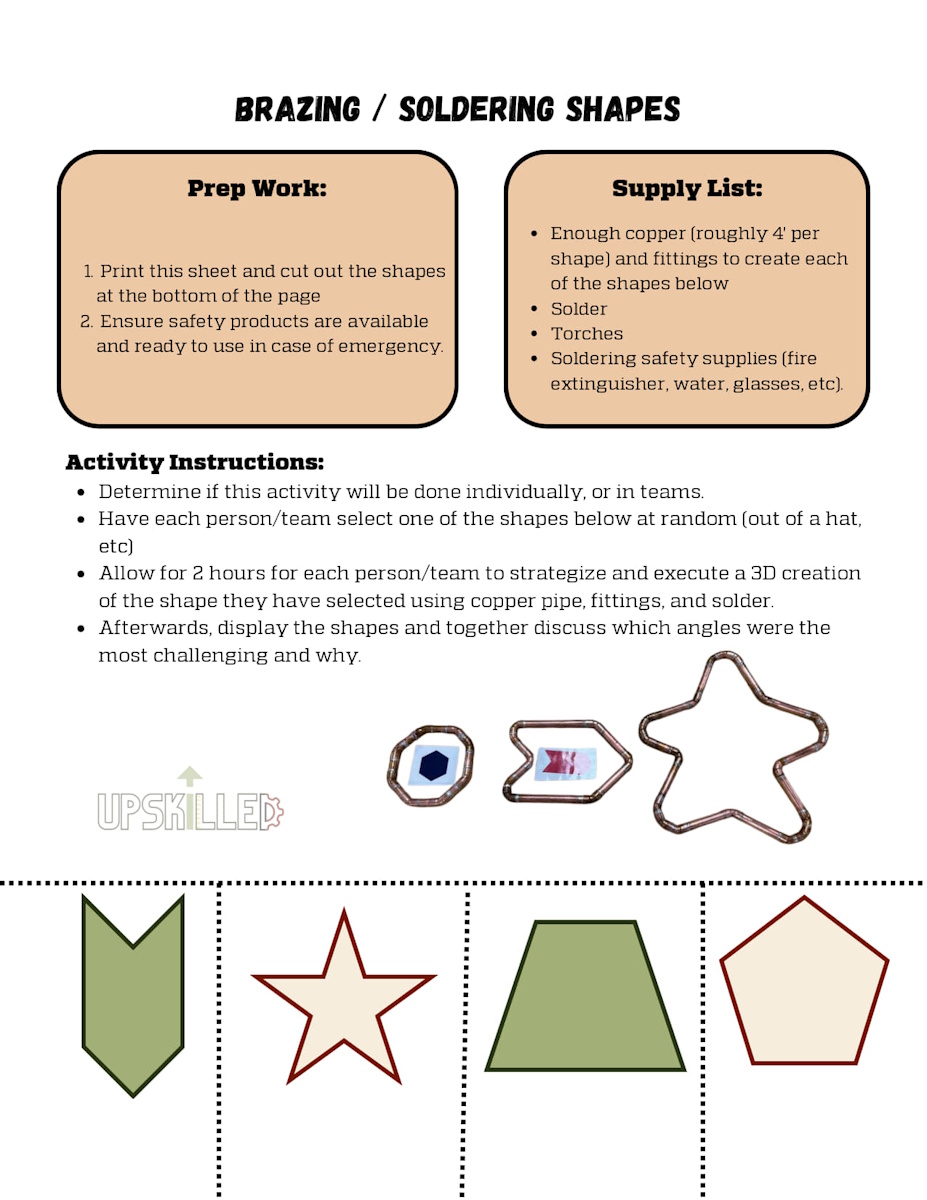
Courtesy of Upskilled Consulting
To start, each technician or team randomly selects a shape provided with the activity. Giving the technicians two hours to do so, they must strategize on how to construct a 3D version of that shape using copper pipe, fittings, and solder. Afterwards, discuss.
Inventory Races
Designed to take place in a parking lot or warehouse, the exercise only requires an open space, a printed or digital copy of the company’s truck stock list, and two or more fully stocked vehicles.

Courtesy of Upskilled Consulting
Technicians are divided into small teams — typically no more than four per group. One technician from each team lines up their stocked company vehicle and opens its doors. Then, the facilitator calls out one truck-stock item per round. Relay-race style, one technician “walks with purpose” to their vehicle, locates the correct part, and returns it across the starting line. The team that brings the correct tool back first earns a point. All parts are returned to their proper place, and the next round begins.
Looking for a reprint of this article?
From high-res PDFs to custom plaques, order your copy today!