AHR Expo 2026
AHRI Standards Updates Aim to Clarify Performance, Flexibility, and Emissions for Contractors and Homeowners
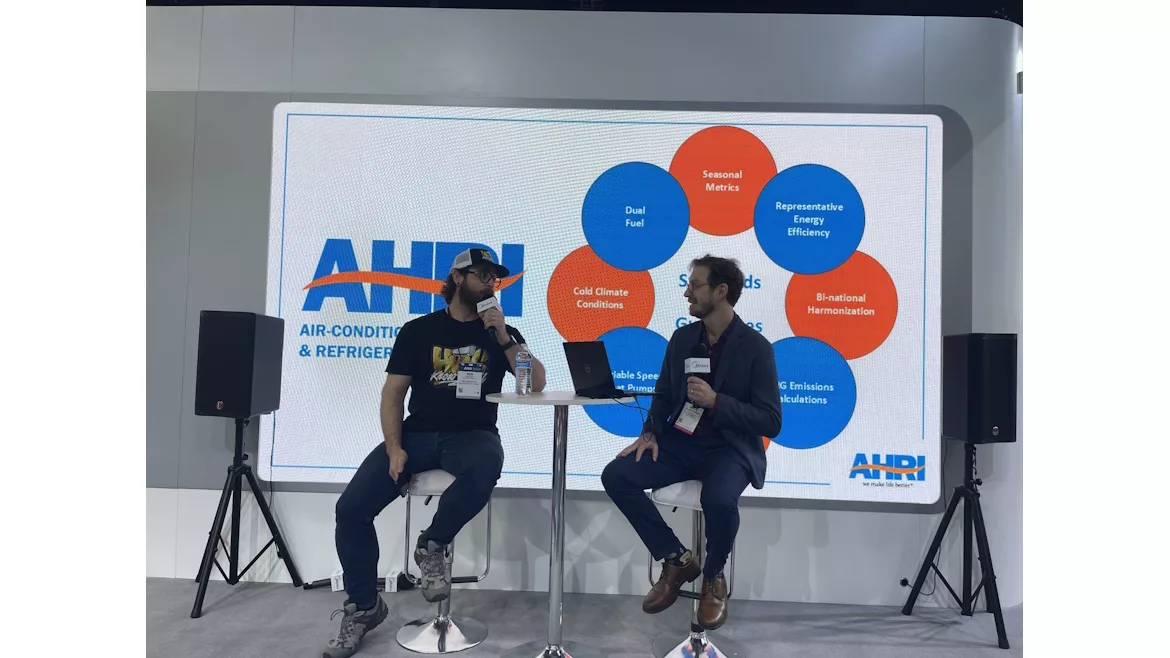
MIDEA PRESS CONFERENCE: Ben Reed (left) of HVAC Know It All interviews Jacob (Cobi) Waxman of AHRI.
Why should HVAC technicians care about standards hammered out by a bunch of engineering nerds on a Zoom call?
Jacob (Cobi) Waxman, manager - standards, AHRI, will be the first to admit he’s one of those nerds. But there’s a reason HVAC installers should pay attention to those technical details, he said. AHRI’s latest updates are directly tied to how modern HVAC systems are designed, sold, and installed. The goal: ratings and requirements that support grid reliability and better reflect how equipment actually performs in real-world situations.
Waxman pointed out three areas where updates will be most impactful for contractors and their customers: new seasonal performance metrics, demand-response, and greenhouse gas emissions reporting.
1/ Seasonal metrics replace single-point testing.
“Seasonal performance metrics” means total seasonal conditioning delivered divided by total seasonal energy use. In other words, rather than rating equipment based on performance at a single outdoor temperature, these new metrics evaluate energy use and capacity across an entire cooling or heating season. By accounting for part-load operation, standby energy consumption, and off-cycle behavior, this approach is intended to better capture how equipment actually runs in homes, especially as variable-speed systems become more common.
Updated standards under development will also incorporate testing at multiple temperatures and compressor speeds, including cold-climate conditions and defrost performance. According to AHRI, this allows ratings to reflect differences between single-stage, two-stage, and variable-capacity systems — something single-point metrics cannot do effectively.
For contractors, this means efficiency ratings that are more representative of real-world operation, helping set clearer expectations with homeowners about comfort and energy use.
Looking for quick answers on air conditioning, heating and refrigeration topics? Try Ask ACHR NEWS, our new smart AI search tool. Ask ACHR NEWS
2/ Demand-response moves into the spotlight
Demand-response is a growing focus in HVAC, driven by increased strain on electrical grids and growing interest in electrification as a decarbonization strategy. HVAC and water heating systems account for a large share of residential energy use, making them key targets for load management.
“Essentially, utilities need to be able to communicate with HVAC/water-heated products and vice versa,” Waxman said. “The product needs to be communicating back to the utility so the utility can manage their different load profiles.”
Waxman said AHRI has developed both residential and commercial demand-response standards.
Comfort, though, remains the key, added Zach Chapin, senior director of R&D - residential a/c, Midea America Research Center.
“You can't take the control out of the hands of the consumer,” he said. Midea’s systems give the user the ability to override a demand-response call, either on the smartphone app or on the unit.
“You don't want to interrupt somebody's dinner party [where] of a sudden it's crazy hot in their house, or something like that,” he said. “I think it's good that there's a balance there … because if the customer is having an issue, it becomes an equipment problem, and then everybody's in trouble.”
3/ Lifecycle greenhouse gas emissions
“These calculations capture the lifetime emissions for fuel…and it could provide a basis for product dimensions reporting in the future,” Waxman said. It’s currently just a guideline, not a mandatory standard, but it could be the basis for product reporting down the road.
What It Means for Contractors and Customers
While contractors may never read an AHRI standard cover to cover, the outcomes shape the equipment they install and the conversations they have with customers. Seasonal metrics provide ratings that better match lived experience. Demand-response standards make grid-interactive systems more practical to deploy. Emissions guidelines help frame sustainability discussions without eliminating flexibility.
“Now we can capture the performance of a product with a higher level of specificity and precision,” Waxman said. “Is it a single-stage, two-stage, or variable-speed process? Does it have an active defrost capability? At what temperature does the compressor cut in and cut out? Does it perform private conditions? How does it perform over the course of an entire cooling season?”
For contractors, answers to questions like these help build confidence with customers that the products they buy will be more representative of their energy efficiency in that customer’s home, season after season.
Looking for a reprint of this article?
From high-res PDFs to custom plaques, order your copy today!