2026 Distribution Trends Roundtable
Distribution pros look at the HVACR year that was, and what they see ahead
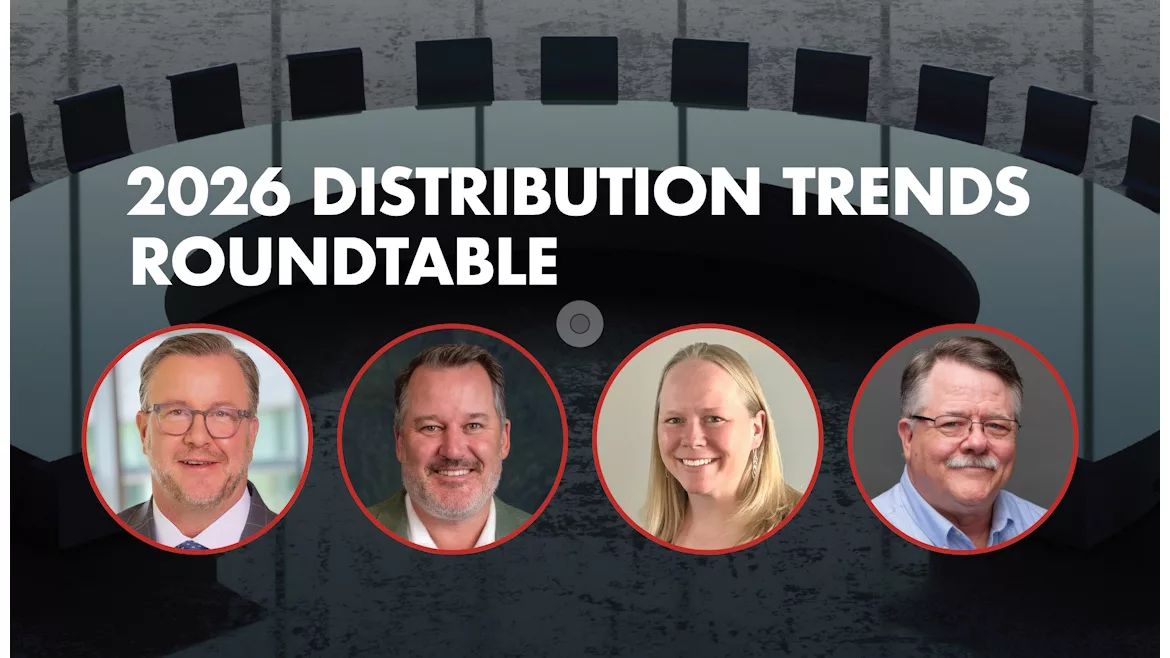
DISTRIBUTION DISCUSSION: Participants in the 2026 Distribution Trends Roundtable are, from left, Scott Hagar, vice president of HVAC at Ferguson Enterprises; Pat Newland, vice president of business development at Hercules Industries Inc.; Lauren Roberts, chairwoman, CEO, and president of cfm Distributors Inc.; and David M. Holt, general manager of HVAC Distributor University.
Tariffs. Economic and regulatory uncertainty. Falling equipment shipment numbers. A refrigerant transition, coupled with a shortage of the primary new refrigerant. Emerging uses for artificial intelligence (AI).
HVACR distribution, and the industry as a whole, had its hands full last year.
As last year came to a close, The ACHR NEWS reached out via email to several distribution professionals for their takes on what they saw in 2025, how their businesses worked through it, and what they expect in the months ahead. The result was the 2026 Distribution Trends Roundtable.
This year’s Roundtable features Scott Hagar, vice president of HVAC at Ferguson Enterprises, based in Newport News, Virginia; Pat Newland, vice president of business development at Hercules Industries Inc. in Denver, Colorado; and Lauren Roberts, chairwoman of Heating, Air-conditioning & Refrigeration Distributors International (HARDI), and chairwoman, CEO, and president of cfm Distributors Inc., based in Kansas City, Missouri. They were joined by distribution expert David M. Holt, general manager of HVAC Distributor University and Contractor University, which are part of the Electric & Gas Industries Association.
Here is what they had to say:
Distribution Trends: Between tariffs, the transition to A2L equipment, the shortage of aftermarket R-454B, reports of consumers pulling back on spending, etc., there were plenty of challenges for HVACR distribution in 2025. From your perspective in distribution, how would you sum up the past year in two or three sentences?
Hagar: 2025 was a year where the industry had to work through a lot of moving pieces at once — A2L timing, pricing pressure, and a more selective consumer. Even with all that, contractors, distributors, and manufacturers did what they always do: communicate, adjust, and keep people comfortable. That resilience puts us in a stronger position heading into 2026, with clearer expectations and a lot of shared learning behind us.
Looking for quick answers on air conditioning, heating and refrigeration topics? Try Ask ACHR NEWS, our new smart AI search tool. Ask ACHR NEWS
Roberts: This past year in distribution has been incredibly challenging, with the cost of HVAC products, continued long lead times in some cases, the shortage of 454B, and other A2L-related fallout. While it was a tough year, most HVACR distributors showed how resilient we can be to deal with all of those challenges and still have a decent year.
Newland: 2025 presented huge challenges on both ends of the transition between R-410A to R-454B. We were forced to stock up on R-410A, as production of R-454B was very limited in the first half of the year. In the latter half of the year, R-454B became abundant, so the change from R-410A to R-454B was much faster than expected, leaving us with large amounts of obsolete inventory.
Holt: I think 2025 was a year defined by compressed change — lots of issues to deal with in a short period of time. Distributors and contractors weren’t dealing with one disruption at a time — they were forced to navigate regulatory shifts, supply chain constraints, pricing volatility, and customer uncertainty all at once.
What stood out most wasn’t just the difficulty of the year, but how clearly it exposed the differences between organizations that had proactively invested in planning, communication, and education, and those that were still operating in a reactive mode.
DT: The EPA (U.S. Environmental Protection Agency) is considering an extension of the December 31, 2025, installation deadline for R-410A residential and light commercial equipment, but since a decision isn’t likely for months, the A2L transition will continue to be an issue for the industry overall in 2026. How much of an issue will this be at your distribution business? (Editor’s note: The EPA in late December said it would not prioritize enforcement of the installation ban, which began January 1, while the deadline is under review.)
Hagar: A2L will remain on everyone’s radar in 2026, but it’s becoming more practical than overwhelming. Recent EPA announcements on enforcement priorities continue to inform the transition.
The emphasis remains on readiness — ensuring the right equipment and parts are available, supporting training and education, and helping contractors confidently navigate customer conversations. We’re well past the initial learning curve, and collaboration across manufacturers, distributors, and trade groups has positioned the industry to move forward thoughtfully and responsibly.
Roberts: The uncertainty around the EPA installation deadline decision continues to be tricky to work through, but each day it becomes less and less of an issue in our business, as we have whittled down much of our 410A inventory before the deadline.
Newland: We will follow all of EPA guidance, but it does have a gray period as the review is underway. That is causing much uncertainty in the industry, which makes decisions on inventory liquidation quite difficult.
DT: David, how much would a repeal or extension of the deadline help distributors?
Holt: HVAC manufacturers were required to stop manufacturing new residential and light commercial equipment using R-410A as of January 1, 2025. An installation deadline extension would certainly reduce short-term pressure around R-410A inventory risk — they wouldn’t have to resort to fire sales to clear their warehouses.
That said, the uncertainty is often harder to deal with than the change itself. Even with an extension, the industry still needs to treat the A2L transition seriously and focus on training, safety education, and clear communication rather than hoping for a permanent pause.
DT: We were up and down, on again and off again, with tariffs for much of 2025. How has your business adjusted, and do you see the tariffs issue smoothing out over the course of the new year?
Hagar: Tariffs added another layer of complexity to a year that already had plenty, and the good news is this industry knows how to adapt. Most distributors stayed close to their suppliers, watched category-level cost trends carefully, and talked openly with contractors about what could influence job pricing. Whether tariffs stabilize or keep shifting, the industry’s heightened focus on clear communication and cost awareness will continue to be an advantage.
Roberts: The uncertainty around tariffs and understanding what was happening from one day to the next was very challenging, and I’d say the biggest way our company has adjusted is by streamlining our process for implementing price changes and increasing our communication lines to our customers about the changes.
Newland: Tariffs had a large impact early in the year, but we have seen much of that impact smooth out in the latter half. We have made a conscious effort to source as many products that remained unaffected by the tariffs in this past year as possible.
DT: David, give us your take on how distributors overall adjusted to the tariffs. Do you see the issue smoothing out?
Holt: From what I’ve heard, most distributors adapted well under such fluid conditions. Pricing strategies became more dynamic, communication with contractors became more frequent, and many distributors were far more transparent about cost drivers than ever before.
Whether tariffs smooth out or not, the big takeaway is this: market volatility isn’t going away. The distributors who invested in solution-based sales processes, better forecasting models, and improved contractor development programs were better positioned to manage the swings than those relying solely on old-school strategies.
DT: There’s increasing use in HVACR of advanced computer technology, such as AI, as business tools for tasks like automated customer service, demand forecasting, dispatching, and more. How has this kind of technology affected the way your distribution business is run, and what does your business do to keep the human touch a part of its transactions?
Hagar: AI and new tech tools are helping simplify the day-to-day — from clearer forecasting to quicker access to answers in the field. That matters when teams are juggling more than ever. But HVACR has always been powered by relationships. The real value of technology is giving counter pros, specialists, and territory managers more space to do what the industry relies on most: solve problems, steady the job, and earn trust.
Roberts: We view the many AI tools we use at our company as a way to speed up the learning curve of our newer employee-owners, and as a way to speed up customer service with more efficient ways to get answers to customers’ questions and needs. We have not used it to replace anyone and intend on maintaining it as a way to be more efficient and accurate while utilizing our existing team to provide the benefits of dealing with a live human whenever our customers choose to.
Newland: We have embraced many AI tools in different areas of our business, but still believe that our counter and sales people, drivers, warehouse, and support staff offer something that AI can never replace. That is strong relationships through product knowledge, industry knowledge, and simply creating friendships with our customers.
DT: David, how do you see this kind of technology affecting the way distribution businesses are run, and how important is it to keep the human touch a part of distributors’ transactions?
Holt: Technology, including AI, is already changing distribution, especially in areas like demand forecasting, inventory optimization, and internal efficiency. Used correctly, it removes friction and frees people up to focus on higher-value work.
But distribution is still a relationship business — people serving people. Contractors don’t stay loyal because of algorithms — they stay loyal because someone helps them think, solve problems, and grow their business. The winners will be distributors who use technology to enhance human conversations, not replace them.
DT: We’ve talked a lot about the HVACR industry’s challenges. What opportunities do you see in the industry for distributors right now and in the immediate future?
Hagar: There’s plenty to be optimistic about. Expectations around comfort and efficiency keep rising, and homes and buildings are being upgraded in response — from IAQ improvements to more sophisticated replacement work. Distributors that lean into training, technical support, and true partnership on profitable jobs are well-positioned. In any transition, the real opportunities show up for the people who stay close to the work and their customers.
Roberts: I think AI and all of the programs and tools available that are powered by AI will continue to be a huge opportunity, and, related to that, another huge opportunity for HVACR distributors who sell commercial HVAC products will be the continued expansion of the data center market.
Newland: Throughout our history, during contracting economies, we have historically invested in many different areas, knowing heavy growth years are near on the horizon. We have seen success from these investments in the past and have no reason to believe it will be different going into the latter half of the decade.
Holt: The biggest opportunity I see is for distributors to continue evolving from product suppliers into trusted business partners. Contractors are hungry for clarity around pricing, regulatory change, workforce challenges, and consumer expectations.
Distributors that provide business education, coaching, consultative support, training, better sales conversations, and data-driven insights will differentiate themselves in meaningful and valuable ways. In many cases, the opportunity isn’t new products … it’s helping contractors make better business decisions using the products they already sell.
Looking for a reprint of this article?
From high-res PDFs to custom plaques, order your copy today!