From Learning to Leading: AI Takes Smart Thermostats to the System Level
Smarter thermostats, smarter HVAC

PREDICTION: Predictive maintenance functionalities use historical as well as real-time data to inform on performance deviations.
Smart thermostats have come a long way from the days of basic connected controls. The newest generations are powered by artificial intelligence (AI), giving today’s thermostats the ability to learn how buildings behave, anticipate comfort needs, and coordinate with entire HVAC systems. For HVACR contractors, AI-enabled controls are changing installation practices, customer expectations, and long-term service opportunities.
Changing Capabilities
Earlier generations of smart thermostats followed a simple logic: users set schedules, and the device executed them. AI is replacing those routines with dynamic learning.
“In the race to make homes more energy-efficient and comfortable, smart thermostats are leading the charge with AI-powered features that go far beyond simple temperature control,” said Peter Messenger of Air 1 Air Conditioning and Heating.
While traditional thermostats rely on fixed schedules to manage heating and cooling, today’s thermostats can learn user behavior, occupancy patterns, and building characteristics.
“Ecobee’s eco+ software, for example, fine-tunes temperature settings based on occupancy, electricity pricing, and even the cleanliness of the energy source,” Messenger said. “Nest’s Smart Schedule similarly learns preferences and suggests tweaks through the Google Home app.
AI is also enabling more granular, space-specific decision-making. Rami Noueir, strategic account executive at Verdant by Copeland, said AI is transforming smart thermostats “from simple, schedule-based devices into systems that understand how each space is actually used.”
Modern thermostats that use AI can learn how quickly each room heats or cools, detect occupancy, and understand users’ preferences throughout the day.
Looking for quick answers on air conditioning, heating and refrigeration topics? Try Ask ACHR NEWS, our new smart AI search tool. Ask ACHR NEWS
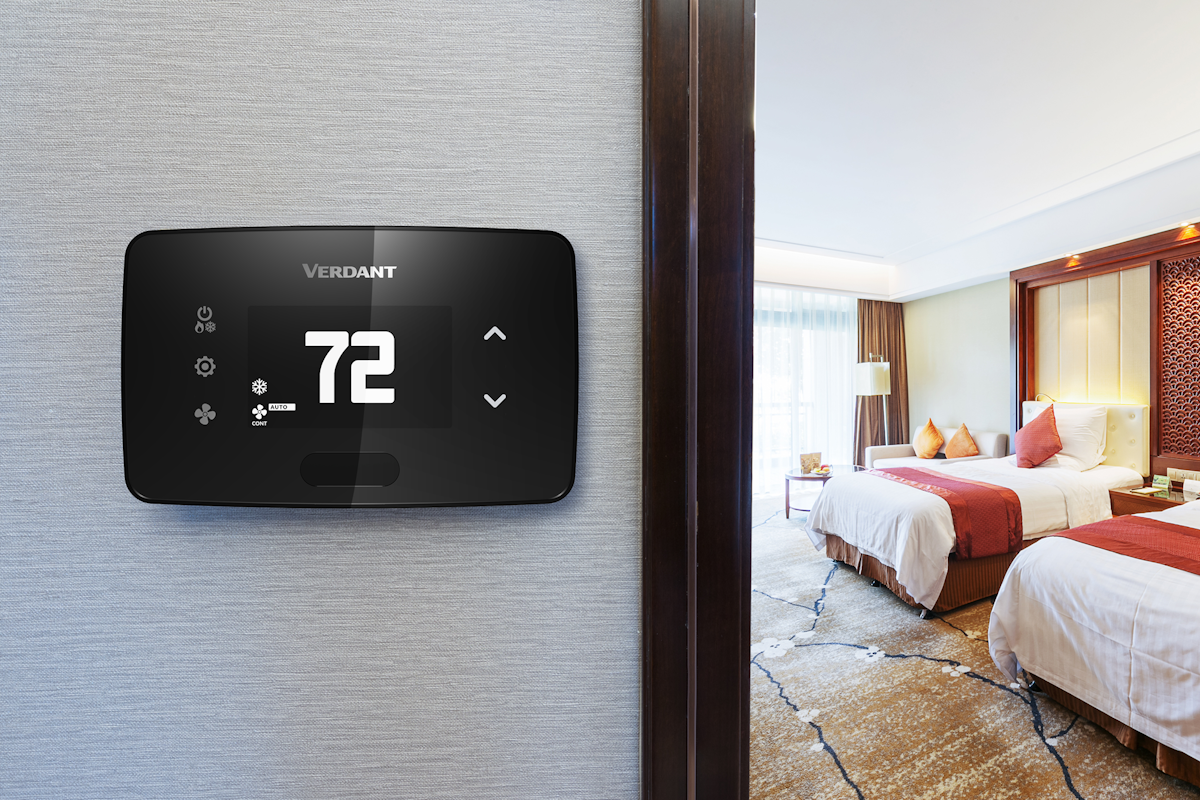
OPTIMIZATION: AI-enhanced solutions offer contractors new opportunities, such as providing value-added, digital services.(Courtesy of Copeland)
“This allows the thermostat to automatically fine-tune comfort settings for each room and person,” said Noueir. “In short, AI turns the thermostat into a learning system that delivers comfort in a more personalized and intuitive way.”
But the learning doesn’t stop at room-by-room adjustments. The same AI principles are now being applied at the system level, where thermostats interact with HVAC equipment and other devices in real time.
“AI allows thermostats to actively participate in a broader building system rather than just follow basic rules,” said Emma Falck, head of product at Siemens Smart Infrastructure Buildings.
Using real-time data — from occupancy to room conditions to outdoor temperatures — today’s integrated smart thermostats can optimize comfort and efficiency with minimal manual involvement.
“By optimizing heating and cooling, they are able to enhance both energy efficiency and user experience,” Falck said.
A More Complete Approach To Comfort
Comfort optimization for AI-driven thermostats goes far beyond just temperature.
Messenger pointed to Ecobee’s “Adjust for Humidity,” which uses the feels-like temperature to determine heating or cooling demand. Nest, meanwhile, analyzes natural heating and cooling patterns in the home — including sunlight exposure — and adjusts output accordingly.
“High humidity makes air feel warmer, so heating is reduced,” Messenger said. “Low humidity makes air feel cooler, so cooling is minimized. This not only improves comfort but also reduces energy use.”
Falck said there are many exciting use cases that leverage AI — one being adaptive room temperature control that works by continuously learning occupancy patterns and system behavior.
“This creates the basis for adjusting conditions through closed-loop optimization,” Falck said. “To deliver energy savings and improve room temperature performance, the control can be autonomously adapted.”
Copeland’s Verdant has recently directly integrated AI into its energy efficiency models. So, instead of relying on fixed assumptions about the weather, building, or HVAC performance, these thermostats continuously learn from real-time data — helping the thermostat to optimize heating and cooling cycles more efficiently, while reducing energy waste, all while keeping comfort levels consistent.
Predictive Maintenance And Smart Diagnostics
One of AI’s strongest advantages for contractors in the smart thermostat game is predictive maintenance. Predictive maintenance tools analyze historical and real-time data to spot performance changes early.
“This allows for preemptive service actions that reduce the risk of breakdowns and improve efficiency,” Falck said.
AI’s ability to identify irregularities earlier and more accurately than traditional models — alerting techs when the equipment starts to behave differently so they can address issues before they become costly failures — is especially important as HVAC systems grow more connected.
“AI will become the core of system optimization and diagnostics,” Noueir said. “As connected devices share more data, AI will be able to analyze far more information than humans could manage manually.” This will translate into continuous improvements in comfort, efficiency, and performance, as well as earlier issue detection, smarter recommendations for techs, and faster troubleshooting.
Smarter Integration
All in all, AI is and will continue to reshape how smart thermostats connect with equipment and other devices.
“An interesting application of AI technology is the integration and onboarding of buildings,” Falck said. “AI-driven onboarding can help connect and integrate smart systems and IoT devices faster, easier, and more accurately. This helps optimize the impact of every device across the complete building system.”
AI ultimately can make integration with whole HVAC systems or other equipment more intuitive.
“Traditionally, connecting a thermostat to an HVAC system or other smart devices required technical know-how and careful setup,” Noueir said. “AI can simplify that process by understanding user intent and even interpreting tone or phrasing, then translating those requests into the right HVAC actions.”
Instead of navigating through complicated menus, users can just describe what they want, and the system adjusts accordingly — resulting in a smoother experience for both homeowners and installers.
Contractor Workflow: More Complexity Upfront, Big Payoff After
For HVACR contractors, AI-driven thermostats demand a deeper understanding of system behavior, equipment interactions, and wireless networks.
Messenger said that these installations often require more time and expertise to install and configure.
A second challenge is underutilization.
“Many users aren’t aware of what their thermostat can actually do, or how to optimize settings,” Messenger said. “This has led to a growing trend: remote access for contractors, allowing professionals to monitor and adjust thermostat settings and HVAC performance.”
For contractors who do embrace it, AI can make their jobs easier. AI-enabled thermostats open new revenue and service opportunities, including energy optimization, predictive maintenance, and remote system oversight. Simplified commissioning and smarter diagnostics can help contractors work more efficiently and deliver stronger customer outcomes.
“Autonomous commissioning, simplified workflows, and more intuitive systems can significantly reduce time investments — both for deployment and for training,” Falck said.
With AI-driven diagnostics, technicians and contractors can arrive better prepared, reduce the number of callbacks, resolve and identify issues early, and support proactive maintenance.
“These advantages help build stronger trust and long-term satisfaction, turning routine service calls into a seamless customer experience,” Noueir said.
Misconceptions About AI
Despite AI’s growing momentum, some misconceptions remain. For starters, AI solutions aren’t just for new or large and complex buildings.
“On the contrary, there is value in deploying these solutions in all kinds of buildings: green- and brownfield, large and small, complex and simple,” Falck said.
Another misconception is that AI must be implemented across an entire facility or portfolio to be effective.
“In reality, AI can deliver value in many smaller ways, including individual tasks or systems for simple buildings,” Falck said.
Noueir said the biggest misconceptions facing AI is that it’s either limitless, or conversely, a marketing buzzword. When, in reality, while AI does have its limits, it excels in specific applications like pattern recognition, simplifying complex decision-making, and optimization.
“Many people don’t realize where AI brings real value,” Noueir said. “While it won’t replace proper HVAC design or installation, it can speed up setup, reduce configuration mistakes, and help systems fine-tune themselves intelligently. When people understand these strengths, they can set realistic expectations and appreciate how AI truly enhances performance.”
Looking Ahead
Fast forward five years, here’s what’s expected for AI and smart thermostats: hybrid optimization, forecasting, and autonomous operations.
Messenger expects hybrid optimization — automatic switching between heat pumps and gas furnaces (for cost-effective performance) – to become mainstream. He also sees thermostats using weather forecasts to anticipate comfort needs and utilities offering incentives for thermostats that reduce grid strain during peak times.
Falck expects AI to play a transformative role in how HVAC systems operate, and how users interact with them.
“Daily operational tasks will be increasingly handled autonomously by agentic-AI systems, freeing staff to focus on high-impact decisions and activities,” Falck said.
Additionally, interactions with operational systems will become more intuitive and flexible — allowing for simpler and faster decision-making.
“It also reduces the level of in-depth knowledge and training an operator needs to manage complex challenges,” Falck said.
Noueir said that AI can also play a role in addressing the shortage of skilled HVACR laborers.
“By improving diagnostic accuracy, providing guided service steps, and reducing trial-and-error troubleshooting — the result will be faster repairs, less downtime, and greater confidence for both homeowners and technicians,” Noueir said.
Looking for a reprint of this article?
From high-res PDFs to custom plaques, order your copy today!