The CO Detection Blind Spot: A Safety Risk — and an HVAC Service Opportunity
Traditional alarms aren’t enough — and contractors can play a key role in early CO protection

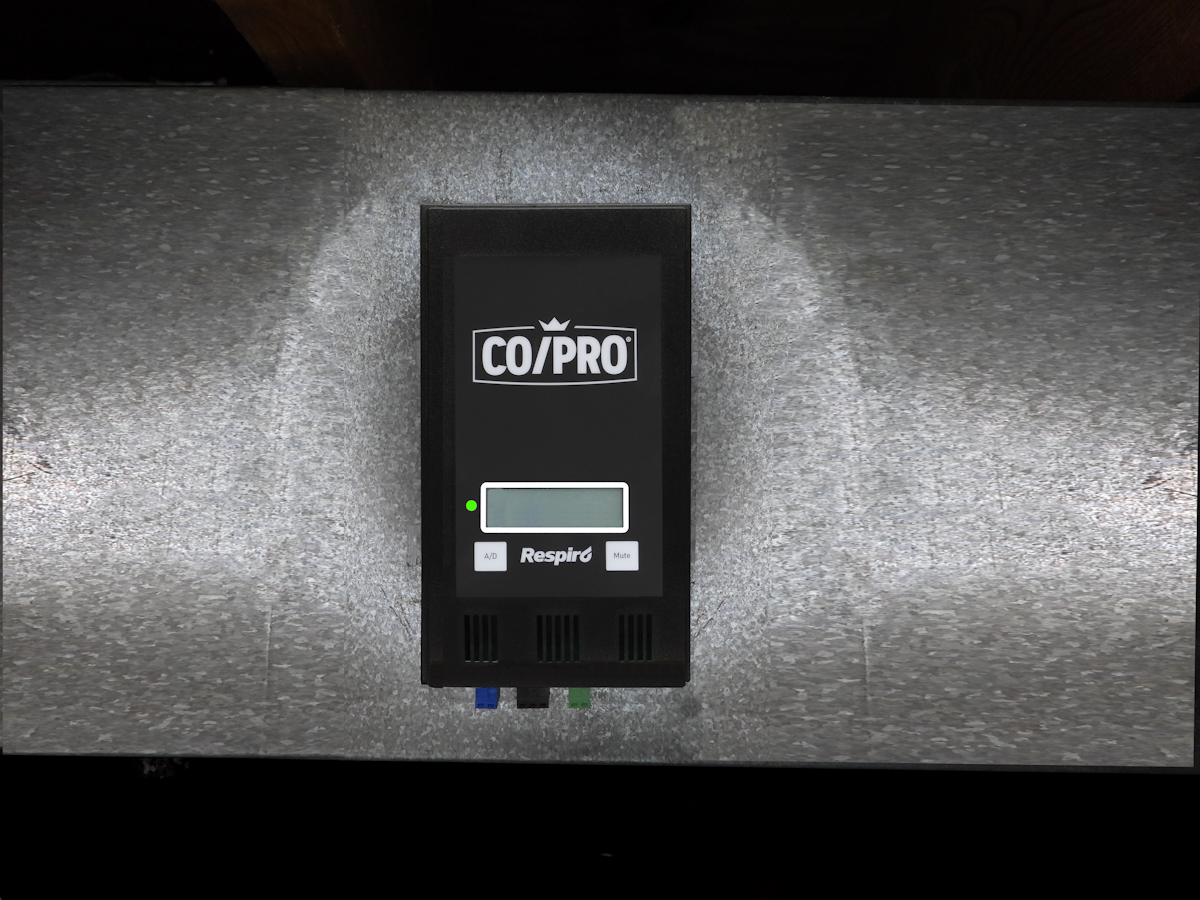
MELTING POINT: Built for high-heat environments, the CO/PRO is put on the equipment itself — placing detection at the point where carbon monoxide problems typically begin.
As furnaces, boilers, and water heaters across the country fire up for winter, proper carbon monoxide (CO) detection should be at the top of everyone’s mind. Yet it’s not.
That’s because for decades, homeowners have relied on battery-powered detectors to protect them — but what most people don’t realize is that traditional detectors are designed to alarm only after CO levels have already reached a dangerous threshold, often long after the gas has been lingering for hours.
As homes become tighter and indoor air quality (IAQ) expectations rise, HVACR contractors are in a unique position to bridge the gap between detection and prevention. By understanding how CO detectors work — and where they fall short — contractors can better educate customers, protect themselves from liability, offer add-ons that prevent hazards before they start, add a new potential stream of revenue, and strengthen trust in the process.
Where The Danger Starts
Here’s why this matters to HVACR contractors: The causes of CO leaks often begin in the same places technicians spend most of their time: furnaces, water heaters, and boilers.
OFFER IT: Contractors can offer appliance-mounted CO devices as an optional upgrade in service agreements, helping contractors enhance safety and increase trust.
“It comes down to products that burn fuel to produce heat,” said Mike Koch, co-founder and president of Respiro. “The exhaust gases that come off of furnaces, water heaters, boilers, they all go through a flue out the chimney — so if something goes wrong on the exhaust system … like a blockage … all that carbon monoxide comes back into the house.”
Now, a blockage from an animal wouldn’t make contractors liable, but a blockage isn’t the only way a CO leak can occur.
Chris Markel, owner of Royal American HVAC Inc., said other common issues are pipe deterioration and improper installation.
Looking for quick answers on air conditioning, heating and refrigeration topics? Try Ask ACHR NEWS, our new smart AI search tool. Ask ACHR NEWS
“Another common carbon monoxide source would come from a failed furnace heat exchanger that is dispersing CO directly into the home's or business's air supply,” Markel said. “It's always a risk when installing or servicing a piece of equipment because there is always the element of human error.”
When The Alarm Actually Sounds
Most people assume CO detectors work like smoke alarms, which leads to a widespread misunderstanding of how CO is actually measured.
Here’s why this is an issue: Most standard CO detectors don’t trigger an alarm until carbon monoxide levels reach 70 parts per million (ppm) — and even then, it can take one to four hours before the alarm sounds. To put that in perspective, firefighters are instructed to evacuate a building if CO readings reach 35 ppm.
“A typical CO detector is rated to go off at a much higher critical ppm for evacuation purposes,” Markel said. “So, a homeowner may not be aware that their equipment is producing low levels of CO, creating potential long-term health effects.”
While CO incidents are preventable, Koch said the real problem is education — or rather, the lack thereof. Both homeowners and technicians often misunderstand how CO detectors work and what they actually measure.
“The more we’ve talked with people in the industry, the more we realize how big of a gap in education there is,” Koch said. “Kids in school learn what to do if you catch on fire — stop, drop, and roll. But no one ever teaches any kid about carbon monoxide or what the alarms sound like. And because it’s invisible, odorless, and tasteless, it’s even more difficult to understand.”
Koch said he’s asked many people what they’d do if the alarm sounded, and most said they’d pull the batteries or unplug it, which immediately resets the detector back to 0 ppm.
CO levels also vary state-to-state, and there are no federal laws that enforce proper detection.
“What I’ve come to learn is that not all states are consistent, and not all require verification that there are working carbon monoxide detectors in the home,” Koch said. “It’s another gap, and people are unaware of the problems.”
From Detection To Monitoring
Though CO is one of the biggest threats HVACR contractors face on every job, many of them aren’t doing anything about it. Markel said he sees HVAC systems that haven’t been properly tested for CO all the time.
“In fact, most companies don't know how to properly examine a heat or even test for CO levels inside the home,” Markel said. “I think the time involved inhibits contractors from conducting combustion testing during a service call.”
Koch shared a similar sentiment and said that some contractors do just “churn and burn” — they just want to go in, sell the furnace, and get out.
“There’s just always going to be a group of people who are focused on making a quick sale and moving on,” Koch said.
That lack of understanding — among both homeowners and many technicians — is exactly what keeps CO risks from being addressed early. That gap also extends to how contractors view CO monitoring and the role it can play in their business.
“A lot of the initial contractors that we talked to said, ‘But people just go buy the $50 carbon monoxide detector from Home Depot.’ They’re right, but they don't get any piece of that. But this is something that has to be professionally installed because we're tying into the power system. … The contractors that get it, they understand the value it will deliver to them and the customers they serve,” Koch said.
To make early CO detection possible, Respiro developed a high-temperature-capable sensor that can be installed on the appliance. The CO/PRO uses a distributed system of smart shutoff switches that can automatically disable equipment when CO levels reach just 25 ppm — far below the 70 ppm threshold of traditional alarms.
Koch said their design required moving away from the traditional “centralized” approach — relying on a single hallway detector — and instead using distributed CO shut-off switches placed near the equipment itself, where CO problems begin.
“By shutting things off at the source, we're detecting much earlier than what a normal CO detector would,” Koch said.
Koch said to think of this type of monitoring like a technician who is there 24/7.
“The CO/PRO definitely takes part of the liability away from the contractor because it's an added level of protection for the customer,” Markel said. “I can tell that my customers feel a sense of relief that they don't need to worry about a CO issue in their home.”
How HVACR Contractors Offer CO Monitoring
HVACR contractors can incorporate shutoff switches into their business however they see fit: as part of new installs, as an upsell during maintenance calls, as part of broader IAQ packages, etc.
“They can offer it as a free add-on, they can offer it as a full add-on, or they can include it in the price of a service agreement,” Koch said. “If a customer signs up for a maintenance plan, the contractor can say, ‘Hey, we’ll include this for you.’ Or they can roll it into the cost of a new furnace, especially since most people are financing now. It’s just a few dollars more per month.”
Markel said they explain to customers that though modern-day heating equipment is reliable and safe when installed properly, there’s always that level of uncertainty — and a CO shutoff switch is just another level of protection for their family.
That’s the other critical piece of the puzzle for contractors: being able to explain it to their customers in a way they’ll understand the need for an extra layer of protection against CO.
Contractors should tailor their approach based on each customer’s situation — whether it’s a family with small children, elderly parents, or even pets left home alone.
“There are so many scenarios,” Koch said. “Contractors just need to be visually aware and go, ‘Here’s how we can help you.’ Because that’s what it’s about — preventing what’s preventable. Contractors are in the home, looking at the equipment that creates the risk. They’re in the perfect position to explain what these devices do, why traditional alarms aren’t enough, and how monitoring can prevent what’s preventable.”
Respiros Origin Story
Koch knows firsthand how dangerous the education gap in CO can be. Years ago, on a phone call with his late father, a military veteran with partial hearing loss, Koch noticed a noise in the background and discovered that the carbon monoxide alarm was going off — his father just couldn’t hear it. When his father had passed away, Koch took over his house. After a brutal Wisconsin winter, sometime in March, upon Koch’s return, he tried to use the faucet. The water was cold — which Koch expected. The pipes were cold. But the next morning, Koch went to take a shower: freezing cold water. That’s when he realized there was an issue with his water heater. Turns out, the issue was with the exhaust pipe — an animal had died in it. Koch said that’s when the technician told him it was a good thing he hadn’t come up earlier in the season. “He told me it was because since that winter had been particularly bad, the furnace would have been running the whole time — and since my furnace and water heater share the same exhaust pipe, the house would have been filling up with carbon monoxide,” Koch said. Needless to say, it could have been really bad. “That’s when we determined: Why are we waiting for things to get bad enough to the point where carbon monoxide has been filling up the house long enough for a CO detector’s alarm to go off, when we’ve been exposed to it the whole time?” Koch said. “Why aren’t we monitoring the sources?” That’s exactly what Koch and his business partner Frank Czekajlo, global sales and co-founder of Respiro, started to develop. It led to the creation of Respiro and the CO/PRO and now the CO/PRO 2. “We looked at all the different types of sensors in the marketplace — and when we looked at this problem, we realized that everything was developed for room-temperature operation,” Koch said. It makes sense for CO detectors in something like a living room, but less so if it’s installed on the appliance itself. “We realized we need to detect CO earlier, and so we decided to develop a high-temperature sensor that we could put directly on the appliances that create carbon monoxide.”
Looking for a reprint of this article?
From high-res PDFs to custom plaques, order your copy today!