FROSTlines
Common Troubleshooting Mistakes to Avoid
Identify the cause and correct course of action before starting the repair
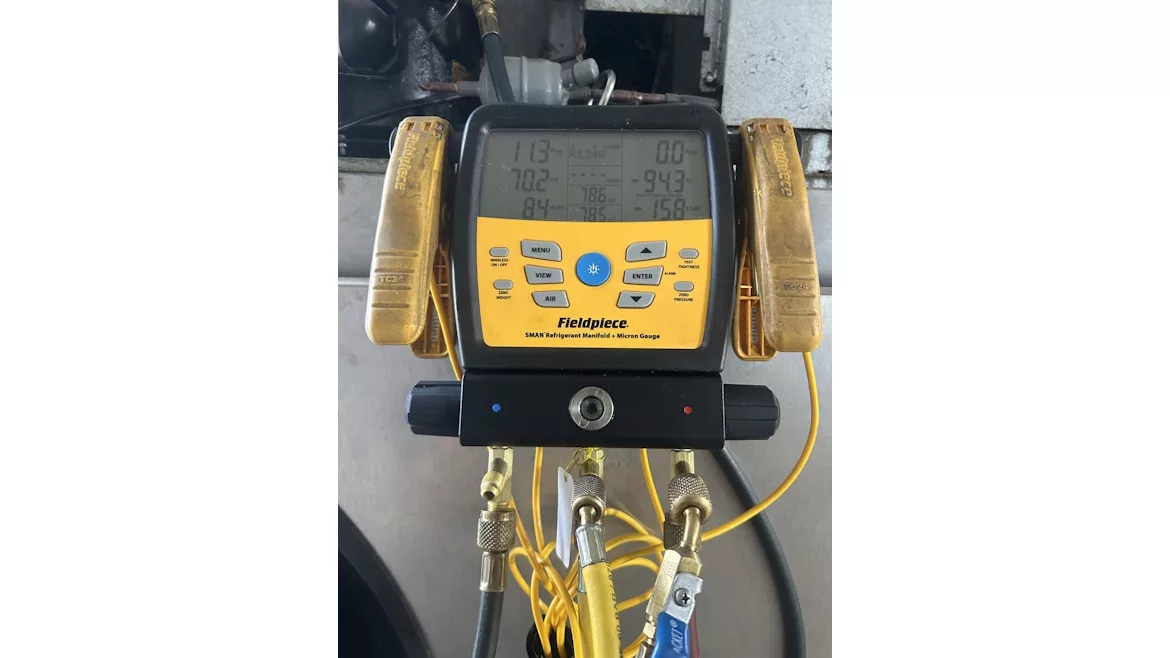
ONE-SIDED VIEW: A common mistake to avoid when troubleshooting a system is only looking at the operating pressure of one side of the system.
When troubleshooting a failed refrigeration system, it is important to correctly identify the cause of the failure and the correct course of action for its repair. Generally, this is not too challenging; however, sometimes our own mistakes make identifying the true cause more difficult. These mistakes can either be from a lack of experience or simply being too lazy and rushing to a false conclusion.
One common mistake to avoid is only looking at the operating pressure of one side of the system. Many times, technicians look at only the system’s low-side pressure and base their diagnosis on that pressure only. This can lead to a big mistake. You need to measure both low- and high-side pressures, as well as the evaporator’s superheat and condenser subcooling value, to really see how a system is performing. On most reach-in coolers and freezers, measuring the evaporator’s superheat and condenser subcooling is too difficult, but you still need to measure at least both low- and high-side pressures to get a clear picture of the issue. With larger systems, this should not be an issue.
Another common mistake to avoid is not looking at the condition of the evaporator coil and basing the cause of the issue on pressures only. An iced evaporator will generally cause a lower suction pressure, which can lead to a false conclusion that the system is low on charge. Always check the condition of the evaporator coil and de-ice it to measure the true operating pressures of a system.
On reach-in coolers and freezers utilizing a cap tube metering device, determining the difference between a low charge and a restricted cap tube can be tricky. One method of diagnosing the difference is to either blanket a static condenser or partially block a fan-cooled condenser. The increased head pressure will raise the liquid level of the evaporator in the restricted cap tube system, but if the system was short of gas, there would be little — if any — change.
When looking for refrigerant leaks with an electronic leak detector, always verify that the leak detector is working normally before using it to locate a leak. Some electronic leak detectors may have some type of indicator when they are not working properly, but others may not. So, it is best practice to test the leak detector before using it. We once had a technician spend three hours looking for a leak, only to realize later that his leak detector was not working.
Another mistake to avoid is not properly checking a single-phase compressor that fails to start and cycles on its overload. This could be caused by a locked-rotor compressor or a failed starting component, such as a start relay or capacitor. Always check the starting components before failing a compressor.
When using jumpers during the troubleshooting process, make sure they are securely attached to the terminal. If they were to “jump” off, they could go to ground and either trip a circuit breaker or cause some additional damage. One time, I had a jumper wire fall off the terminal and touch the capillary tube of a system. The electrical short burned a hole in the capillary tube. Not only did I need to fix the original problem, but I also had to change the capillary tube on the system.
When troubleshooting, avoid being lazy and making common mistakes. This will make you a better technician and a greater asset to your company.
Looking for quick answers on air conditioning, heating and refrigeration topics? Try Ask ACHR NEWS, our new smart AI search tool. Ask ACHR NEWS
Looking for a reprint of this article?
From high-res PDFs to custom plaques, order your copy today!