FROSTlines
Cold Storage Group Petitions EPA to Ease Refrigerant Limits
Opponents argue that changing the rule would undermine the AIM Act
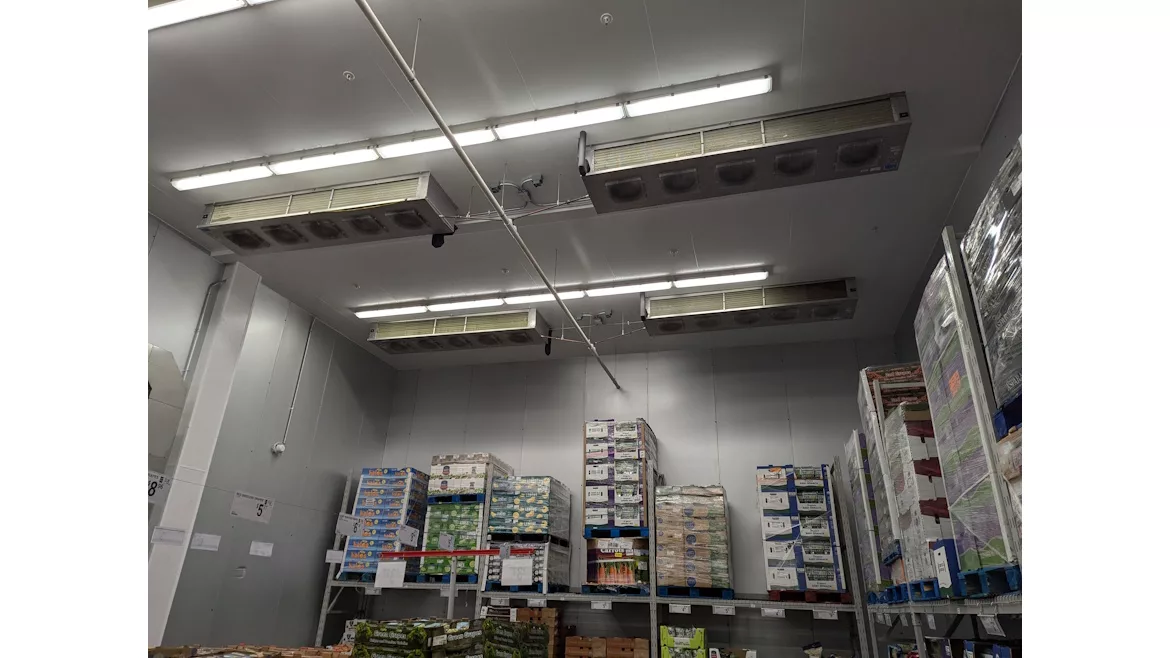
HIGHER GWP: A trade group is asking the EPA to raise the cold storage sector’s HFC limit from 150 GWP to 700 GWP.
The U.S. Environmental Protection Agency (EPA) is considering a petition from the Coalition for the Use of Safe and Efficient Refrigerants (CUSER), which is urging regulators to relax refrigerant restrictions for cold storage warehouses set to take effect next year. The group wants the EPA to raise the sector’s HFC limit from 150 GWP to 700 GWP, which would allow continued use of the A1 refrigerant R-513A (~630 GWP).
CUSER argues the petition is necessary because lower-GWP substitutes remain unavailable, prohibitively costly, and often blocked by building codes. Supporters agree, saying a rule change is necessary to keep food and pharmaceutical supply chains reliable and affordable. Critics counter that it would weaken the AIM Act’s Technology Transitions (TT) rule and undermine efforts to drive adoption of lower-GWP refrigerants. Comments closed August 1, with manufacturers and other industry stakeholders weighing in on both sides of the debate.
Supporting
Supporters of the petition argue that cold storage warehouses, which require thousands of pounds of refrigerant to maintain temperatures from -20°F to 55°F, should not be grouped with sectors subject to 150 GWP limits, such as household refrigerators, vending machines, and vehicle air conditioning. Instead, they contend these facilities are more comparable to data centers and industrial refrigeration, where higher GWP thresholds are already allowed.
Indeed, most cold storage facilities in the U.S. are large industrial facilities averaging over 100,000 cubic meters in size, said Sara Stickler, president and CEO of the Global Cold Chain Alliance (GCCA), in a letter to EPA. And many GCCA members already use ammonia, CO2, and halocarbon refrigerants, she said, in order to meet the critical cold storage needs in the U.S.
“GCCA members choose the refrigerant that best meets the unique needs of their facilities and customers,” she said. “In some cases, jurisdictions have overly restrictive policies against ammonia, making refrigerant options even more important. While GCCA does not align itself with the negative connotations about ammonia and CO2 included in the CUSER petition, GCCA agrees that the TT rule incorrectly placed cold storage in the inappropriate category. Cold storage warehouses are large industrial facilities, much more comparable to data centers, industrial process refrigeration, and very large air conditioning systems, all of which have been grouped for a 700 GWP limitation.”
Building on that concern, other industry groups also weighed in. In a separate letter to EPA, Stephanie Harris, chief regulatory officer and general counsel for the Food Industry Association (FMI), argued that EPA’s current TT regulations under the AIM Act threaten to restrict access to safe, nonflammable A1 refrigerants starting in 2026, only months away.
“This not only impacts America’s access to fresh food, but also many thousands of jobs created by the cold chain,” she said. “Losing access to low-GWP HFCs and blends currently used in cold storage systems would be highly disruptive. At the same time, EPA should not force the cold storage sector to go backwards to older refrigerants that the industry has been moving away from because of safety concerns. EPA should also not force the sector into refrigerants such as flammable HFO chemicals or CO2 systems that have proven to be unreliable at the scale of cold storage warehouse systems. Although EPA predicted that alternative refrigerants would be available by 2026, that has not been the reality in the market.”
Looking for quick answers on air conditioning, heating and refrigeration topics? Try Ask ACHR NEWS, our new smart AI search tool. Ask ACHR NEWS
Opposing
Opponents argue that the petition would undermine the AIM Act’s goals, noting that natural refrigerants like ammonia and CO₂ are already commercially available and widely used in cold storage facilities. They contend these systems are safe, efficient, and capable of meeting cold storage needs, and from their perspective, the existing 150 GWP limit is both achievable and appropriate.
In a letter to EPA, the International Institute of All-Natural Refrigeration (IIAR) argued the petition caters to narrow industry interests while disregarding proven technologies already in use. Gary Schrift, president of IIAR, pointed out that natural refrigerants such as ammonia and CO₂ are already widely available and supported by established equipment and safety standards. In IIAR’s view, raising the GWP limit would slow progress and unnecessarily extend reliance on synthetic refrigerants.
“Ammonia and CO₂ systems are not ‘alternative’ technologies — they are the current industry standard,” said Schrift. “The infrastructure of manufacturers, design firms, contractors, and educational institutions supporting natural refrigerants is mature and robust. These systems are cost-effective, energy-efficient, and readily available for immediate implementation.”
He added that the timeline established by the AIM Act for HFC reduction is achievable because of the well-established history of using natural refrigerants, especially in cold storage facilities.
“Current natural refrigeration systems can easily meet the phase-down schedule proposed by EPA, particularly for cold storage applications where they are already in active, majority, and expanding use,” said Schrift. “The cold storage sector does not require a relaxation of the 150 GWP limit. Natural refrigerants are already in widespread use, supported by decades of experience and infrastructure. The EPA’s current ruling aligns with both industry reality and public safety.”
Hillphoenix, a refrigeration equipment manufacturer and subsidiary of Dover Food Retail (DFR), also opposed the petition, pointing out that many low-GWP (<150) options are already available, including ammonia, CO₂, and newer A2L refrigerants. The company specifically pushed back against CUSER’s negative characterization of CO₂ systems.
“There are many false claims and accusations regarding the use of CO2 as a refrigerant by those who are in opposition to its use in both industrial and commercial applications due to the lack of understanding of how to size, select, and control CO2 systems and components,” wrote Paul Sindoni, president of DFR.
He noted that CO₂ has very different thermophysical properties than CFC, HCFC, and HFC refrigerants, which — when properly engineered — can improve efficiency. “When these design characteristics are incorporated by engineers skilled in CO2 system selection and operation, the resulting annual energy consumption can be lower than that of traditional synthetic refrigeration systems in cooler climates and can be on par with traditional systems in warmer climates,” said Sindoni.
TT Rule
The comments weren’t limited to cold storage refrigerants — several stakeholders weighed in on the TT rule as a whole. For example, the National Grocers Association (NGA), a trade group representing independent grocery retailers and their wholesalers, urged EPA to scrap the rule entirely and start over.
“We ask that you roll back the TT rule and issue a new rulemaking with a revised GWP limit for retail refrigeration, extended compliance timeframe for all retail refrigeration sectors to 2032, and a formal mechanism by which individual users could seek extensions of specific sub-sector compliance timeframes,” wrote Max Wengroff, senior manager of government relations at NGA.
He added that replacing supermarket refrigeration systems can cost over $1 million per store and often requires shutting down the entire facility, since it is illegal to retrofit HFC systems with CO₂ or propane. In addition to the costs associated with replacing the systems, he expressed concern that parts availability has not reached that of traditional HFC system parts and likely will not for several years.
“Not only does this make it more expensive to install and maintain non-HFC systems, but it also means that stores will have to wait an extended period to repair their refrigeration systems,” said Wengroff. “There is [also] a dearth of technicians qualified to work on these [newer] systems. While stores in major metro areas may be able to find repair technicians in their areas, stores in rural areas will be forced to pay technicians to travel several hours to service their systems.”
EPA administrator Lee Zeldin seemed to echo some of these concerns in a recent post on X, noting that the TT rule phased out certain HFCs in refrigeration, air conditioning, and heat pumps in a “frantic and rushed transition.”
“In turn, commercial costs at the grocery store went up, while residential access to affordable AC units, supplies, and maintenance became more difficult for the American people,” he tweeted. “The Trump EPA is now fixing it! Our formal proposal, about to be released, is focused on preserving access to affordable refrigerants and HVAC [systems] by allowing companies to continue installing systems that have already been manufactured or imported into the U.S., while not forcing Americans to replace their whole HVAC system when only part of it needs to be replaced. Common sense for the win again!”
According to some industry groups, significantly changing the rule would be a grave mistake. In a joint letter to EPA, the Air-Conditioning, Heating, and Refrigeration Institute (AHRI), the Alliance for Responsible Atmospheric Policy (Alliance), the Heating, Air-conditioning & Refrigeration Distributors International (HARDI), and the Plumbing-Heating-Cooling Contractors–National Association (PHCC) urged EPA to maintain the TT rule as finalized, stating:
“The rule provides a clear, enforceable structure that rewards domestic production and long-term investment, rather than speculative delay or dependency on foreign-based supply. It supports industrial reinvestment without distortion, aligns environmental goals with American economic interests, and preserves regulatory consistency vital to capital-intensive sectors. We welcome continued engagement with EPA and stakeholders to ensure implementation remains focused on domestic capacity, market integrity, and rule-of-law predictability.”
Since this article was posted, the Environmental Protection Agency (EPA) issued a proposed rule that addresses the concerns raised by CUSER. If finalized, the proposed rule will, among other things, raise the GWP threshold for cold storage warehouses from 150 or 300 to 700 starting January 1, 2026, followed by a GWP limit of 150 or 300 starting in 2032. The proposed rule will be open for a 45-day public comment period after publication in the Federal Register at www.regulations.gov, docket number EPA-HQ-OAR-2025-0005.
Looking for a reprint of this article?
From high-res PDFs to custom plaques, order your copy today!