FROSTlines
Clearing Up Misconceptions About A2L Refrigerants
Understanding how these new alternatives work is essential for technicians and contractors
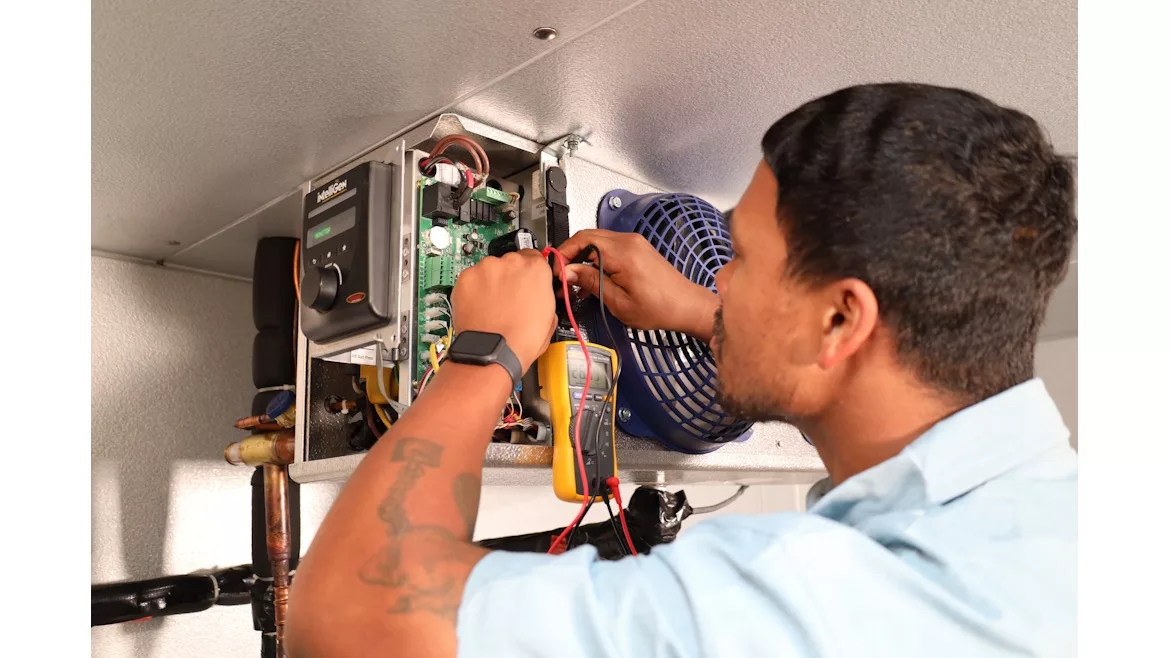
NEW TECHNOLOGY: Some of the new refrigeration equipment now available uses A2L refrigerants.
As the HVACR industry enters a new chapter with the adoption of mildly flammable (A2L) refrigerants, it’s more important than ever to separate fact from fiction. A2Ls are already being widely used in air conditioning and refrigeration applications, and understanding how they work is essential for technicians, contractors, and building owners alike.
Classifications
Refrigerants are classified by toxicity and flammability. Class A refrigerants are considered non-toxic, while Class B refrigerants are toxic. Flammability is broken into three levels with one subclass.
Class 1 refrigerants do not propagate flame and are considered nonflammable. Class 2 refrigerants have low flammability, while a subclass of that group — Class 2L refrigerants — are considered mildly flammable. These 2L refrigerants will not burn without an ignition source and will self-extinguish when that source is removed. Class 3 refrigerants are highly flammable and have strict charge limitations.
An A1 refrigerant is both non-toxic and nonflammable, while a B1 refrigerant is toxic but nonflammable. Historically, most systems used A1 refrigerants (e.g., R-410A, R-404A), which didn’t require leak detection in typical installations. However, any refrigerant can displace oxygen in a confined space and become hazardous at certain concentrations.
While refrigerant detection systems (RDS) have long been used in mechanical rooms and large systems, these systems are now becoming standard even in smaller applications using A2L refrigerants. As a result, leak detection is no longer optional, it’s part of the equipment package.
It is also important to understand that an existing A1 system cannot be retrofitted to use A2L refrigerants, and there are no drop-in options. That said, service parts like coils, compressors, and valves will remain available for legacy systems. This makes the decision to repair or replace more nuanced, factoring in cost, system age, and expected lifespan.
Common Misconceptions
A common misconception when replacing a split system with an A2L-compatible outdoor unit and coil is that the furnace must also be replaced. That is not true. The existing furnace can remain, but a compatible OEM leak detection kit must be installed. The sensor will likely be factory-installed in the new coil, and the RDS must be wired to shut down the furnace in the event of a leak.
Looking for quick answers on air conditioning, heating and refrigeration topics? Try Ask ACHR NEWS, our new smart AI search tool. Ask ACHR NEWS
Walk-in coolers and freezers using A2L refrigerants also require leak detection due to their enclosed nature. Safety requirements depend on the type and volume of refrigerant, the size of the space, and the mitigation zone classification. ASHRAE Standards 15 and 34 provide the formulas and tables for determining allowable charge limits and necessary safety measures.
Mitigation zones are categorized as follows:
- Zone 0 requires no action, as the refrigerant volume is minimal;
- Zone 1 indicates the enclosure volume is sufficient to safely contain the refrigerant;
- Zone 2, the circulation zone, requires that fans remain operational during a leak or sensor failure;
- Zone 3, the ventilation zone, requires exhaust fans and fresh air intakes. Fan capacity and airflow must be properly calculated; and
- Zone 4 is not permitted, as the refrigerant volume exceeds the allowable limit for the space.
Always consult the manufacturer’s guidelines and the appropriate ASHRAE standards for the specific application.
Another misconception is that A2L systems require more maintenance, but in reality, all refrigeration systems need regular servicing to operate efficiently. A2Ls function just like legacy refrigerants, and each refrigerant has its own pressure-temperature relationship — nothing new there.
A2L refrigerants do not degrade over time and do not need to be replaced unless there’s a significant leak. In systems using blended refrigerants with high glide, it’s best to recharge with fresh refrigerant after a major leak to ensure proper composition and performance.
Facing Change
There’s been a lot of noise around A2L refrigerants — claims that they’re inefficient, unstable, expensive, or unsafe. Let’s be clear: They are not explosive under normal conditions, and when handled properly, they are no more dangerous than many substances technicians already work with every day. What matters most is education and training.
And while new tools, such as recovery machines and tanks designed for A2Ls, are part of the transition, the core skills remain the same. Technicians have always been resourceful and creative, solving problems in the field under pressure — whether it’s traffic, weather, long hours, or refrigerant shortages.
This isn’t the first time our industry has faced change. From the R-22 phaseout to the rise of digital controls, we’ve adapted before, and we’ll do it again. Yes, new technology can be expensive, but not keeping up with it can be even more costly. This industry has always risen to meet the challenge, and we’ll do it again.
Looking for a reprint of this article?
From high-res PDFs to custom plaques, order your copy today!