How Commercial Buildings Can Deal with Wildfire Smoke
There are three key strategies to addressing smoke from wildfires and controlled burns
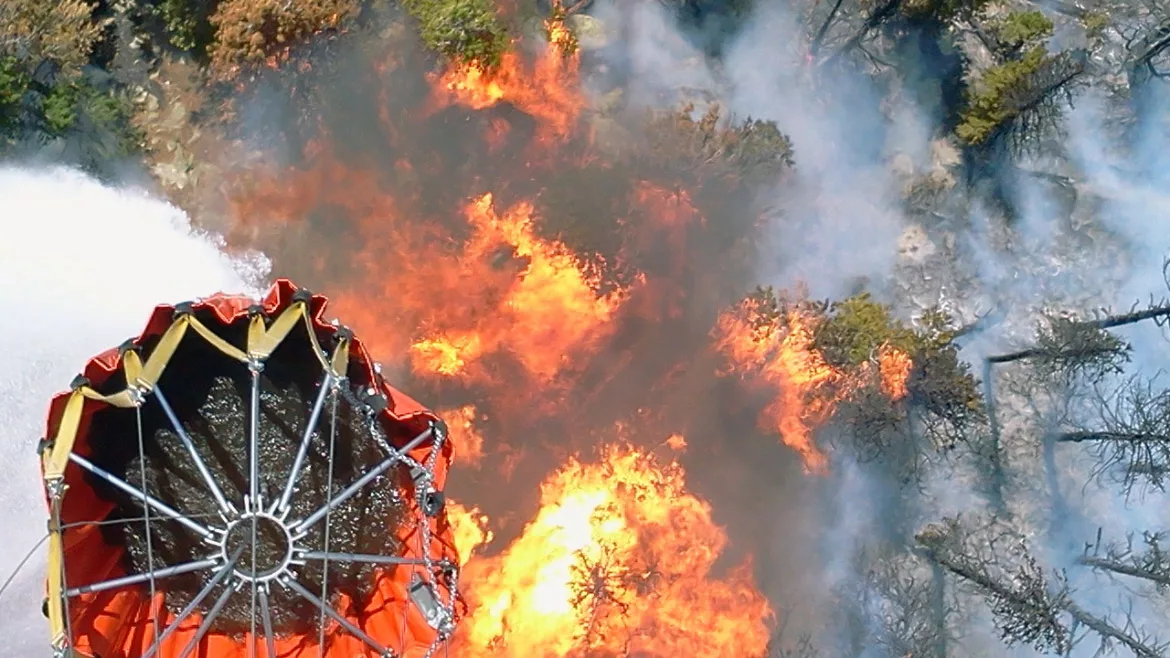
FOREST MANAGEMENT: A lack of water and high wind speeds has created the costliest blaze in U.S. history. (Courtesy of the National Guard)
With high wind speeds and lack of water impeding firefighters in Southern California as they combat historic wildfire destruction, the state's approach to the first line of defense – forest management and fire prevention – has come under renewed scrutiny.
Total direct damage from the wildfires could amount to between $135 billion to $150 billion, making this likely the costliest blaze in U.S. history. The risk of such an event even led insurers to cancel home insurance policies months ahead of wildfire season. While they are more challenging to measure, the health costs of the fires and smoke will be much, much larger.
While the state has doubled the number of acres it treated for wildfire prevention since 2021 to 700,000 acres in 2023, this is a drop in the bucket compared to the more than 2 million acres that have now been burned in the current wildfire season.
As the current crisis unfolds, the focus has shifted to protecting buildings and their occupants from smoke and fire damage.
Spurred into action by increasingly common devastating wildfires, ASHRAE began developing new guidelines for protecting building occupants from smoke. L.A.-based Mike Gallagher, P.E., fASHRAE and president of Western Allied Corporation, recalls the urgency.
"We coincidentally started work in 2020,” he said. “Los Angeles was one of the cities where the fires hit hard. We started off on the normal path that you follow to develop a guideline. But just a couple of months into the process ... we got hit with these fires, and it was decided by ASHRAE leadership that we should divert our efforts to coming up with guidance, instead of going through the full guideline route."
The result of this accelerated effort was first published as interim guidance on ASHRAE's website. After several more years of development and peer review, it evolved into the comprehensive ASHRAE Guideline 44-2024, Protecting Building Occupants From Smoke During Wildfire and Prescribed Burn Events, released in December — just weeks before the current devastation.
Looking for quick answers on air conditioning, heating and refrigeration topics? Try Ask ACHR NEWS, our new smart AI search tool. Ask ACHR NEWS
The guideline specifically targets a range of facilities, from commercial and institutional buildings to multi-unit residential complexes, with special consideration for highly susceptible populations such as children and the elderly. It provides detailed recommendations for both new construction and retrofits, covering everything from building envelope design to ventilation systems and air-cleaning technologies.
"This guideline is an interesting mix of health science and engineering," Gallagher explained, noting its exhaustive human health component makes it unique to other more mechanically focused guidelines.
Joining Gallagher on ASHRAE’s Guideline 44-2024 committee is Sarah Henderson, scientific director of Environmental Health Services at the BC Centre for Disease Control, who has been studying the health effects of wildfire smoke for more than 20 years. She was one of Canada’s representatives on the committee, a country racked by wildfires in 2023 – resulting in poor air quality throughout Canada and downwind in the U.S.
"The past few years have been indicative of what we can expect in the future," Henderson noted, reflecting on Canada's recent wildfire experiences. Importantly, she points out that while there's guidance from various agencies like Health Canada on creating cleaner indoor air spaces, "there isn't anything this technical from any of our agencies so far. Canada and many other countries often wait for ASHRAE to take leadership."
Henderson emphasized that this guideline is distinctive in its approach, considering both short-term and potential long-term effects. And with provisions for susceptible populations, like children in school and people in hospitals.

WILDFIRES: Wildfires have been a common site in America between the Maui disaster in September 2023 and Canada’s 2024 wildfires. (Courtesy of U.S. Customs and Border Protection)
The guideline's core focus, according to Henderson, is fundamentally about one critical question: "How do you take a building and try to make it as smoke-free as possible inside when it's smoky outside?" She and Gallagher stress that this is a building-by-building challenge, dependent on each structure's unique operational characteristics and envelope design.
"Every building is almost like a person," Henderson explained, "unique in its personality and operational characteristics.”
Manage Outside Air During Smoke Events
The fundamental strategy during wildfire events focuses on management of outdoor air. As Gallagher puts it: "The goal during a wildfire event where you've got a lot of smoke in the air, is to have the absolute least amount of outside air coming into the building you can get away with and still be pressurized in that building."
This pressurization is crucial because, as he explains, "if you're pressurized inside the building, then you're not going to get smoke infiltration at the doors and the windows and every little crack."
For buildings with Dedicated Outdoor Air Systems (DOAS units), the process becomes more manageable.
"If you can concentrate outside air intakes at fewer locations in your design," Gallagher noted, "it would make filtering much easier. If you've got a system that's got DOAS units, then you're already doing that. So that's great, but most systems don't have DOAS units.”
For larger facilities like hospitals with sophisticated digital systems, monitoring and adjustment are straightforward.
"If this was a hospital or a big commercial building with a direct digital system and a bunch of air handling units, it's pretty easy to do a lot of this automatically, because you probably are measuring air flow ... you probably are even monitoring building pressure,” Gallagher said. “But if you're like 80% of the commercial space in the U.S., you're being served by unitary equipment. You have got to go check it.”
What does this look like in practice?
"You're going to need two people, each with a cell phone," Gallagher explained. “One person manages the outside air damper position, while the other verifies building pressure at entry points, ensuring smoke doesn't infiltrate.”
Economizer Strategies for Wildfire Smoke Mitigation
For clients concerned about wildfires, Gallagher emphasized a critical design consideration: economizer optimization. Traditional economizers typically have two positions – minimum outside air for ventilation and a fully open position for cooling.
"Ideally, you would want economizers with a minimum outside air position setting that could be set specifically for smoke events and automatically triggered when needed," he explained. The challenge is that "almost none of the existing economizers in the current inventory have this capability."
He said not to let the perfect be the enemy of the good, and for building managers to involve HVAC contractors in preparing a smoke readiness plan for exactly positioning dampers manually in the event of heavy smoke.
“They're going to have to determine what damper settings are necessary for that minimum amount of outside air that will maintain positive pressure. They're going to have to mark them in some way so that two years from now, when you have the fire, you can find the markings,” Gallagher said.
Make a Smoke Readiness Plan
Gallagher emphasized that the most important element of any building’s smoke readiness plan is to inventory air filters for all occupancy scenarios, as stores sell out quickly. While building managers can plan around extra filters during controlled burns, wildfires like the ones raging in Southern California right now are much less predictable.
.jpg)
PALISADES: Wildfires have spread from the Palisades across southern California. (Courtesy of Wanmei Liang, NASA Earth Observatory and the European Space Agency)
"As soon as it gets smoky in the air, there are no filters available to buy," Gallagher warned. Filters typically last only one to three days during a smoke event before becoming so full they begin to collapse. The guidelines recommend upgrading to MERV 13 filters during smoke events and planning for rapid replacement.
“MERV 13's are a lot more efficient than MERV 10s. They catch a lot more crud. But as a result, they don't last as long. So, the tradeoff is that you have to store more filters on site,” Gallagher said, adding that electrostatically charged HVAC filters have proven to be effective at catching more particulate matter than standard filters as well.
Hospitals are a unique situation, as they require high air change out rates compared to other public facilities, and are also open constantly to serve people who are sick at all hours.
“What we’ve learned from recent wildfire events is that hospitals need to look not just at their HVAC filters, but at all the filters in the facility and have a good stock for replacement,” noted ASHRAE’s Guideline 44-2024 committee member Abdel Darwich, PE, principal and director of quality assurance at Guttmann and Blaevoet.
“We have seen hospitals that had their NICU Incubators filters clogged, putting premature newborns with not fully developed lungs at risk form wildfire smoke,” Darwich added. “In addition, some hospitals saw their medical air intake filters completely blocked, thus stopping the medical air to all their instruments, including surgical ones.”
For buildings with more advanced systems, supplemental HEPA-style air cleaners can provide additional protection, taking pressure off the mechanical filters in the same way managing outside air and the building’s negative pressure optimally can. Henderson also recommends using air sensing technology to measure the effectiveness of a building’s smoke readiness plan.
“You can get a pretty good internet connected monitor for fine particulate matter, which is the primary pollutant in wildfire smoke, for $200 bucks. You get a great one for $1000 bucks. There's no reason not to have something like that inside of your building to understand how your management plan is working and what the exposures are,” Henderson concluded.
Post-event recovery is equally important. Once smoke clears, buildings should focus on flushing indoor spaces with clean air and using carbon-impregnated filters to mitigate lingering odors.
ASHRAE is providing free public access to a read only version of the new ASHRAE Guideline 44-2024, Protecting Building Occupants From Smoke During Wildfire and Prescribed Burn Events, available until Feb. 11, 2025. To purchase Guideline 44-2024 visit ashrae.org/bookstore.
Looking for a reprint of this article?
From high-res PDFs to custom plaques, order your copy today!