The Rise, Fall, and Resurrection of R-744

CO2 refrigeration’s rise, fall, and resurrection is a fascinating tale of chutes and ladders.
In the late 1880s, CO2 refrigeration (R-744) emerged as a solution in marine and industrial refrigeration systems. In the early 1900s, R-744 was built into air conditioning systems. Through the 1920s, CO2 systems were paired with new innovations, such as fin coils, and began appearing in restaurants, hotels, hospitals, and many other applications. Using duplex compressors, department stores began installing horizontal CO2 machines of up to 300 tons in size.
Following World War I, CO2 was phased out, replaced by chlorofluorocarbons (CFCs), which were widely recognized as “safer” options at the time due to the “toxic compounds” that accompanied R-744.
In the mid-1970s, regulations were explored to limit the use of hydrofluorocarbons (HFCs) due to their environmental impact. In 1987, the Montreal Protocol was enacted, and, CFC bans began to take effect. Officially, in 2010, the Montreal Protocol enacted a global ban on CFCs.
In response, R-744 — boasting an ozone-depleting potential (ODP) of zero and a global warming potential (GWP) of 1 — was ironically reintroduced as an environmentally safer alternative. Since then, the refrigerant has gained a foothold in Europe. Per industry data, more than 57,000 CO₂ refrigeration systems have been installed there. On the flip side, the U.S. is just getting up to speed, as fewer than 1,150 systems have been installed domestically.
CO2 Refrigeration Systems
The escalating demand for sustainable, energy-efficient, and environmentally conscious cooling technologies presents a compelling business case for CO2 refrigeration. And U.S. businesses are taking notice. According to the North American Sustainable Refrigeration Council (NASRC), the demand for R-744 is projected to reach 13 million pounds by 2027, up from 3 million pounds in 2023.
Today, modern CO2 refrigerant systems come in various configurations. Some of the most common include:
Transcritical systems operate above the critical point of CO2, meaning there is no phase change during the cooling process. These high-pressure, high-discharge temperature systems are commonly specified in supermarket or ice rink applications. Transcritical systems with heat recovery offer additional efficiency benefits.
Looking for quick answers on air conditioning, heating and refrigeration topics? Try Ask ACHR NEWS, our new smart AI search tool. Ask ACHR NEWS
CO2 scroll compressors are widely known for their low vibration, low noise, longevity, and reliability. These units are widely used in small and medium-sized cooling capacity applications.
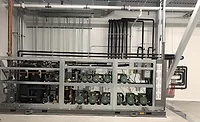
CO2 booster systems solely use CO2 refrigeration. Using high-pressure control valves, condensers, and high-pressure copper piping, these units have incorporated components designed to help overcome some of the pressure challenges that commonly plague CO2 refrigeration systems.
Contractors Roll with the Changes
Travis Kisner is no rookie when it comes to CO2 refrigeration, having completed his first CO2 refrigeration project in 1991. For the next seven years, he exclusively worked with R-744. One of his primary tasks was providing refrigeration services to North Africa. And, believe it or not, resources were scare on the Arabian Peninsula.
“I’ve been working on CO2 pretty much my whole life,” said Kisner, who currently serves as the regional services sales director for Jax Refrigeration Inc. “When I was first getting started, the CO2 we used was rarely pure. We bought it in bottles and were forced to stabilize it with helium, which would require an entire drain. It was quite unpleasant.”
Over time, technological and manufacturing advancements continued to drive CO2 refrigeration systems’ performance and availability.
“CO2 systems have really come a long way in a short time,” Kisner said. “The quality of the CO2 has drastically improved, and you can actually get it — back when I first started, it was incredibly difficult to find.”
Estes Refrigeration Inc., a Richmond, California-based family-owned company that’s been in business since 1953, completed its first R-744 project in 2012. Today, the company specializes in cold rooms and commercial/industrial freezers, which often specify CO2 refrigeration.
In the early 2010s, one of Estes’ largest customers issued a directive requiring all HVAC projects to utilize refrigerants with a GWP of 10 or lower.
“This severely limited our options to hydrocarbons [HCs], CO2, and ammonia,” said Mark Doninelli, vice president, Estes Refrigeration. “Since 2012, we’ve completed 50-plus CO2 projects. We feel CO2 is a wonderful option for our customers.”
Doninelli said the systems are unique in their nature and performance.
“These are not your standard refrigeration diagrams – there’s a lot more sophistication to them,” he said. “You can’t use TXVs [thermostatic expansion valves]; you have to EXVs [electronic expansion valves]. Also, for air-cooled units or transcritical equipment, you have to use a flash tank, which essentially keeps the CO2 cool. As pressure builds, you bleed it back down the suction line.”
Despite their complexity, Doninelli credits the HVAC manufacturers for their drive to create equipment that’s easier to operate, maintain, and service.
“The systems have gotten better and better, and the gas is now more widespread and affordable,” he continued. “There are more options on the market, and it’s becoming a much more appealing and desirable option for end users.”
Evan Aschow, lead engineer, Effecterra, has 15 years of experience in the CO2 refrigeration industry. Over time, his knowledge base has matured in step with the equipment.
In the early stages, prior to the adoption of transcritical CO2, the industry approach involved maintaining the refrigerant in a subcritical state and circulating it throughout the store – a process that has changed over time, he said.
“Challenges surfaced as the CO2 pressures fluctuated widely, a phenomenon we initially perceived as ‘normal’ due to its broader temperature-pressure relationship compared to synthetic chemical refrigerants,” said Aschow. “It was only through subsequent experience with various control systems employing CO2 in DX systems that we realized it had the potential for stability that was on par with conventional refrigerants.”
At Effecterra, Aschow is tasked with providing optimal component selections and precise programming and tuning of control systems. Whenever applicable, Aschow seeks to incorporate R-744. Of course, his customers’ experience and knowledge remain a significant factor.
“CO2 systems necessitate a comprehensive understanding of the system before any intervention occurs,” he said. “A robust and uncluttered control network is imperative, as the immediate shutdown of evaporators during emergencies aids in maintaining lower pressures, thereby extending the time before a pressure relief event. Additionally, a nuanced understanding of refrigerant characteristics, including solubility, booster architecture, and flash gas dynamics, is pivotal. This comprehension, coupled with considerations of proper superheat, oil management, and compressor stabilization, collectively contributes to ensuring the longevity of a CO2 system.”
While his team has only completed a handful of CO2 refrigeration projects, Adam Dykstra, refrigeration operations manager at DeTroye Electric Service in Oostburg, Wisconsin, is excited about the refrigerant’s performance and potential.
“Some of the stuff these systems can do with superheat is vitally important,” said Dykstra. “We’ve come to appreciate CO₂ systems and the numerous benefits they offer — they’re smaller, and the cost of ownership tends to be lower. Additionally, there currently are no maintenance regulations. While ammonia systems require specific preventive maintenance and quarterly reports, those requirements don’t exist with CO₂.”
An Uptick in Production
Per Grand View Research, the North American CO2 refrigeration market is expected to grow at a compound annual growth rate (CAGR) of 19.3% through 2027. As a result, many U.S. manufacturers are expanding their production of CO2 equipment.
Copeland, for example, recently launched its first Vilter-branded industrial CO2 compressor unit, which uses single-screw compressors for transcritical and/or subcritical applications (or both).
Vilter’s subcritical CO2 compressor line, designed for the low side of a CO2 transcritical or cascade system, is available in 11 displacements with a power range of 100-900 horsepower per compressor.
“Copeland’s commercial CO2 expertise provides the unmatched experience needed to meet the rigors of high-pressure industrial CO2 compression,” said Michael Gersmeyer, senior product manager, Vilter for Copeland. “The unique Vilter single-screw compressor design is ideal for handling the high pressures seen in CO2 transcritical operation.”
Conclusion
As CO2 systems continue to evolve, they will undoubtedly play a significant role in the refrigerant landscape.
This impact is already on display in many supermarket applications, where commercial refrigeration systems account for approximately 40% of the energy consumption. The recently released 2024 U.S. Supermarket Scorecard provides a progress report across 16 popular chains, grading the performance of their refrigeration systems’ environmental impact.
Additionally, CO2 took center stage at the 2022 Beijing Olympics, where organizers stated its use offset the equivalent of 3,900 automobiles (or the planting of 1.2 million trees).
“At some point, we all have to recognize that the climate is changing,” said Doninelli. “We can’t continue to pollute the environment in which we live. So, until something else better is developed CO2 refrigeration is going to be the best refrigeration choice in most cooling applications.”
Looking for a reprint of this article?
From high-res PDFs to custom plaques, order your copy today!