Aiding High Humidity Levels With a Secondary Dehumidification System
Without proper dehumidification, there is no comfort
One of the most important aspects of an HVAC contractor’s job is providing exceptional comfort to their homeowners. For contractors in humid climates, a lot of that comfort is provided by controlling humidity levels, which can be aided by adding a secondary dehumidification system.
And if a homeowner is in need of a secondary dehumidification system, odds are there is some sort of evidence to show it. Too much humidity can lead to those muggy feelings/smells, bacteria growth, equipment damage, leaks, floods, and more. Thus, humidity control plays a pivotal role in the overall conditioning and comfort of the home.
Since homeowners can feel (or smell) the effects of high humidity levels, this makes the conversation around installing a secondary system more approachable. That humidity-related occupant discomfort, like respiratory issues or musty smells, is caused by things like mold/bacterial growth on HVAC systems or in different places throughout the house.
“Bacteria, fungus, mold, mildew, they need water to grow, and the less access they have the water, the more you control that water, the mold, bacteria, and fungus can thrive in the environment that you're supposed to thrive in,” said Marco Radocaj, co-owner of Balance HVAC in Vero Beach, Florida.
However, humidity is still often overlooked by homeowners as the source of their issues. Many just concern themselves with what temperature their thermostat is set at, especially since an increasing number of homeowners have smart thermostats that measure humidity.
But it doesn’t stop them from waking up in the middle of the night, wondering, “Why is it so hot when it’s set so low?” or “What’s that smell?” or “When did I get allergies?”
Conveying Humidity Issues
All of these questions work in a contractor’s favor when trying to convey humidity issues to a homeowner, because if they are in need of a secondary system, they are already feeling and seeing a problem. Maybe they’ve noticed foggy windows or mold growing in corners of the home with the highest humidity levels, on top of the aforementioned comfort qualms. So that conversation is a little bit easier right off the get-go.
Looking for quick answers on air conditioning, heating and refrigeration topics? Try Ask ACHR NEWS, our new smart AI search tool. Ask ACHR NEWS
“Comfort is one of the easiest selling points for us, because a lot of the times, what we’ll ask homeowners is what temperature do they set their thermostat to at night, and a lot of people will set it down really low so it’s cold, but the reason it has to be set so low is because it’s so humid in the house,” Radocaj said.
What they might not see — and will also have to be explained — is that the bacteria growth that can occur on an HVAC system can impact the system as well as the air quality.
“The harm that moisture can cause in a system is rust; it can cause deterioration on your system, your coils … it can even cause electrical corrosion,” said Jason Minor, regional vice president for Southern Home Services in Maitland, Florida. “The [bacterial] growth can actually clog your condensate drains up and cause a lot of different problems, from water leaking through your ceiling to flooding your basement or crawlspace, wherever your piece of equipment is.”
Ultimately, contractors just have to let their customers talk about the issues they are experiencing, then explain why they’re happening and share the benefits a secondary dehumidification system can provide.
“To better inform the homeowner regarding the best ways to resolve any humidity problems is to have a service technician call their attention to the fact that there are devices which will properly dehumidify the entire home and will do so more effectively and efficiently than several small units spread around the home,” said Butch Welsch, owner of Welsch Heating & Cooling in Saint Louis, Missouri.
Some homeowners may opt to instead buy a little dehumidifier that they can dump out when it fills up with water. But those come with some safety risks.
“If they pull too much power, they could end up becoming a fire hazard,” said Chuck DeLong, operations manager and IAQ specialist at Homesense Heating & Cooling in Indianapolis, Indiana. “I would recommend the AprilAire dehumidification system, where it pulls out about 100 pints of water a day from the structure of the house — the wood, the floors, the walls, it even goes as far as to pull some moisture out of the attic as well — taking care of any musty, moldy smells.”
Controlling Humidity
For optimum comfortability, relative humidity in a home should be between 45-55%.
“[Smart thermostats] do have humidity sensors, so they can tell you what your humidity level is in the house,” said DeLong. “However, it's only measuring it in that one area.”
So, all homeowners are getting is the humidification level of the space in which the thermostat is installed, which is typically a hallway.
“A secondary standalone system will actually measure the humidity that is going through the duct system, through your house, and be able to adjust to allow to get more water out of the air, or less, depending on where you have it set,” DeLong said.
Humidity control is one thing, but whatever is being removed by dehumidifiers and the system’s MERV 13+ filters is another, as they are clearing the air even more.
“With the smell … things like pet dander, or waste products … those will decompose faster in a wet environment, making the smells stronger, so if you can control humidity, you're controlling that smell, and it never really gets to that level where it's noticeable or overwhelming … Odors are trapped in the vapor in the air, so the less water there is in the air, the less there is to trap,” Radocaj said.
What’s important to remember about a secondary dehumidification system is that it’s not the pillar. Any kind of dehumidification system should be a supplement to the primary HVAC unit, which needs to be properly sized for the best protection against water.
“The a/c unit should operate more efficiently if there is a dehumidifier because the a/c is mostly removing the sensible heat, while the dehumidifier is removing the latent heat,” Welsch said.
The Need for More
Besides the evidence of excessive humidity, there are several other factors that could cause the need for an added dehumidification system.
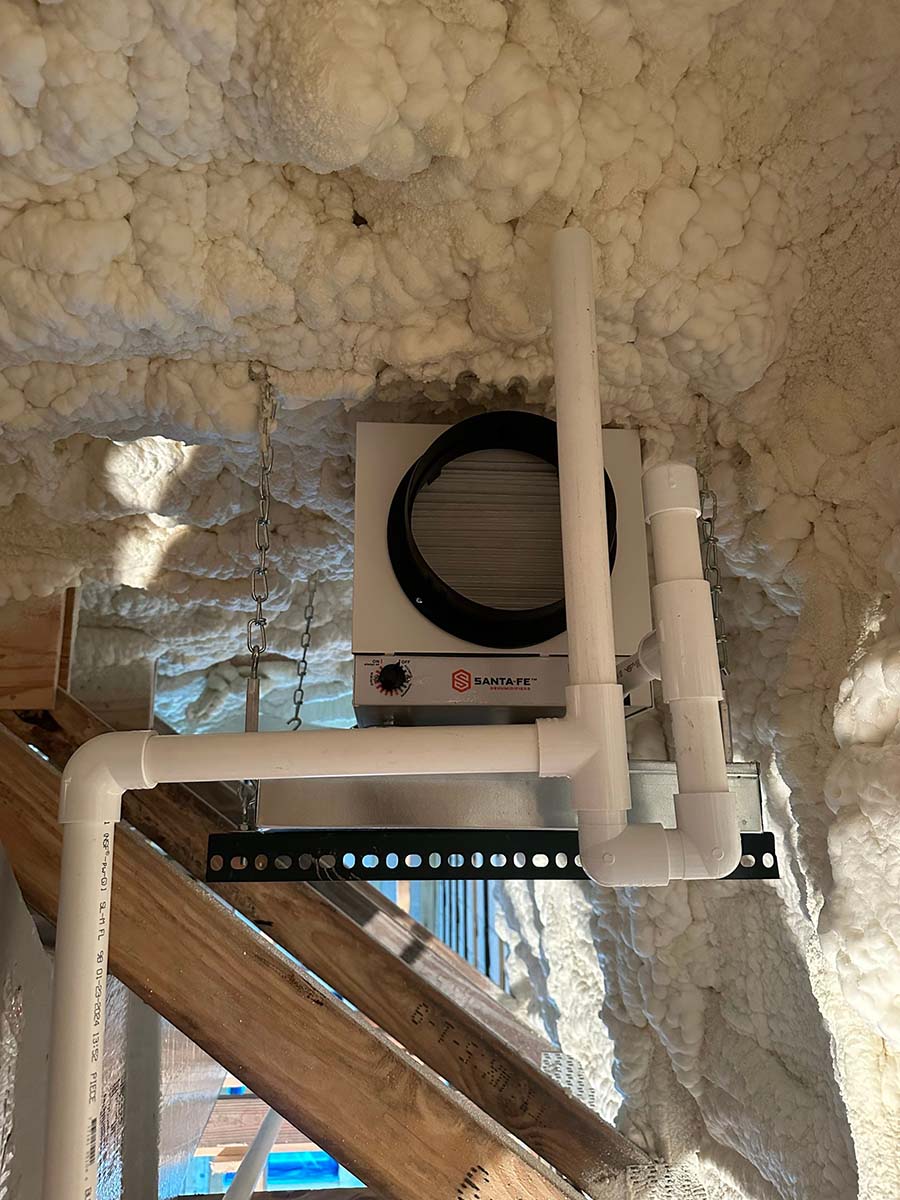
DEHUMIDIFIER: A secondary dehumidification system takes some of the load off. (Courtesy of Balance HVAC)
“One of the major ones would be the improper sizing of the air conditioning system,” said Welsch. “A unit that is oversized will only run part-time, and the humidity in the home will increase more quickly than the temperature. A unit that is undersized will not have the capacity to remove as much humidity from the home as a properly sized unit.”
According to Radocaj, most homeowners in Florida don’t have a proper dehumidification system in place. What brought it to light was the transition and push toward the energy-efficient building of homes.
“There's no efficient way to remove water; it takes energy, and there's no way to hide from it … And back when these houses were designed — oversized [equipment] on undersized ductwork, because the technology in the load calculations wasn’t nearly where it is now — the oversized system with the undersized ducts could handle that moisture a lot better,” Radocaj said. “But the newer equipment that pushes for efficiency can’t, and they can sometimes even accelerate those moisture problems.”
This is where a secondary dehumidification system can help tremendously, by — quite literally — taking a load off.
Minor said the best way to remedy these issues is with variable-speed equipment.
“If you use something that’s variable capacity, it can ramp the fan down,” Minor said. “So it actually blows less air, but makes the coil wring humidity out of the air without cooling the air as much as a standard system … So you're only using what you need, and you can control humidity, which saves on electrical consumption and is actually easier on the equipment.”
When that happens, Minor said, IAQ is increased, while humidity is decreased, and this allows homeowners to set their temperature at a higher setting but feel more comfortable.
Looking for a reprint of this article?
From high-res PDFs to custom plaques, order your copy today!


