Heat Pump RTUs Taking Center Stage in Expanding Market
New standards are driving innovation, surpassing old technology

As the demand for more environmentally friendly HVAC units continues trending upward, heat pump rooftop units (RTUs) are becoming the more logical choice for both new construction and retrofits, no matter the climate.
The heat pump industry is also undergoing a period of rapid innovation, leading to technological advances that allow heat pump RTUs to operate in areas that see prolonged stretches of frigid temperatures while still meeting new energy efficiency standards. With how easy these RTUs are to install coupled with financial incentives from the government, these units are emerging as a key solution to the issues of efficiency and sustainability.
The fight against climate change is also helping the heat pump market while invigorating innovation at environmentally conscious manufacturers, but when it comes to getting the public to adopt these new heat pump technologies, there’s still a way to go. Education will be a key driver to getting there.
senior product manager, ducted systems
Johnson Controls
The Drive for Demand, Innovation
Since the Department of Energy (DOE) has raised its efficiency standards for commercial unit air conditioners and heat pumps by roughly 20% since 2015, heat pumps are constantly evolving to keep pace with the new standards.
By January 2025, an EPA mandate will also essentially outlaw the manufacturing of all high-GWP products, said William Ward, product manager at Daikin Applied Americas, which translates to even more innovation needed in the future.
“There’s some fine print, but that is essentially the high-level theme, especially with (RTUs),” Ward said.
To increase efficiency, some RTUs require more advanced coils and heat exchangers, meaning more materials are needed to manufacture them. This, in turn, has driven up the price, and inflation and increased operational costs aren’t helping the situation.
Looking for quick answers on air conditioning, heating and refrigeration topics? Try Ask ACHR NEWS, our new smart AI search tool. Ask ACHR NEWS
“The upgrades that make this equipment more efficient have impacted the average price of equipment,” said Jason Carter, senior product manager, ducted systems, Johnson Controls. “However, the life cycle cost of the equipment will improve and payback will be quicker because of the decrease in energy consumption. Increasing the energy efficiency of these units is also a crucial step in the global decarbonization effort.”
Carter also noted that heat pump RTUs used in new construction are typically simpler and more cost-effective than for building retrofits, which has historically limited heat pump adoption. Now, advanced units that are smaller and more efficient make it easier to retrofit these systems into existing buildings. This allows building owners and operators the ability to create compliant, healthy, energy-efficient spaces for both new and existing facilities.
“With a smaller footprint and better levels of efficiency and capacity, RTUs are now being used in more applications than ever before, including both retrofits and new builds,” Carter said.
Locations and Regulations
As for who is springing for new RTUs, that likely depends on the location where the question is posed.
“The heat pump demand varies from state to state as well as vertical to vertical,” said Farooq Mohammad, vice president, commercial business at Rheem. “For example, there is higher demand for heat pumps on the West Coast due to regulations and incentives. There is also a larger demand for heat pumps in buildings where the owner will be occupying/operating the premises. Additionally, heat pumps are being specified in school districts in several states. While the drivers are varied, we are seeing a general uptick in the demand for heat pumps.”
Specifically, states like California, New York, and Washington were earlier adopters of this type of legislation and, in 2023, the U.S. Climate Alliance — a bipartisan coalition comprised of 24 governors — announced similar goals, which will spur even more demand.
“The coalition’s goal is to quadruple the use of heat pumps within their respective states by 2030,” Carter said. “As regulations and guidelines evolve, they will likely continue to drive heat pump RTU adoption in the U.S. Likewise, recent updates to model building energy codes, including the 2024 International Energy Conservation Code (IECC) and ASHRAE Standard 90.1, will advance HVAC system efficiencies for new construction. At the local level, these policies include mandatory building performance standards (BPSs) that will drive energy-efficient retrofits of existing buildings to meet today’s standards.”
And while environmental consciousness is certainly a factor, some building owners may not be left with much of a choice, depending on their location.
“There's a desire to go all-electric, and there's penalties in some areas where you could actually be paying a tax by installing natural gas as opposed to using an all-electric solution,” Ward noted.
New technology is also promising to expand the heat pump RTU’s footprint into regions that previously weren’t adopting them.
“Building owners and contractors in traditional heat pump markets — those with more temperate climates — are still buying heat pumps at a similar or increasing pace,” said Aaron Olita, director, unitary product management, Trane Commercial. “Trane anticipates increased interest in northern climates as products advance in capabilities tailored to colder climates. The electrification of heat using heat pumps is also a lever that building owners can use to help achieve their sustainability goals.”
The IRA Factor
As Inflation Reduction Act (IRA) money and other tax credits become more available, heat pump RTUs will also become a more viable option for a wider range of consumers, even if other outside pressures are driving up prices.
“Most of the Inflation Reduction Act incentives on heat pumps are geared towards residential homeowners,” Mohammad said. “Commercial building owners can utilize section 179D tax deductions for new construction or renovation to improve the overall efficiency of the building and receive a certain rebate per square foot. However, this deduction is not limited to HVAC or heat pumps.”
There are also several types of other rebates available for commercial applications.
“Commercial products may be eligible for heat pump rebates through HOMES and HEEHRA rebates in multifamily buildings,” Carter said. “There is also some potential for Investment Tax Credit (ITC) and Production Tax Credit (PTC) provisions to give commercial building owners incentives to install equipment. These tax credits, incentives, and rebates can help drive sales to contractors by opening the door to customers that might have not replaced or upgraded equipment without the help of these programs. The ROI varies from project to project, but overall, increases in efficiency make a direct impact on return.”
Additionally, other entities are also able to cash in on these incentives.
“These expanded federal incentives have fundamentally changed the economics of installing a central energy plant that uses thermal battery and heat pump technology,” Olita said. “Moreover, tax credits are now available directly from the IRS to nonprofit organizations such as K-12 schools; local, county, and state governments; tribal nations; and more. Via section 179D of the Inflation Reduction Act, the tax deduction has increased from $1.88/square foot to $5.65/square foot. They have also reduced the depreciation period from 39 years to 5 years.”
Where the Rubber Meets the Roof
While the heat pump itself isn’t new, some contractors may not have much experience with their installation, and there are plenty of training opportunities available. Local regulations are also a factor that needs to be kept in mind.
“In general, rooftop units are fairly easy to install,” said Mohammad. “Rheem has focused on significantly simplifying the installation and service of the units on our Renaissance platform. However, there are always additional installation requirements and building codes that vary (sometimes widely) across the country, whether it’s flue vent extensions in some states or seismic/hurricane restraints in others.”
Contractors should work closely with distributors and manufacturers to get the latest relevant training on installation requirements, he added. Rheem, for example, will be offering extensive training on products to handle new refrigerants and sensors, as low-GWP refrigerant products will be launched this year to meet the 2025 EPA requirements.
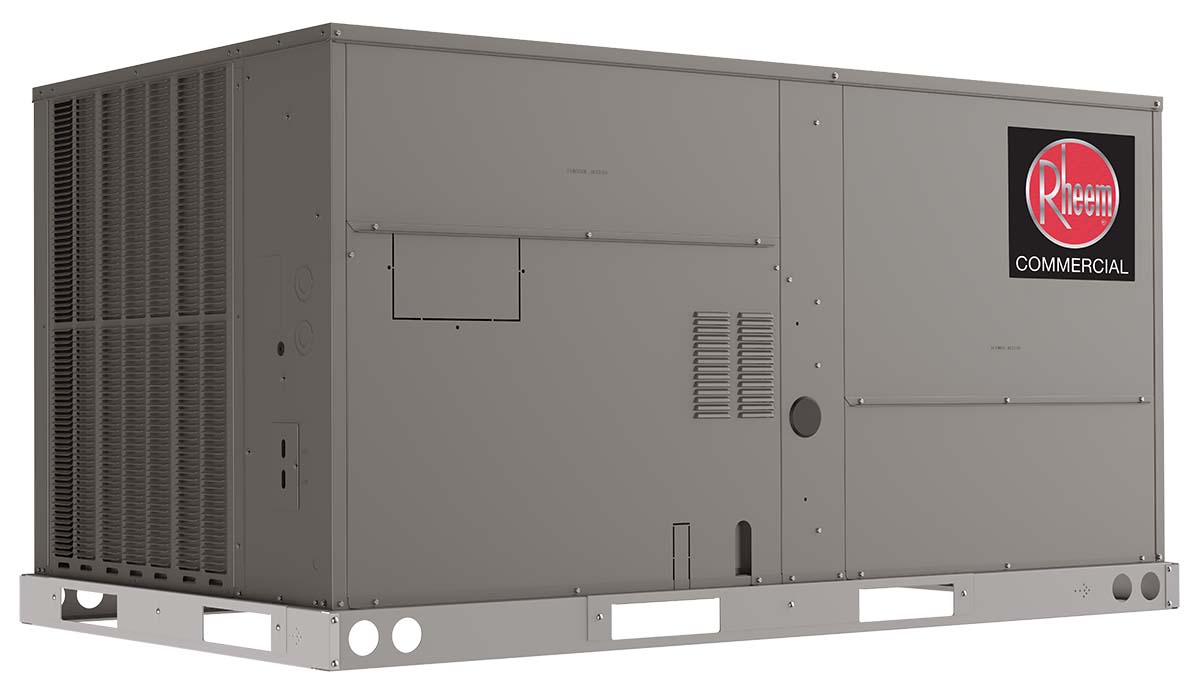
WORKING WITH DISTRIBUTORS, MANUFACTURERS: Before a contractor tackles installing a heat pump RTU, they should be sure to be up-to-date on the latest training and techniques, information that is readily available from the manufacturers themselves. (Courtesy of Rheem)
Added components, more complicated sequence of operations, and using heat pumps in new applications and locations are a few of the items contractors should become familiar with before installation and commissioning.
“I would suggest being proactive — take advantage of training provided by HVAC professional associations and manufacturers,” Carter said. “Johnson Controls has extensive online training, and the Ducted Systems Academy provides both remote learning and hands-on training for all residential and commercial equipment. Using manufacturer-provided installation instructions and startup sheets will also help guide a contractor through a successful startup and commissioning process.”
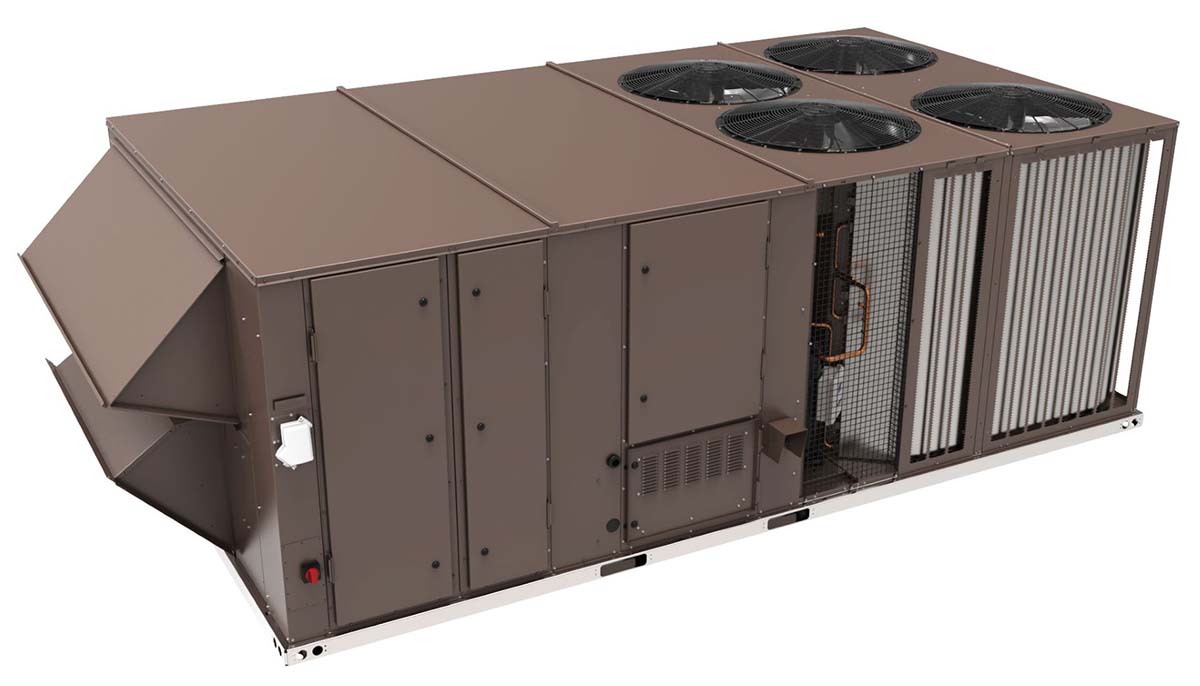
BE PROACTIVE: Remote learning and hands-on training for all residential and commercial equipment is available through a number of manufacturers. (Courtesy of Johnson Controls)
While they serve the same function, contractors also need to be aware the process isn’t the same as with gas units.
“There are operational differences between heat pumps and traditional gas heat rooftop units — the defrost cycles on heat pumps are a good example of that,” Olita said. “Heat pumps operate the compressors more frequently than a traditional gas heat unit. Follow the manufacturer's recommended preventative maintenance guidelines for the heat pump.”
There is also a bit of a learning curve when it comes to replacing existing infrastructure, and Ward predicts units that are more retrofit-friendly will soon be hitting the market.
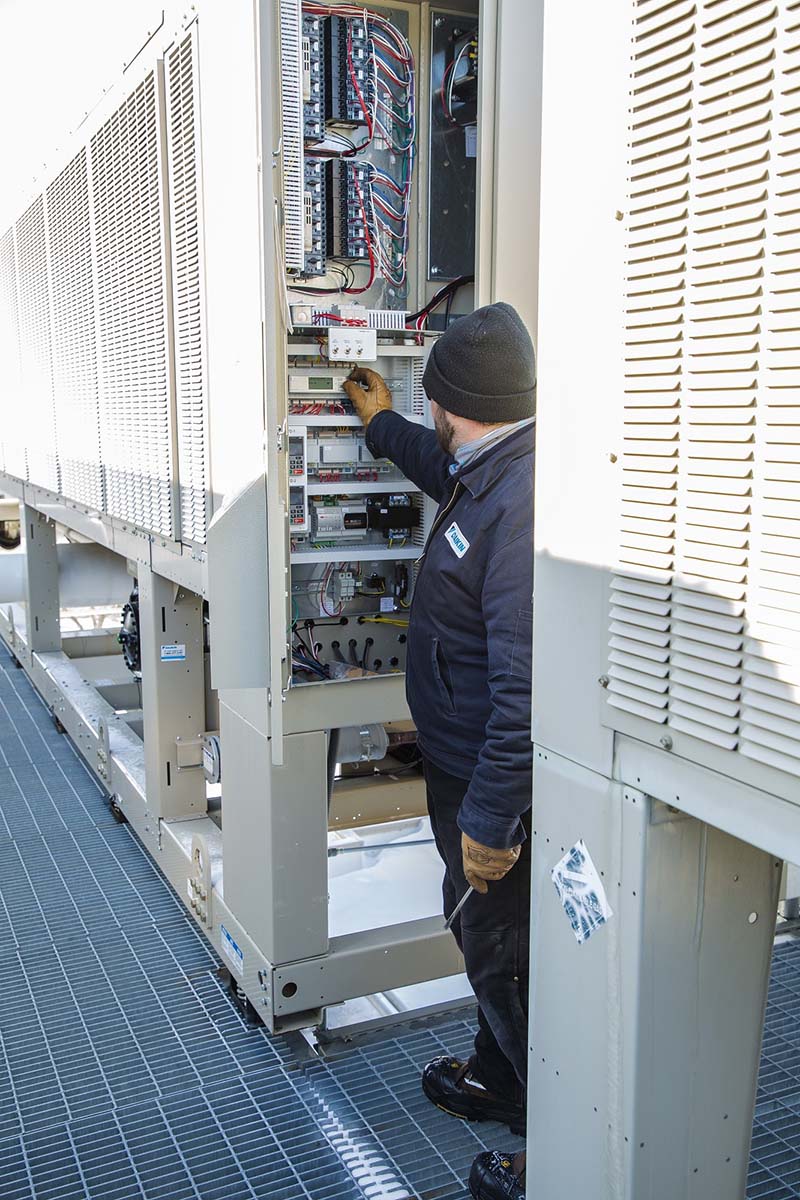
SUPPLEMENTALS: In colder climates, modern heat pump RTUs can add a supplemental backup heat source, either gas or all-electric, to help out on the coldest of days. (Courtesy of Daikin Applied)
One of the challenges to replacing an existing RTU with a heat pump, especially in cold climates, is adding a backup heat source, like gas. But for those who want to stay all-electric, Ward said Daikin is currently working on a solution.
“What you're going to do is put some supplemental electric resistance heating on that, along with a heat pump,” Ward said. “Well, this introduces a challenge from a retrofit point of view — when you put an electric heater into a heat pump, you have to calculate the load that the heat that the rooftop unit requires from an electrical view.”
This requires a significant increase in the size of the wire feeding the unit, which — again — means additional costs and more retrofitting.
“One very simple low-hanging piece of fruit that we're working on is just adding the option to put two points of power to a piece of equipment — you could have one power feed going into the unit that feeds all of the controls, all the fans, all the compressors, all the stuff that was there in the old gas unit, and then you're on a separate power feed up to the unit that just runs that just the electric heater,” Ward said. “How does this make retrofit easier? It means you can use the existing infrastructure in a building, and run all the stuff on the unit other than the electric heater, meaning you don't have to dig wires out of a difficult roof run, etc. You just run a smaller, lower-cost, simpler-to-route power feed up to the unit to make installation easier.”
Looking for a reprint of this article?
From high-res PDFs to custom plaques, order your copy today!