Chillers Go Green With Low-GWP Refrigerants
Manufacturers are offering new solutions that comply with EPA regulations
Late last year, the Environmental Protection Agency (EPA) unveiled a proposed rulemaking that outlined its strategic approach to eliminate the use of high-GWP HFCs in new air conditioning and commercial refrigeration systems. This rulemaking is an integral part of the AIM Act, which instructs EPA to reduce HFC production and consumption by 85% by 2036.
Under this rulemaking, EPA proposed a 700 GWP limit for most new comfort cooling equipment, including chillers, starting January 1, 2025. This caught many in the HVAC industry by surprise, as the expectation was for EPA to propose a 750 GWP limit for most comfort cooling equipment, as well as a transition date of January 1, 2024 for chillers, in alignment with California’s HFC phasedown.
These dates could still change, as EPA’s final rule will not be available until later this year. Fortunately, the proposed 700 GWP limit is not anticipated to adversely impact manufacturers' decisions regarding the choice of refrigerants for chillers, as the majority of available solutions already fall below this limit.
Refrigerant Choices
In response to the phase down of high-GWP refrigerants such as R-410A and R-134a, OEMs are starting to offer a variety of low-GWP options in their chillers. Daikin Applied, for example, plans to use R-32 (675 GWP/AR4), R-513A (630 GWP/AR4), R-1234ze(E) (1 GWP/AR4), R-515B (292 GWP/AR4), and R-1233zd(E) (1 GWP/AR4). This is quite a wide range of refrigerants, said Bill Dietrich, director of chiller applications at Daikin Applied, but the company wants to ensure that customers have the right option based on the application.
“The A2L refrigerant R-32 is an ideal alternative to R-410A, and we’ll be releasing R-32 air-cooled scroll chillers in 2023,” said Dietrich. “There are multiple replacements for R-134a, including A1 refrigerant R-513A, which is a slightly less efficient option but meets the proposed 700 GWP limit proposed by the EPA. Because it can easily be used within existing building codes and installations, many see it as a good interim alternative.”
For the longer term, Daikin Applied plans to utilize the A2L refrigerant R-1234ze(E), which can be used in centrifugal or screw chillers and offers excellent efficiency, said Dietrich. While it has an ultra-low GWP of close to 1, it requires engineering work to match existing capacity and meet safety standards, he said. The company is expecting to introduce R-1234ze(E) products within a year.
R-515B is an A1 refrigerant that has similar capacity and efficiency to R-1234ze(E), while R-1233zd(E) is considered a low-pressure refrigerant and only applied for centrifugal compressors, said Dietrich.
Looking for quick answers on air conditioning, heating and refrigeration topics? Try Ask ACHR NEWS, our new smart AI search tool. Ask ACHR NEWS
“We think this will be the most popular low-pressure refrigerant, as it’s an A1 refrigerant that offers ultra-low GWP and lower toxicity. This alternative is more efficient than R-134a, and we anticipate releasing R-1233zd(E) products in the fall.”
Johnson Controls has long been a champion of the transition to lower-GWP refrigerants, said Brian Smith, director of global project management at Johnson Controls, and the company has spent years testing, evaluating, and implementing these refrigerants, in order to deliver both a low carbon footprint and high-performance outcomes in low-, medium-, and high-pressure chiller systems.
“In particular, R-1234ze(E), R-1233zd(E), R-454B (465 GWP/AR4), R-515B, and R-513A refrigerants have among the lowest GWP on the market and are in use within a range of Johnson Controls chiller solutions available in the U.S.,” said Smith. “In fact, our York YVFA Free-Cooling, Variable-Speed Screw Chiller was the first of its kind to use R-1234ze(E) in the U.S., and the York YLAA was the first air-cooled scroll chiller to use the A2L refrigerant R-454B.”

FIRST OF ITS KIND: The YORK YVFA Free-Cooling, Variable-Speed Screw Chiller was the first of its kind to use R-1234ze(E) in the U.S. (Courtesy of Johnson Controls)
Trane also offers a broad range of chillers that use a variety of refrigerants with GWPs of less than 700, including low-pressure R-514A (2 GWP/AR5) and R-1233zd(E) for large water-cooled centrifugal chillers, said Chris Hsieh, applications engineer at Trane.
“These provide the highest efficiency in cooling, heating, and heat recovery options in the marketplace,” he said. “Each refrigerant is nonflammable and offers high efficiency over a range of 120 to 4,000 tons.”
Trane plans to provide several choices for replacing R-134a in its chillers, taking into account crucial factors such as safety standards (flammability), efficiency, and environmental impact, said Hsieh. Among the options available for air-cooled and water-cooled chiller-heaters, both R-513A and R-515B will be offered to customers. These alternatives offer a low-GWP refrigerant choice while striking the optimal balance between safety standards and cost-effectiveness, he said.
R-454B will replace R-410A in most of Trane’s air-cooled chillers, where it provides the best balance of safety standards, efficiency, and impact on the environment, said Hsieh.
“R-454B has the lowest GWP of all R-410A replacements and offers improved efficiency, increased operating map, reduced refrigerant charge, and less system complexity,” he said.
In North America, Carrier will offer R-513A, R-515B, and R-1234ze(E) in medium-pressure centrifugal and screw chillers; R-1233zd(E) in low-pressure centrifugal chillers; and R-32 in scroll chillers, said Tom Franaszek, director of product management-water cooled chillers at Carrier.
“The chiller replacement for R-410A is R-32,” said Franaszek. “R-32 is a slightly higher pressure and higher capacity refrigerant and will require modifications to the compressor. The efficiency at full-load AHRI rating conditions is slightly better, and the part load is about the same. In fact, Carrier’s first air-cooled chillers with R-32 — the 30RC — have already been released for sale.”
Carrier will use R-513A, R-515B, and R-1234ze(E) as replacements for R-134a in its chillers. “R-513A is a direct replacement for R-134a and will provide almost the same capacity with about a 2% to 3% reduction in full- and part-load values (IPLV), though performance can vary by model,” said Franaszek. “R-515B is not a direct replacement for R-134a and requires a 37% increase in displacement, with a 1% to 2% loss in full- and part-load efficiency. R-1234ze(E) will be used in the future due to its ultra-low GWP (close to 1), though engineering work is required due to its A2L rating. Performance should be similar to R-515B.”
Franaszek added that for low-pressure centrifugal chillers, R-1233zd(E) is a good option, as it is classified as an A1 refrigerant and increases the full- and part-load performance slightly; however, it does require a redesign, as the displacement is much larger.
Natural Options
With the growing focus on low-GWP refrigerants, some are wondering whether natural (non-fluorinated) refrigerants such as ammonia, CO2, or hydrocarbons (e.g., R-290) could soon be available in chillers. However, even though these refrigerants have a low GWP, typically in the 0 to 3 range, they come with their own challenges in terms of safety, performance, and cost, said Franaszek.
“Ammonia has a GWP of 0 and carries a safety rating of B2L, which means higher toxicity/lower flammability,” he said. “Safety standards do not allow safety classification 2 and 3, as well as B toxicity, to be used in direct systems above a very limited charge of refrigerant. For example, the charge limit is 114g for direct systems using propane, a refrigerant classified as A3 (lower toxicity/highly flammable). Classifications 2, 3, and B can be used in indirect system like chillers when located in a machine room or outside a building. But there are still significant safety precautions required, especially when the refrigerant could be in near or around an occupied space. Other natural refrigerants carry a 3 safety flammability rating, meaning they are highly flammable.”
Ammonia chillers are not a product that Daikin Applied currently offers in North America, and it’s doubtful that they will become widespread in this part of the world without significant legislative or regulatory action, said Dietrich.
“In Europe, Daikin has ammonia chillers with screw compressors, though these have been primarily used for industrial process cooling applications,” he said. “While ammonia chillers offer efficiency gains, the refrigerant has higher toxicity levels, as well as different materials of construction, so initial costs can be higher. As a result, we’re only seeing ammonia chillers in more niche applications and don’t anticipate broad adoption.”
CO2 has a better safety profile than ammonia, said Hsieh, but it has reduced thermophysical properties due to its low critical temperature. Although CO2 is used in water heating as well as refrigeration applications with lower temperature requirements, Hsieh pointed out that basic principles of Rankine cycle thermodynamics suggest that the optimal efficiency for refrigeration, comfort cooling, and heating depends on the critical temperature, which is lacking in CO2.
“Obtaining equal efficiency to today’s fluids that have much higher critical temperatures requires the use of more complicated cycle designs and components to recover cycle losses,” said Hsieh. “If these cycle enhancements are added to a cycle using higher critical temperature fluid, efficiency can be enhanced greater than CO2. Trane continues to evaluate CO2’s tradeoffs of health, safety, energy efficiency and economics and will introduce products as appropriate to meet the needs of customers.”
One of the most natural alternatives to refrigerants may be water, said Smith, which is the fluid used in York’s absorption chillers. Indeed, this design eliminates the need for refrigerants altogether, he said.
“Absorption chiller applications have historically been driven by heat source availability,” said Smith. “However innovations in equipment design can now accommodate a wider array of waste heat recovery sources, lower pressure ranges, and broader temperature capacities, making them a viable option for more applications.”
Contractor Considerations
director of global project management
Johnson Controls
Contractors may have questions about the new lower-GWP refrigerants, such as the feasibility of retrofitting them into existing chillers, as well as the necessary guidelines for safely handling A2L alternatives. When it comes to retrofitting, manufacturers generally do not support the practice of putting new alternatives into existing chillers.
“Because extensive equipment redesign is often necessary to ensure system and fluid compatibility, retrofitting a different refrigerant into an existing chiller system is often not possible or is cost-prohibitive, and in some cases will not be allowed due to the equipment safety standards,” said Smith. “And because retrofitting often requires many components to be replaced, when it is feasible, it can be more cost-effective to do a complete equipment replacement.”
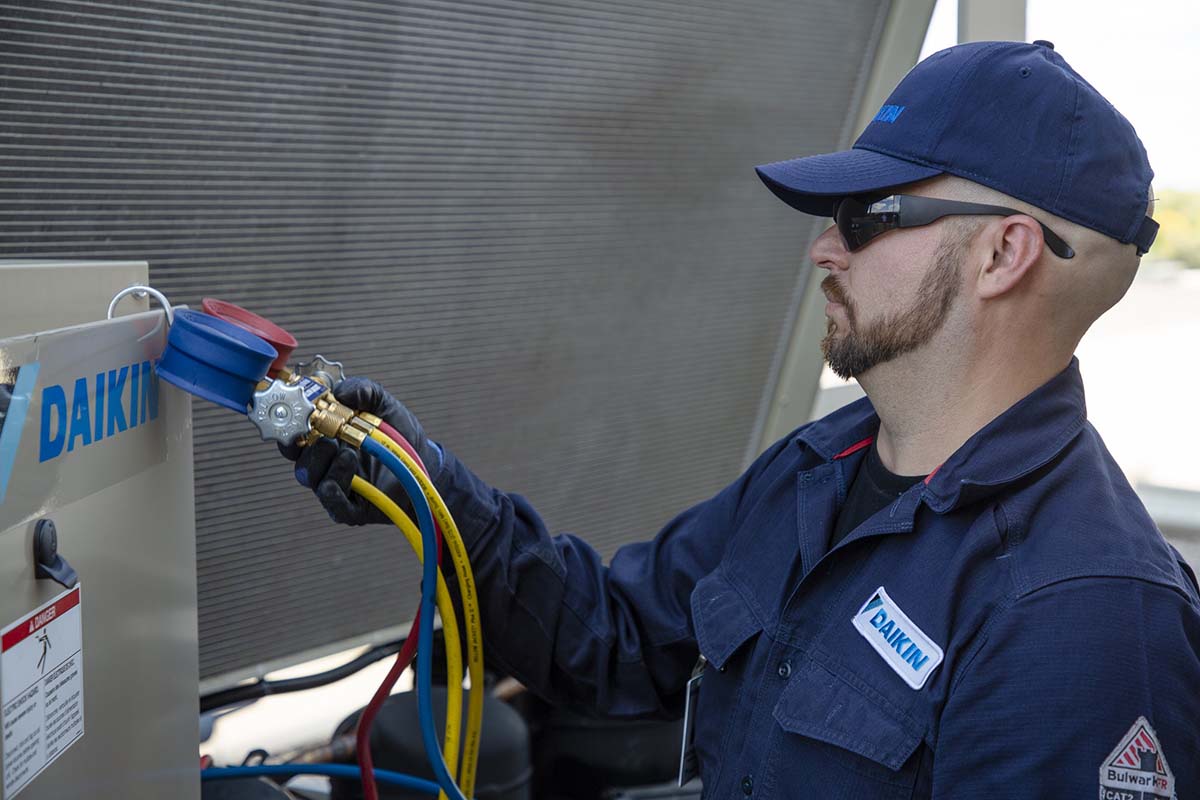
WIDE RANGE: A service technician checks refrigerant pressures in a chiller. Daikin Applied plans to offer a wide range of low-GWP refrigerants in its chillers. (Courtesy of Daikin Applied)
While retrofitting to a lower-GWP refrigerant must be determined on a case-by-case basis, sometimes, it’s just a hard “no,” said Dietrich.
“For example, safety standards do not permit retrofitting from a Group A1 refrigerant to an A2L refrigerant,” he said. “And while it’s possible to go from an A1 to another A1, it’s not a simple process. In fact, it’s sometimes more effective to properly maintain an existing machine and switch refrigerants only when a new chiller is needed. Nonetheless, our team at Daikin is planning to develop retrofit kits for chillers to switch from R-134a to R-513A, but it’s best to consult the chiller manufacturer to see what’s possible.”
Regarding the safe handling of certain new alternatives like A2L refrigerants R-454B, R-32, R-1234ze(E), and R-1234yf, Hsieh noted that thorough testing conducted by ASHRAE and AHRI has resulted in updated protocols for product usage, application, handling, and service.
“Service technicians and installing contractors must understand that 2L refrigerants are flammable, so they will be required to do more due diligence and follow updated refrigerant storage, handling, and service procedures,” said Hsieh. “New service tools will be required that are 2L certified, and handheld leak detectors will be required when servicing equipment. Also, pump down procedures will be extensive and will require more time to ensure refrigerant is not trapped in a circuit or component. In the end, these practices are like what is used today but will require more time and diligence.”
Because the service and installation practices will be different, contractors should get their technicians trained on how to safely and effectively handle lower-GWP alternatives as soon as possible, said Dietrich. In addition, contractors should connect quickly with their preferred sales reps and manufacturers about selections, performance, lead times, etc.
“Most manufacturers are just bringing their lower-GWP chillers to market now,” he said. “But as of January 1, 2024, some refrigerants, including R-134a and R-410A, will be banned from use in new chillers in 12 states. The rest of the states will likely follow suit as of January 1, 2025, pending the EPA regulations that are expected by October. So change is coming quickly.”
Looking for a reprint of this article?
From high-res PDFs to custom plaques, order your copy today!