HVAC Solutions Help Data Centers Achieve Sustainability
The right equipment can reduce energy consumption, as well as the carbon footprint

Data center growth has exploded in recent years; however, this increased demand for data processing comes at a cost, as data centers are notorious for their massive energy consumption and carbon footprint. In fact, according to the Department of Energy (DOE), data centers consume 10 to 50 times the energy per floor space of a typical commercial office building, accounting for approximately 2% of the total U.S. electricity use.
To tackle this problem, there has been more of an emphasis on promoting sustainability in data centers. HVAC systems play a large role in achieving sustainability, as this equipment is responsible for ensuring that the temperature and humidity levels in a data center remain within the acceptable range 24 hours a day, seven days a week. By implementing sustainable HVAC solutions, data center operators can significantly reduce their energy consumption and environmental impact.
Director of business development, data centers
Danfoss
Sustainable Strategies
A sustainable data center aims to balance the need for reliable and effective data processing with the need to minimize its environmental impact. To achieve that objective, a sustainable data center actively works to reduce power usage, energy, water, and carbon emissions, said Michael Strouboulis, director of business development, data centers, at Danfoss.
“Lowering power usage effectiveness (PUE), which measures the ratio of the total power coming into the data center to the power consumed by the information technology equipment (ITE), as well as water usage effectiveness (WUE), carbon usage effectiveness (CUE), and increasing energy reuse (ERE), are key to meeting sustainability and net-zero carbon targets,” said Strouboulis. “The transition to all four of these metrics naturally involves looking at the entire data center infrastructure, including the mechanical systems that support data center cooling and ITE thermal management, which account for as much as 30% to 40% of the power into the facility.”
Sustainable data centers also strive to attain carbon neutrality targets and lower carbon emissions by utilizing renewable energy sources and adopting energy-efficient HVAC equipment and monitoring technologies, all while ensuring reliable and effective power supply, said Mukul Anand, global director of business development, applied HVAC global products at Johnson Controls.
“Digitally equipped BMS and optimization software provide insights and control that help facility managers run buildings as efficiently as possible,” said Anand. “Some facility managers are also working with HVAC manufacturers to find ways to use waste heat in other building areas, which minimizes fossil fuel use. In response, HVAC engineers are developing products that can very efficiently use this waste heat.”
Sustainability in a data center extends beyond just its power sources, encompassing its construction and design as well. For example, the materials and components employed must be durable and minimize waste by avoiding unnecessary repairs and replacements, said Rachel (Ray) Larimore, project manager at Ruskin.
Looking for quick answers on air conditioning, heating and refrigeration topics? Try Ask ACHR NEWS, our new smart AI search tool. Ask ACHR NEWS
“The design should also maximize the space while allowing for ease of maintenance,” said Larimore. “HVAC systems are generally difficult to access for maintenance, since they are most often built into walls and in high ceilings. However, data center owners are taking particular care to design their facilities with maintenance schedules and longevity in mind.”
Finally, sustainable data centers have an end-of-life strategy that limits waste and environmental pollutants, which is a key aspect of these types of facilities, said Justin Scott, applications engineer at Infinitum.
“Operators must responsibly dispose of refrigerants and other fluids, and work with partners to recycle or remanufacture components and subcomponents,” said Scott. “Data centers also have thousands of motors with valuable materials, such as aluminum, steel, and magnets that would benefit from refurbishment and reuse, rather than being thrown into a landfill.”
HVAC Solutions
Achieving sustainability in a new or existing data center can be a challenge, as it can be difficult to balance design conditions with energy efficiency. Uptime is absolutely critical to data centers, so the HVAC equipment has to be designed to keep the facility operational in the most extreme conditions it will face, said Anand.
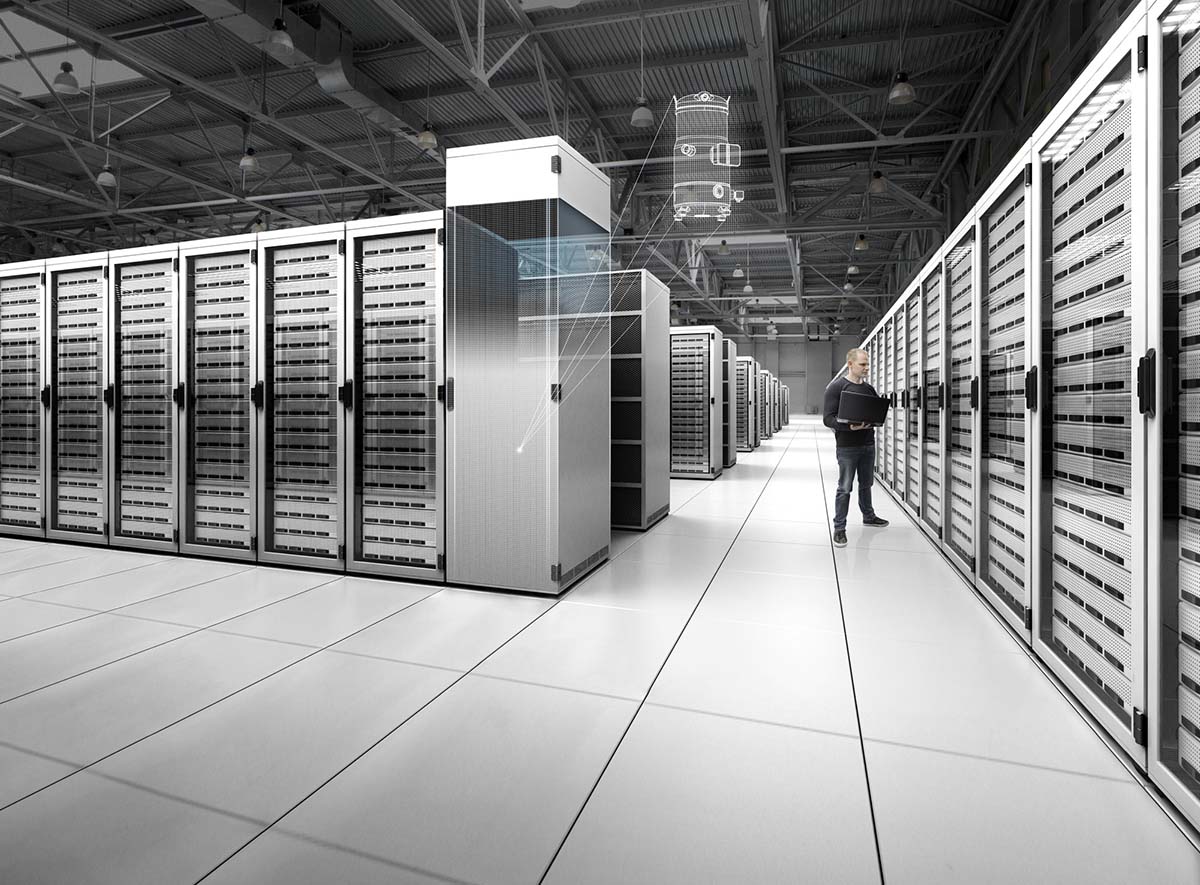
OPTIMAL UPTIME: Data centers are running processes 24/7, so uptime and operational efficiency are paramount. (Courtesy of Danfoss)
“Yet a data center may only experience extreme conditions a handful of times — if ever — and this can result in a trade-off when it comes to sustainability,” said Anand. “This is because equipment typically operates in conditions for which it wasn’t originally selected, and that can result in decreased energy efficiency.”
One technology that is widely used to increase sustainability and reduce energy consumption in data centers is free cooling. Free cooling refers to the use of cooler outdoor air to reduce the temperature of the facility's cooling water or air without the need for mechanical cooling. By using free cooling, HVAC systems can significantly reduce energy consumption and operating costs, especially in regions with mild climates.
“Data centers have used direct evaporative cooling to achieve cooling, which can be water and energy intensive,” said Anand. “We see a shift there. Advances in air-cooled chillers make it possible to use economization instead. Some air-cooled chillers feature additional free cooling coils that generate free cooling when ambient conditions are milder or colder. The latest air-cooled chillers operate at inverted conditions, which means they can provide free cooling even in the absence of free cooling coils, providing excellent efficiency at low ambient conditions. These lighter chillers also allow for a smaller carbon footprint.”

COST SAVINGS: Using efficient motors — such as the Infinitum motors used in this data center fan array — can translate to 10% savings in energy consumption and costs. (Courtesy of Infinitum)
Utilizing energy-efficient motors and variable-speed drives (VSDs) is also essential for optimizing the energy consumption of cooling system components such as compressors, fans, and pumps. The VSD allows the motor's output to match the computing demand and saves energy by delivering the exact amount of power required at any given time, said Strouboulis.
“The effect that VSDs have on energy consumption is huge,” he said. “Chillers with oil-free, magnetic bearing, VSD compressors are some of the most efficient pieces of equipment used in data centers, because they offer efficient heat transfer and reliable cooling throughout their life cycle without the maintenance requirements and performance degradation experienced with other types of compressors.”
Utilizing efficient components in HVAC equipment to enhance sustainability is important, agrees Scott, especially in data centers that experience usage cycles. He cites Netflix as an example, noting that their data centers may experience a peak load at 8 p.m. when users stream content, and a smaller load at 8 a.m. Given this usage profile, it would make sense to decrease the load on the HVAC system during the morning hours.
“EC motors used together with an efficient fan creates a highly efficient EC fan with a flat efficiency curve across full and partial load conditions,” said Scott. “EC motors can run at variable speeds with partial-load efficiency, saving energy at off-peak times. Some are able to maintain high levels of efficiency across a wide range of loads and speeds. Using more efficient motors, like EC motors, can translate to 10% savings in energy consumption and costs overall.”
Power consumption in a data center can also be reduced through the use of energy-efficient controls and careful planning to reduce the energy required to operate HVAC systems, said Larimore. For example, she said that it may be possible to reduce the number of actuators used to modulate airflow by reducing the number of sections or optimizing installation locations to power multiple sections of dampers from a single actuator. This can reduce the overall power needs in the design.
“Airflow design needs to be taken into consideration as well,” said Larimore. “Keeping electronics cool to avoid failure is of great importance in a data center. Rather than overcompensating by bringing in extra air, HVAC equipment should be designed to optimize airflow and circulation to keep the building at the required temperature and with enough clean air without being wasteful.”
Looking Ahead
The sustainable data center trend will likely continue, given the rising demand for digital services and growing awareness of the impact of these types of facilities on the environment. As such, the HVAC equipment designed for data centers will continue to evolve. For example, today's primary way for cooling data centers is precision air, and that will be around for the "low rack power density" data centers for some time, said Strouboulis.
“However, with the proliferation of high-performance computing (HPC), artificial intelligence (AI), machine learning (ML), IoT, and other evolving computing technologies, rack power densities are rising, and liquid cooling is becoming essential to ensuring reliability and performance,” he said. “For example, CRAC/CRAH and row-based containment cooling solutions are ideal up to 15 to 20 kW, but there is a point, maybe around 20 kW, past which they are no longer cost-effective or efficient. At that point, you start to look at other techniques that are cooling closer to the source of heat and are located very close to the rack doors or even closer than that, as these techniques will be cooling microchips directly by direct-to-chip or immersion liquid cooling.”
Compared to traditional air cooling, liquid cooling is more efficient at transferring heat away from electrical components, said Scott. That is because liquid’s heat-carrying capacity can be up to 3,500 times greater than that of air.
“There are a few ways to apply liquid cooling and each has challenges,” he said. “One approach is to bring fluid to the chip set to remove heat, but while this is great for the processor, it doesn’t cool other components. A second approach is bringing liquid cooling to the rack where air supplements the cooling. A third approach is immersion cooling of server racks in a tank, where the fluid surrounds server boards and removes heat. The challenge is moving parts in and out of fluid and potentially contaminating/damaging other components. With liquid cooling, you still need traditional air coolers, chillers, and evaporative cooling.”

PEAK EFFICIENCY: The York YVAM air-cooled magnetic bearing centrifugal chiller can reduce the full-load power consumption of the chiller and deliver peak efficiency beyond typical industry standards. (Courtesy of Johnson Controls)
Speaking of chillers, new technology is available that can help contractors design more sustainable data center systems. Specifically, low-friction, air-cooled, magnetic-bearing centrifugal chillers can reduce the full-load power consumption of the chiller and deliver peak efficiency beyond typical industry standards, said Anand. In addition, the electrical infrastructure that powers the chiller — including transformers, uninterruptible power supplies (UPS), generators, automatic transfer switches, and switchgear — can all be sized lower, leading to first-cost savings.
“Cooling products that use low-GWP refrigerants are also available to further minimize resource consumption and reduce community and planet impact,” said Anand. “In addition, HVAC engineers are working on quieter products that consume less natural resources and have the maximum amount of recyclable content.”
Another factor that will influence the future design of HVAC equipment is the increasing price of real estate.
“Because land is so valuable in key locations, including Ashburn, Phoenix, Dallas, and Silicon Valley, data centers are now growing vertically rather than horizontally,” said Anand. “When a data center grows vertically, the interior square footage that must be cooled gets larger, but the amount of rooftop space to place chillers doesn’t. Multistory data centers are one of the challenges that continue to drive innovation in the design of HVAC equipment.”
Identifying Improvements
Contractors can help their data center customers identify ways to improve their sustainability by evaluating their operating conditions from three different perspectives, said Mukul Anand from Johnson Controls:
- Is any equipment operating outside of its parameters that could indicate a potential issue in the near future?
- Is the HVAC equipment operating at optimal energy efficiency given the ambient conditions?
- Are there spikes in the system that are reducing efficiency and reliability?
“While the first two are pretty self-explanatory, the third relies on understanding facility trends,” said Anand. “For example, if a data center typically ramps up in heat generation at 8 a.m., it can be automated to gradually ramp up capacity starting at 7 a.m. rather than going at 100% capacity at 7:59 a.m. This can minimize system spikes, improve energy efficiency, and extend equipment life.”
It can sometimes be difficult for contractors to obtain this type of information, as some data centers — due to concerns over cybersecurity and privacy — have developed their own real-time, AI-assisted monitoring and tracking systems used for optimizing operations, predictive and service maintenance, energy consumption optimization, capacity management, and planning, said Michael Strouboulis from Danfoss.
“However, there are third-party SaaS packages that offer additional insights, such as predictive analytics, to service enterprise and edge data centers,” he said. “Energy audits and installing smart devices such as energy metering can help identify areas of improvement. Contractors can also install sensors that feed information to cloud-based monitoring of essential components of the cooling system in order to ensure systems are running at peak performance and thereby reducing carbon emissions.”
Looking for a reprint of this article?
From high-res PDFs to custom plaques, order your copy today!