ACCA Defends Need for Manual J in Residential Home
A few minutes spent on data entry will ensure satisfied customers, professional results

Who wants to learn about problems after the job is completed? Residential HVAC system design is a foundational step in the process to deliver predictable comfort, and estimating the heat loss and gain of a dwelling (Manual J) is the cornerstone of that process. Approaching a new equipment installation with a few guesses could lead you into a trap. But on the other hand, a few minutes spent on a survey and data entry will make you look like a professional and save you from uncomfortable conversations later. You can follow the procedure and have confidence or guess and find out the hard way. Doing it right in our industry is the mark of strength.
15-Minute Manual J
Manual J has a reputation as an exhausting process. But it’s simply about collecting some building characteristics and entering the data into approved software. For most homes, it’s easy to measure the exterior of the house and to determine the window type used. A few minutes with a tape measure, a walk around the house, and a peek in the attic (and crawlspace) is all it takes. With a few templates of common building components, you can calculate a Manual J in about 15 minutes. It may take some practice, but it is achievable for almost anyone, even small companies.
It might seem reasonable to ask the homeowner if the old system did a “good job.” But this could set you up for failure if the customer’s memory “evolves.” If they think the old equipment was great but your new system is underperforming, how do you prove them wrong? When the equipment selection is based on their opinion, and their opinion is that the new equipment isn’t working, what argument can you make? Equipment selection based on the customer’s opinion can easily lead to an uncomfortable discussion with your customer.
NOTE: The ACCA 5 Quality Installation Standard allows you to skip the Manual J calculation when an existing home has a load calculation and there have been no changes to the dwelling or duct system.
System Performance
Manual J may not be the problem. In my opinion, 99% of equipment in America have some excess capacity, so that’s not the issue. The problem is why that excess capacity doesn’t help make customers comfortable. There is a laundry list of reasons why systems underperform: incorrect airflow, wrong refrigerant charge, and ducts that are leaky, under-insulated, or undersized (or all three). HVAC professionals test and commission the systems they install. They use tools like measureQuick to identify and correct problems, avoid callbacks, and create comfortable customers.
Another factor could be poor communication with the installer. Most installers (or start-up technicians) that I know take pride in their work, but they’re not mind readers. Therefore, it’s up to the company leadership to set them up for success and ensure they know critical details like fan speed settings (or desired airflow). Then it’s up to the installer to measure and record elements of the system’s operation to confirm that it’s working as specified. For more information about the measurements that should be taken, see the ACCA 5 QI Standard (free PDF download at acca.org/standards/quality).
To help HVAC professionals across the country, ACCA works with partners like measureQuick and Department of Energy’s Smart Tools for Efficient HVAC Performance (STEP) campaign. We want installers to be aware of tools that can show them when they did the job right and help owners confirm the equipment is installed correctly and operates as it should.
Looking for quick answers on air conditioning, heating and refrigeration topics? Try Ask ACHR NEWS, our new smart AI search tool. Ask ACHR NEWS
Climate Matters
Record high (and low) temperatures are a problem. But three significant factors help mitigate this problem: excess capacity, the flywheel effect, and abnormally high temperatures short bursts. As I said earlier, most equipment has some excess capacity. The lowest amount of excess capacity that ACCA Manual S specifies is 15% (or 115% of the total cooling load). This limit helps prevent short cycling, which increases equipment life. It’s similar to how mileage on your car from long trips causes less wear than the same mileage from stop-and-go city traffic. Also, in humid climates, right-sized equipment is vital. Those long run times will reduce humidity and increase comfort.
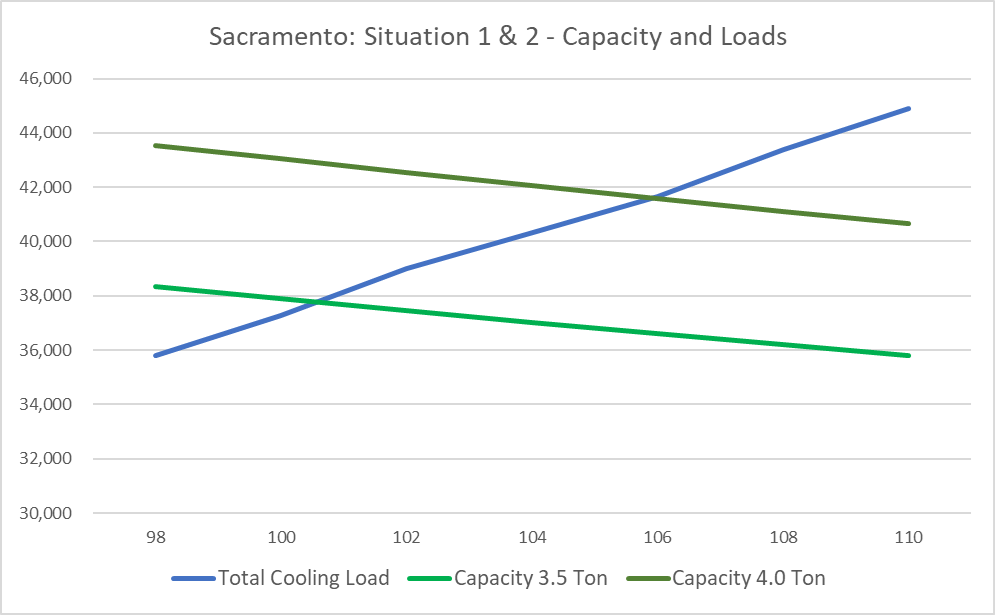
Manual J calculates loads, but Manual S is the standard for equipment selection and size limits. In dry climates like Sacramento, Manual S allows a heat pump to add an extra 15,000 BTU/h of capacity over the load. Here’s an example of two Sacramento homes designed at 98˚F (the Manual J summer design temperature for Sacramento) and some sample equipment capacity at that temperature:
Situation 1: Manual S: 115%
Home’s Load ≈ 36,000 BTU/h
3.5 Ton Capacity ≈ 38,300 BTU/h
Excess Capacity ≈ 7%
Situation 2: Manual S: +15,000
BTU/h
Home’s Load ≈ 36,000 BTU/h
4.0 Ton Capacity ≈ 43,500 BTU/h
Excess Capacity ≈ 22%
(About 7,800 BTU/h in excess capacity. If a 5-ton were used, it would exceed the 15,000 BTU/h limit)
As temperatures rise, the heat gain (cooling load) goes up, and the equipment’s cooling capacity goes down. In Situation 1, the equipment does a great job all the way to 101˚F. Situation 2 has almost enough capacity to maintain comfort at 108˚F (10˚F over the design temperature).
Click chart to enlarge
In addition to excess capacity, there is the flywheel effect. Simply put, it takes time for heat to migrate through a building assembly (walls, floors, windows, doors, etc.). But, of course, there is much more to it. Still, during heat waves that exceed the design temperature, a 1˚F increase in outdoor temperature does not immediately translate into a 1˚F rise on the thermostat. If the heat wave lasts long enough, the temperature will rise. But it takes time, and these temperature spikes only last an hour or two. Then, as the temperature drops, the equipment can catch up, and the thermostat may not move at all.
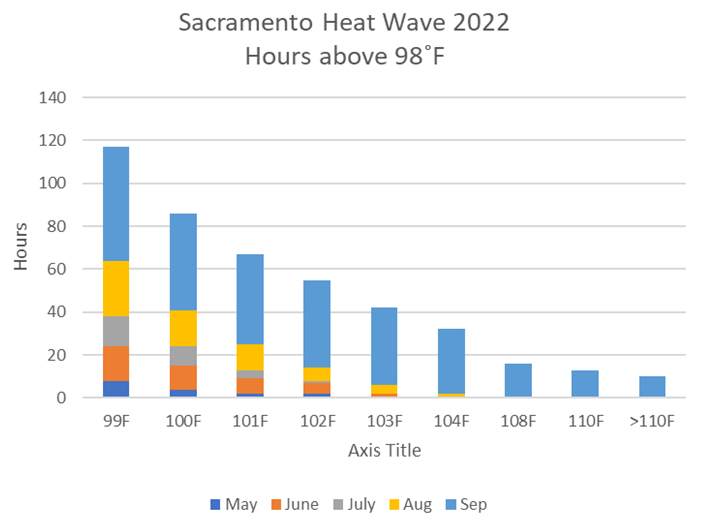
During the summer in Sacramento last year, 109 hours were above 98˚F. That’s 1.3% of the year above 98˚F (not 102˚F) and only 42 hours were above 102˚F, or 0.05% of the year. June saw temperatures rise to 103°F for two hours and August had four hours above 103˚F.
(NOTE: In the example above, at 103˚F, the difference between the load and the equipment capacity in Situation 1 is only 2,300 BTU/h, in Situation 2, there is sufficient capacity to handle the heat.)
One ferocious four-day period in September was scorching. But no one should design for that situation; humidity removal stinks and that much oversizing would cause harmful short cycling (for the other 99% of the year). A better solution is to present options to customers who want to be more prepared for bizarre weather events like this. First, offer equipment that takes advantage of the expanded Manual S sizing tolerances. Second, recommend variable-capacity equipment with more robust sizing tolerances. Let your customer decide if they want to purchase equipment for these extraordinary circumstances.
Click chart to enlarge
A Word on Climate Change
The outdoor conditions can change. But the fluctuations are minor and infinitesimally incremental over decades. If there is any change, it may only be about 1˚F (up or down) during the life of a cooling system. If a system is replaced every 15 years or so, Manual J will have incorporated the latest weather data to support an accurate heat loss/gain calculation. The heat wave last year, or even a few years ago, will be factored in. Remember, if the design temperature changes, almost all installed equipment has excess capacity when it is properly installed.
The same applies for heating. As a result, the winter outdoor design temperature may also fluctuate. Since fuel-fired furnaces can last for several decades, can this be a problem? Not really; Manual S allows at least 40% oversizing for furnaces so that excess capacity will be available throughout the equipment’s life. While most people concerned with climate change are focused on warming, ACCA will diligently and vigilantly monitor cooling and heating weather data.
Time is Short
Theo Etzel wrote a book titled “Invest Your Heartbeats Wisely.” It’s excellent advice. Anyone can calculate a Manual J quickly with a bit of practice (if a Manual J needs to be done at all). ACCA believes an HVAC professional should do their homework and prepare standards-based options to help a customer make their best choice. Do good work and check it. You don’t have to use measureQuick to evaluate your work, but use something objective. Commission your work and know that it’s performing to the manufacturer’s specifications so you can give your customers what they paid for and want. When you take care of the customer, their expectations will take care of themselves.
Is Manual J necessary in an existing home? Only if you want satisfied customers and predictable comfort.
Looking for a reprint of this article?
From high-res PDFs to custom plaques, order your copy today!