Considerations for Electric Radiant Snow Melting Systems
Important factors include surface type, reason for use
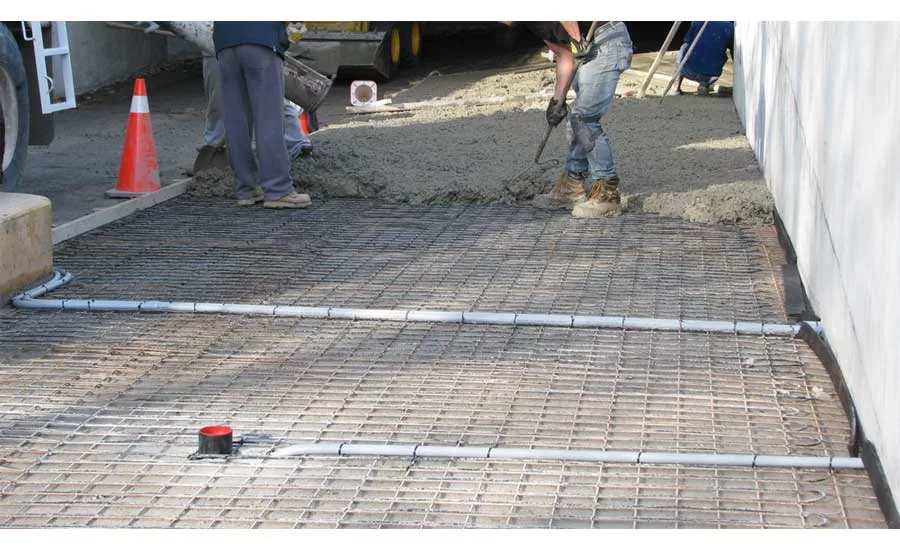
CONCRETE APPLICATION: A crew covers a radiant heat system with concrete. Concrete remains the most popular option for radiant systems because of its ability to conduct heat.
Electric snow melting solutions have been around for over 50 years in North America, and while the technology of the heating element has remained relatively unchanged, the quality and durability of surrounding materials have improved. Installation practices are also very similar, even 50 years later. Where technology has advanced is in the speed and accuracy of controls that instantaneously measure temperature, moisture, and precipitation by quickly activating. This has been key to lowering energy consumption, and now these controls are so accurate that they are only energizing the heating cables when necessary.
Before beginning any snow melting project, several general questions need to be asked so the manufacturer can make their best recommendation based on the needs and requirements of the system.
What Is the Primary Use for The Snow Melting System?
Will this be melting snow on a sidewalk, driveway, or critical building entrance like a hospital or wheelchair accessible ramp? Where is the geographical project location? Snow melting calculations are based on ASHRAE Snow Melting Heat Flux Requirement standards1. It’s measured by five atmospheric factors:
- Rate of snowfall
- Snowfall-coincident air dry-bulb temperature
- Humidity
- Wind speed near the heated surface
- Apparent sky temperature
Other factors such as back and edge heat losses must be considered in the complete design, and it is recommended to refer to Chapter 52 of the 2019 ASHRAE® Handbook1. This will determine how much heat is needed based on the specific project location and how critical it is to keep the area clear of all snow accumulation. For example, a project in Baltimore, Maryland would not require the same amount of heat that Toronto, Canada would need to melt snow and ice accumulations.
What Type of Surface Material Covering Will Be Used?
The most popular is concrete, as this is the best for thermal conductivity, but there are additional options.
Concrete
Before beginning any concrete installation, it’s important to know where those expansion joints will be located so the system can be designed with cables fitting between expansion joints, ensuring maximum system longevity.
The National Electric Code (NEC) and Canadian Standards Association (CSA) prohibits any electric cable system to pass through concrete expansion-contraction joints. So even though these radiant cables will be embedded directly in the concrete, multiple cables and/or mats must be used to cover these larger areas that require expansion joints. Concrete will heave, expand, and move slightly, so it’s important to not cross, under any circumstances. Otherwise, if the concrete moves, the cables will break.
Some other things to remember when working with concrete are thickness and whether insulation can be used under the slab. When placing the cables before concrete is poured, it’s important to prepare the concrete forms and reinforcement/rebar to ensure the cable is suspended at the correct depth.
Looking for quick answers on air conditioning, heating and refrigeration topics? Try Ask ACHR NEWS, our new smart AI search tool. Ask ACHR NEWS
Depth matters. Too deep, and you’re heating the earth below the concrete first. Too shallow, and the cable doesn’t have enough time to thermally dissipate heat horizontally before it rises. If the outline of heating cable melting the snow is visible, that means the cable is too close to the surface. The NEC requires a minimum depth of 1.5 inches (38 mm), but most manufacturers recommend a depth of 3 inches (76 mm) as being ideal.
Pour and finish each slab area between the expansion joints individually. Be sure to check for damage and avoid walking or striking the mats with shovels or other tools. The concrete mixture must not contain sharp stones which may damage the cable. Finally, concrete needs 30 days to harden before operation of the heating cables.
Asphalt
Asphalt is another popular covering, although it does require planning and may lead to additional labor costs due to the required slow and cautious pouring processes. However, not all snow melting systems can withstand the extreme temperatures of hot asphalt installations, so consult with the manufacturer first.
Ensure only a high quality, durable heating cable is used, as only some cables can withstand the heat and compression from freshly poured asphalt. The aggregate is very hot and, coupled with the high compression of the installation equipment, installers must be very careful that the cables are not destroyed during the installation of the asphalt.
Extreme caution must be taken to ensure that the heating cable manufacturer’s maximum temperate rating of the cable is not exceeded. Typically, hot asphalt can exceed 240°F (115°C), so the cables must be protected, or the asphalt must be cooled to below the maximum temperature requirements of the cable.
Ensure there is a firm base of 4 to 8 inches (102-203 mm) of concrete, sand, or rock aggregate tamped down and ready to receive the asphalt. Clean the area below the heating mat/cable so that it is free from sharp objects. It is extremely important to keep heavy equipment, machinery, vehicles, shovels, and rakes away from the cable to prevent damage.
In the application of asphalt, we recommend a maximum load of 2 tons for the roller. To minimize strain on the cable, lay the mats perpendicular to the roller’s path.
Pavers
This application requires the cables be placed in sand below the pavers. Pavers can be considered anything from bricks, flagstone, marble, tiles, or any stone/masonry the customer wishes to use as the finished surface. These installations are much easier, as the cables can be accessed even after installation is completed. The only real considerations for this application are the thickness of the paver and how this will impact the reaction time of the heat. The thicker the paver, the longer it will take to transfer the heat. Anything thicker than 5 inches in depth makes it very difficult to transfer enough heat to be 100% effective.
Save 40% in Energy Costs by Installing Insulation
Insulation is always recommended, and high-density polyurethane is very popular, as it’s rated for ground and masonry contact. The cost is minimal upfront to add insulation, but many installers or DIYers are simply unaware. There are major long-term advantages to insulating, including providing a barrier from the cold ground. Heat much like electricity takes the path of least resistance. So, if the cold ground below the cable is not isolated, the heating cable will transfer most of its heat to these areas before heat is built up enough to radiate up to the paved surface.
Insulation can not only lower overall energy consumption; it can also help to optimize the system, speeding up reaction times and reducing power consumption since no heat is lost to the ground. This also can help the cables to run less often, prolonging the life of the system.
Reasons to Invest In An Electric Radiant Snow Melting System
Electric radiant snow melting systems provide substantial benefits that many are unaware of. These include:
Efficient Snow Removal — Designed area is kept free from ice and snow at all times. For engineers and architects considering these products in LEED applications, keep in mind that these electric systems can be part of a clean renewable energy program. This eliminates costly plowing and labor-intensive snow removal, coupled with less salt and mess being tracked into buildings.
Better for the Environment — The environmental benefits are also very attractive as the snow melting system can eliminate the need for harmful deicing chemicals and salts from entering local waterways, utilizing this clean technology that can tie directly into renewable energy.
Fully Automated, Maintenance-Free Operation — Electric radiant snow melting systems are silent, have no moving parts, making them virtually maintenance free. Like most other comparable heating systems, yearly checkups and repairs are not needed, which is a huge savings on maintenance costs.
Enhances Safety — Avoid slips, falls, and injuries (and the subsequent litigation) sustained from icy steps, walkways, and driveways and keep traffic/working areas free from snow and ice.
In addition, the snow melting system automatically detects precipitation and temperature, and therefore only operates when needed, like just before a snowstorm hits for maximized performance.
Looking for a reprint of this article?
From high-res PDFs to custom plaques, order your copy today!