The Basics of Servicing A2L Systems for HVACR Contractors
Safety is a concern when handling the new mildly flammable refrigerants
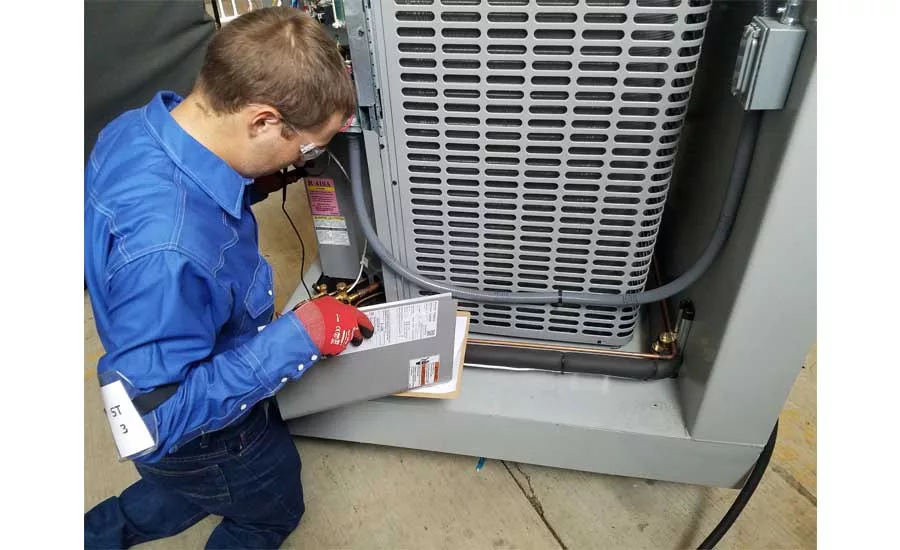
READ THE MANUAL: When installing any piece of equipment — A2L or not — always look to the manufacturer's literature to make sure that it's approved for installation in that area. (Courtesy of ESCO Group)
There has been a flurry of legislation passed at the state and federal level, which will lead to the phasedown of high-GWP HFC refrigerants such as R-410A. Some of the new low-GWP refrigerants designed to take the place of R-410A, such as R-32 and R-454B, are mildly flammable (A2L), and there may be concerns about handling these types of refrigerants.
At a recent webinar (below) hosted by AHRI, Jason Obrzut, director of industry standards and relations for ESCO Group, sought to allay those concerns by discussing how servicing A2L equipment will not be that much different than working on R-410A systems.
Safety First
The first issue that needs to be discussed when servicing A2L equipment is safety. That’s because the accumulation of any refrigerant — not just A2Ls — in a confined space can displace oxygen and lead to suffocation, said Obrzut. But the accumulation of a flammable refrigerant in a confined space can lead to ignition if a viable ignition source is present.
“Prior to beginning any work, the jobsite itself should be evaluated for safety hazards such as possible ignition sources or the presence of flammable vapors prior to beginning to work,” he said. “It is also recommended that a safe work area be designated using cones or construction horses or barriers.”
Before installing any A2L equipment, it is also important to make sure that the equipment is approved for the site, as well as use in the designated area or space, said Obrzut. This information can be found in the manufacturer’s literature, and it is extremely important to pay attention this.
“When installing any piece of equipment — A2L or not — always look to the manufacturer's literature to make sure that it's approved for installation in that area,” he said. “And whether it’s an A1 or an A2L system, always make sure the system is properly grounded before installing the equipment. That’s especially important when working with flammable refrigerants.”
The installation of a residential or light commercial A1 and A2L system will be very similar, said Obrzut, with the differences seen mainly during pre-installation. As discussed, this includes evaluating the installation site for safety issues and making sure that the A2L equipment is approved for a particular installation site. The charge size of the system will also vary, depending on the application.
Looking for quick answers on air conditioning, heating and refrigeration topics? Try Ask ACHR NEWS, our new smart AI search tool. Ask ACHR NEWS
“The maximum charge size for A2L equipment will be limited by the cubic feet of airspace that is served by the equipment,” said Obrzut. “So not only do we have to size the equipment for the structure properly as to Btuh, but we also have to make sure that the space itself can accommodate this equipment. The space must be large enough and have enough air to keep the refrigerant at or below a percentage of the lower flammability limit (LFL) should the entire charge leak into the space.”
There are two new terms that are used to describe the allowable charge in A2L systems (where allowed by code): M1 and M2. An M1 charge indicates the system does not have mitigation strategies, while an M2 charge includes mitigation strategies and software.
“The terms M1 and M2 are new to us,” said Obrzut. “M1 is a charge for the unit without any additional components installed, while the M2 charge includes mitigation strategies, such as active room sensors that turn on ventilation or that force the unit into a pump down. Some systems may come from the factory with mitigation preinstalled, some may not. We may have to evaluate the installation area to determine whether or not mitigation is required.”
Evacuation and Charging
Similar to other refrigerants, A2L systems must be evacuated prior to being charged, but the vacuum pump used must be rated for use with A2L refrigerants, said Obrzut.
“Some manufacturers may recommend that if a system was previously charged with an A2L refrigerant and there's oil present in the lines, that the system be flushed with dry nitrogen prior to evacuation,” he said. “This is sometimes referred to as a nitrogen sweep, and this helps remove any refrigerant that may be entrained in the oil.”
Some manufacturers may even require that their A2L equipment be triple evacuated, he added, but this can vary from one manufacturer to the next. The industry-accepted standard for a quality deep vacuum has typically been 500 microns, but a manufacturer may require a different target for their equipment, and if they do, it will be found in the installation manual.
The process of charging an A2L system is the same as charging an A1 system, but there are some important safety factors that need to be taken into consideration, said Obrzut. And, as noted above, charging the system with an A2L refrigerant must be done carefully to ensure that the maximum allowable charge weight is not exceeded.
“The maximum allowable charge is not a universal figure, and it's going to vary from one system installation to the next,” he said. “Some of the variables that can affect the allowable system charge include the system design and capacity, the length and size of the refrigerant piping, the indoor cubic volume, and the occupancy classification of the structure. Again, there will be charging charts that are published in the manufacturer’s literature to help determine what the maximum allowable charges are for a particular installation.”
Once the system is charged and the disposable refrigerant cylinder is empty, technicians should recover any residual refrigerant from the cylinder and render it useless, said Obrzut. This usually means puncturing it with a non-sparking pick.
“Traditionally, there would be a little ring at the top, and we would puncture it up there,” he said. “However, these newer refrigerant tanks will not have that type of relief valve at the top, so puncturing the relief valve is not recommended.”
A2L refrigerant cylinders will be color-coded gray with a red stripe, and right now, the recommendation is for these cylinders to have a quarter-inch, left-hand thread, but there may be some cylinders with a quarter-inch, right-hand thread, said Obrzut. Either way, locking caps should be placed on the unit after it's installed and charged.
Recovery and Repairs
A2L systems will be designed with electrical components that are called intrinsically safe, which means components such as the contactor or capacitor will be enclosed, said Obrzut. This will isolate any electrical activity from the atmosphere, so it cannot be a possible ignition source in case of a leak.
“Typically, when we're working on an air conditioner or heat pump or refrigeration unit, we're used to seeing that little arc from the contactor, but that will all be housed and enclosed, so we won’t see that anymore,” he said. “If the heat or a spark is generated, it'll be contained within the protective closure, which will prevent these components from being a possible ignition source if there is a leak of an A2L refrigerant.”
When performing repairs on the system, Obrzut noted that it is important to ensure the unit is grounded, just as it was during installation. This means capacitors must be discharged in a way that will not cause a spark.
“The industry-accepted method for discharging capacitors has been to short them with a screwdriver, but that has to change,” he said. “Use the manufacturer's recommended method, which is to use a resistor to discharge it, as this will not cause a spark. If it is a field component like a contactor or a capacitor, make sure that after service, the enclosures are resealed before putting the unit back in operation.”
Before opening any A2L system for repair, the refrigerant must first be recovered, and the tools used to do so must be rated for use with A2L refrigerants or flammable gases. Technicians should refer to the EPA recovery efficiency chart for target recovery levels, said Obrzut. The chart will state what the target is when recovery is finished based on how much refrigerant is in the system, as well as the refrigerant’s pressure classification.
“When finished recovering an A2L refrigerant, do a nitrogen sweep, which will remove any residual refrigerant vapor that may be entrained in the refrigerant oil,” he said. “This is especially important if torches are going to be used on the system to make some sort of a repair. I would also add that if torches are used, take that recovery tank and move it away from the job site.”
As can be seen, the installation and service of A2L equipment should not differ that much from equipment containing A1 refrigerant. By following a few new procedures as well as best practices that should be utilized for every installation anyway, technicians can feel safe and secure when working on the new A2L systems.
To learn more about A2L refrigerants, ESCO Institute offers training through its A2L e-learning course, and AHRI offers information at its Safe Refrigerant Transition Taskforce website.
Looking for a reprint of this article?
From high-res PDFs to custom plaques, order your copy today!