Best Practices for Creating Safer and Healthier Indoor Air Quality
Understanding the technology to preserve high-quality air
The spotlight is on indoor air quality as COVID-19 continues to change the way we look at the world outside of our homes. While there is still much to learn about SARS-CoV-2, the type of coronavirus responsible for the COVID-19 outbreak, there is strong evidence that it spreads through the air from person to person. This message has been broadly disseminated through news media, social media, and other sources. As a result, consumers and employees are aware—perhaps more than ever before—of the importance of safe and healthy indoor air quality.
Viruses, including the one that causes COVID-19, present a particularly difficult challenge for air sanitizing and filtering systems. Unable to move on their own, viruses require a carrier — such as the droplets of water that come from the nose and mouth when a person coughs, sneezes, laughs, shouts, sings, or even simply speaks.
Gravity quickly pulls larger droplets to nearby surfaces. However, the tiniest virus-carrying droplets, called aerosols, can linger in the air and travel on air currents. At only about 0.1 microns in diameter — a miniscule dot compared with the size of molds, allergens and even bacteria — SARS-CoV-2 can slip through many filters intended to trap indoor particulates.
Fortunately, there are several emerging technologies that boost the ability of commercial HVAC systems to control airborne pathogens—including the type of coronavirus that causes COVID-19. None of these technologies can be 100 percent effective; however, when properly installed and maintained, they can have a dramatically positive impact on indoor air quality.
This white paper discusses five of these technologies, as well as guidelines from leaders in community health and HVAC. The practicality, cost, and effectiveness of each of these technologies depends on the size of the building, how the solution is installed and used, the details of the HVAC system and other factors. It is important to note that the HVAC solutions discussed here should not be used as the first line of defense against COVID-19. These technologies are considered secondary environmental controls.
Best Practice Guidelines: CDC and ASHRAE
Two of the leading voices in the junction between COVID-19 and indoor air quality are the American Society of Heating, Refrigerating, and Air- Conditioning Engineers (ASHRAE) and the Centers for Disease Control and Prevention (CDC). Each organization has offered COVID-19 best-practice guidelines for building owners and managers regarding HVAC systems. The following is a summary of that advice (combined from the two organizations to eliminate overlap):
- Increase outdoor air ventilation, using caution in highly polluted areas. With a lower occupancy level in the building, this increases the effective dilution ventilation per person.
- Ensure ventilation systems operate properly and provide acceptable indoor air quality for the current occupancy level for each space.
- Disable demand-controlled ventilation (DCV).
- Further open minimum outdoor air dampers (as high as 100%) to reduce or eliminate recirculation. In mild weather, this will not affect thermal comfort or humidity. However, this may be difficult to do in cold or hot weather.
- Improve central air filtration to MERV 13 or the highest compatible with the filter rack and air-handler, and seal edges of the filter to limit bypass.
- Check filters to ensure they are within service life and are appropriately installed.
- Consider portable room air cleaners with HEPA filters.
- Consider UVGI (ultraviolet germicidal irradiation), protecting occupants from radiation, particularly in high-risk spaces such as waiting rooms, prisons and shelters.
- Keep systems running longer hours—24/7, if possible—to enhance air exchanges in the building space.
UV-C Lighting
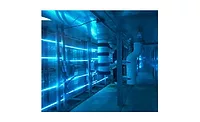
The effectiveness of ultraviolet (UV) light in purifying surfaces is well known. Although all UV light can kill or deactivate pathogens, UV-C wavelengths— ranging from 100 to 280 nm (nanometers)—are the most effective. Specialized lights that emit UV-C can be installed to inactivate viruses, bacteria, mold and fungi.
Typically, these installations are in one of two locations: 1) in filtration systems within HVAC ducting and/or 2) outside of HVAC ducting. If the lights are installed outside of HVAC ducting, they should be positioned near the ceiling to prevent human exposure to UV radiation. In addition, the UV-C unit should be placed so that air recirculates across it, since one pass alone may not have the desired germicidal effect.
Looking for quick answers on air conditioning, heating and refrigeration topics? Try Ask ACHR NEWS, our new smart AI search tool. Ask ACHR NEWS
Widespread testing has yet to be conducted on the ability of UV-C to eliminate SARS-CoV-2, the virus that causes COVID-19. However, it has proven successful in dealing with measles and tuberculosis, as well as viruses other than SARS-CoV-2 that also cause severe acute respiratory syndrome (SARS). It is important to note that, since ultraviolet germicidal irradiation (UVGI) does not physically remove neutralized pathogens from the air, UV-C lights must be used in conjunction with a proper filtration system.
Air Ionization
The technology behind air ionization takes a unique approach to capturing microscopic aerosolized droplets that may contain pathogens, such as the virus that causes COVID-19. In effect, the process—also known as bipolar ionization — “fattens up” virus particles to make it easier for filters to capture them. This is accomplished with high-voltage electrodes that split apart molecules of oxygen into positive and negative ions in a process called ionization. These unstable ions seek out other particles in the air to return them to a balanced state.
As they encounter viruses, bacteria, molds, allergens, odor-causing gases, volatile organic compounds (VOCs), and other particulates, the ionized oxygen molecules grab hold and bind with them. In the process, dangerous pathogens —such as SARS-CoV-2, the virus that causes COVID-19 — are neutralized and can no longer infect a host, such as a human being. The larger-sized molecule that results can be more easily trapped in an air filter.
Air ionization technology has already been proven to neutralize several different viruses. More recently, a scientific study in Spain found that the technology drastically decreased the amount of a virus similar to SARS-CoV-2 that passed into a simulated hospital ward. This study helped to confirm that, when combined with traditional filtration and good ventilation, air ionization can massively decrease the spread of COVID-19.
In fact, Philip Tierno, a clinical professor of microbiology and pathology at the NYU School of Medicine, told Business Insider that air ionization “… can reduce 99.9% of microbes in a matter of minutes.”
Air ionization units are typically easy to integrate with existing HVAC systems and are relatively inexpensive to install. As such, they are a powerful, yet cost-effective, solution for sanitizing indoor air. In addition to its other advantages, air ionization may reduce the need for outdoor air in the overall system, although a trained professional is required to make this determination.
Air Filtration
A study from Harvard’s T.H. Chan School of Public Health found that an increase in air pollution of fine particulate matter of only 1 μg/m3 (one microgram per cubic meter of air) is associated with an 8% increase in the COVID-19 death rate. In other words, there is strong evidence that proper air filtration helps to control the spread of COVID-19 in indoor air.
The effectiveness of an air filter to capture and hold airborne particles is expressed by its MERV, or minimum efficiency reporting value. The MERV of standard filters ranges from one to 16; the higher the number, the better the filtering. ASHRAE reports that filters with a MERV of 13 or higher are efficient at capturing airborne viruses, and that a MERV of 14 or above is preferred.
HEPA (high-efficiency particulate air) and ULPA (ultra-low particulate air) filters go beyond the effectiveness of the highest-rated MERV filters to block bacteria and viruses in indoor air circulation. HEPA filters are required to remove 99.97% of particulates 0.3 μm (microns) in size.
Upgrading the MERV of existing air filters may be a relatively inexpensive solution if efficient filters are already part of the HVAC system. However, it is important to consult a professional before making these changes. Increased air pressure from the higher-MERV filters can have a detrimental effect on an HVAC system if it is not sufficient to handle these filters.
High Ventilation
Proper ventilation is a best practice for indoor air quality. While it is not enough on its own to prevent transmission of the virus that causes COVID-19, mixing a higher than normal amount of conditioned outdoor air into recirculated air can improve indoor air quality as part of a broader strategy to reduce the spread of viruses and other dangerous particulates.
Important considerations in this strategy include the level of allergens and pollutants in the outside air, as well as extremes of temperature and humidity in the area where the building is located. In some limited situations, increased ventilation can be effectively achieved simply by opening windows and doors.
However, a better solution in most cases is to use an air economizer within the existing HVAC system and/or add a dedicated outdoor air system (DOAS), also known as a make-up air unit. A DOAS covers the deficit when an existing system is unable to match the recommended amount of ventilation, improving indoor air quality and helping to control humidity inside a building year-round.
Humidity Control
It is common knowledge that maintaining optimal temperature and humidity in a conditioned space creates a more comfortable environment for guests and employees. But it may be surprising to learn that staying within a proper range of humidity values also plays a key role in minimizing the growth and spread of airborne pathogens, including the virus that causes COVID-19.
The tiniest droplets of virus, called aerosols, can travel long distances while suspended in the air. When these droplets encounter a hydrated host — such as a human being — they can rehydrate and spread. According to the American Society for Microbiology, an indoor relative humidity between 40% and 60% may help to defend against the virus that causes COVID-19 in two important ways. First, it may limit the spread and survival of the virus. Second, it may boost the body’s ability to filter out the virus by keeping mucus membranes hydrated and improving immune system functions.
Using a humidifier within the HVAC system and/or dehumidifying the air with a reheat process or other technique can help to achieve and maintain the proper humidity.
Content provided by CoolSys.
Looking for a reprint of this article?
From high-res PDFs to custom plaques, order your copy today!