Latest Guidelines For Mitigating Spread Of COVID-19
Webinar series details how to reduce virus transmission in commercial buildings
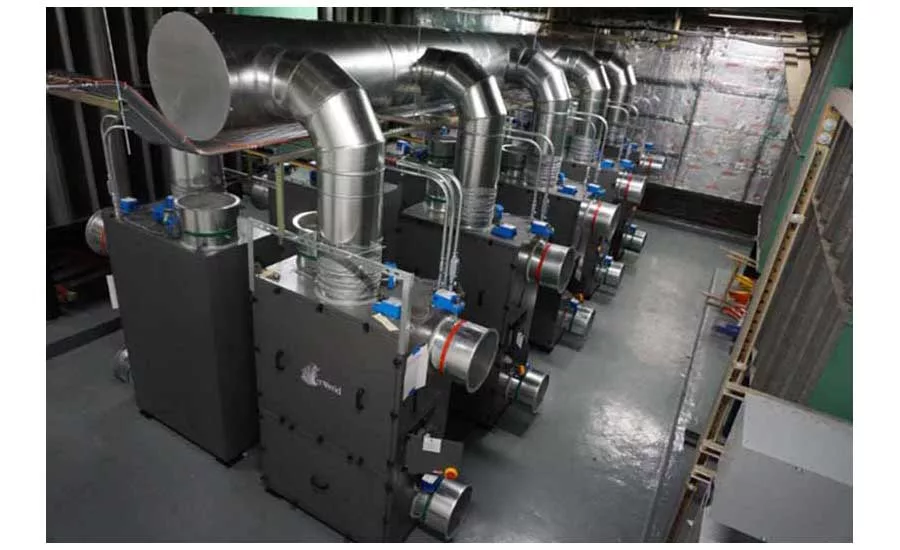
Mitigating the spread of the COVID-19 virus is top of mind for just about every commercial building owner and manager in the U.S. and around the world. With so much demand for information, enVerid — a provider of commercial IAQ solutions — hosted a webinar series that featured industry experts explaining how the COVID-19 virus spreads, as well as how to reduce its transmission in buildings.
Transmission & Mitigation
In the first webinar, Luke Leung, P.E., LEED Fellow, leader of the commercial team for the ASHRAE Epidemic Task Force and director of sustainable engineering at Skidmore, Owings & Merrill, Chicago, Illinois, shared the latest research on airborne transmission and mitigation strategies.
He said that there is a lot of evidence that the COVID-19 virus is airborne and can survive for some time in the air and on surfaces, noting that this has been affirmed by both the World Health Organization and the Centers for Disease Control (CDC).
“On July 9, the WHO came out with a statement saying that there’s a potential for airborne transmission,” said Leung. “Then on Oct. 5, the CDC said the element could go more than six feet away, potentially infecting people. And what’s interesting is that they said it can potentially infect people shortly after the COVID-19 positive person left an area. Now they didn't say whether this is airborne, or if the person touched the surface and you touch the surface. Whatever the path is, they did mention that when somebody has COVID and uses the space and leaves and you walk right into it, there's a potential that you can get infected.”
He added that environmental factors such as temperature, humidity, and light have a significant impact on the survival of the virus in the air and on surfaces and that high-efficiency filters are nearly as effective as dilution with outside air from a risk standpoint and significantly more cost effective from an energy consumption and cost standpoint.
“Winter's coming, and we are thinking about winterizing our buildings,” he said. “If you've been using the economizer cycle for 100% outside air during early fall, that’s fine. But when winter comes and you worry about energy consumption, I think the good news here is you can achieve very close performance to 100% outside air by having a very good filter and recirculating the indoor air.”
ASHRAE Recommendations
In the second webinar, William Bahnfleth, Ph.D., P.E., FASHRAE, FASME, FISIAQ, chair of ASHRAE’s Epidemic Task Force and professor of architectural engineering at Penn State University, previewed ASHRAE’s new core recommendations for COVID-19 mitigation. These include:
- Following public health guidance, such as wearing masks, social distancing, and washing hands;
- Assessing HVAC systems to ensure they’re operating as intended;
- Ensuring required minimum outdoor air ventilation (using ASHRAE 62.1 as a baseline), upgrading filters (MERV 13) for recirculated air, and supplementing with standalone HEPA filters, UV-C, or other technologies demonstrated to be effective/safe to exceed baseline outdoor air and filtration requirements (e.g., air change targets); and
- Improving air distribution, such as promoting mixing without creating strong drafts.
“There are also several recommendations that could be classified as controls or operational measures, such as maintaining temperature and relative humidity setpoints and maintaining design outdoor airflow under off-peak conditions,” he said. “Use the occupied mode when people are present (including workers and cleaning crew), and flush preoccupancy to remove any residual contamination in the air in the building. And finally, our last recommendation is that in some circumstances, either at-risk populations such as nursing homes or long term care facilities or when high risk activities are going on, there might be other aspects of mitigation that are needed.”
Looking for quick answers on air conditioning, heating and refrigeration topics? Try Ask ACHR NEWS, our new smart AI search tool. Ask ACHR NEWS
The foundation of ASHRAE’s response to the pandemic has been to apply the precautionary principle based on the perception of the risk of airborne transmission, said Bahnfleth. Back in April, ASHRAE posted a statement that said, “The transmission of SARS-CoV-2 through the air is sufficiently likely that airborne exposure to the virus should be controlled. Changes to building operations, including the operation of heating, ventilating, and air-conditioning systems, can reduce airborne exposures.” And that is what is behind what ASHRAE is doing, he said.
“In terms of mitigating overall risk, where HVAC fits in is not clearly established,” he said. “But we know if we do a bad job, we're increasing risk, creating the possibility that airborne transmission will occur. So that's the fundamental problem. Risk cannot be quantified very accurately, and yet, we're trying to provide some guidance that will result in ways to safely occupy buildings.”
That guidance is also evolving. While ASHRAE’s initial guidance in April and May was very conservative and had little consideration for cost and operational impacts, ongoing reassessment has led to refinements that achieve similar levels of protection with lower cost and energy use impact.
“For ventilation, we recognize that increasing it is expensive and energy intensive and that there are limits to how much you can increase it based on temperature and humidity control,” said Bahnfleth. “Increasing outdoor air for most systems means that you're decreasing recirculation through filters, which means that they do less good. So there's an adverse trade off there, not a synergy. And the theoretical ability to vary the outside air varies widely.”
Another ventilation consideration is whether the system should operate 24/7 if nobody is in the building. Bahnfleth said that only three to five air changes are needed to clear out whatever is in the air when occupancy ends, and that can be achieved in an hour or two with proper filters.
“We have evidence that better filtration is as effective as ventilation and lower cost,” he said. “A recent study shows that filters are very effective at reducing the relative risk of infection down to about MERV 13 compared to ventilation. After MERV 13, at least in the office building context in the study, it seems that you can pay more for filters, but you don't get a lot of additional performance out of them. So this is one of the key pieces of research that we think is justification for focusing more on air cleaners than on increased ventilation in almost every situation.”
As for the role that temperature and humidity control play in mitigating the spread of SARS-CoV-2, that has been a source of debate amongst some industry groups, said Bahnfleth. “We're not entirely sure what the relative contribution to risk is simply from controlling temperature and humidity — is it really going to make a big difference, given all of the other things that we're doing to reduce risk and the timescale on which exposure happens?”
He added that there has been a lot of research conducted on how air temperature and humidity affects pathogens and, to some extent, infection risk. Elevated temperatures tend to reduce the survival of microorganisms in the air, and there have been studies that show that overall infection risk is minimized if relative humidity stays between 40% and 60%. But that is not true in all cases, as viruses exhibit pathogen-specific behaviors.
“The main concerns are what happens in some buildings if you try to modify the temperature and humidity?” said Bahnfleth. “We’re particularly concerned about moisture damage and mold growth and in very dry climates where this may be difficult. And also in in very cold climates. Also, different pathogens respond differently, so it's a long-term strategy for future standards. I don't know what the outcome will be.”
In conclusion, Bahnfleth said that making recommendations during the pandemic is an exercise in engineering judgment combined with understanding the science, and ASHRAE is filling in the gaps as best as it can.
“We think we've done the best job that we could do in reassessing and updating the recommendations to improve the cost effectiveness and the energy impact,” he said. “But HVAC protections only affect one of the transmission modes, so we have to combine that with all the other [core recommendations] to get really good protection and to be safe in our buildings.”
Along with these webinars, a third concerning new methods for modeling COVID mitigation approaches will be available online at: https://enverid.com/resources/webinar-series-covid-iaq-new-best-practices/.
Looking for a reprint of this article?
From high-res PDFs to custom plaques, order your copy today!