ACHR News
search
Ask ACHR NEWS AI
cart
facebook twitter instagram linkedin youtube
  • Sign In
  • Subscribe
  • Sign Out
  • My Account
ACHR News
  • NEWS
    • Breaking News
    • New HVAC Products
    • Featured Products
    • Manufacturer Reports
    • HVAC Data
    • Legislation
    • ACHR NEWS Centennial
  • RESIDENTIAL
    • Air Conditioners
    • Furnaces
    • Residential Heat Pumps
    • Ductless
    • Residential IAQ
    • Testing, Monitoring, Tools
    • Components & Accessories
  • COMMERCIAL
    • Air Handlers
    • Rooftop Units
    • Chillers and Cooling Towers
    • Commercial Heat Pumps
    • Boilers and Hydronics
    • VRF/Ductless
    • Commercial IAQ
  • REFRIGERATION
    • Refrigerants
    • Refrigerant Regulations
    • Leak Management
  • CONTRACTOR PRO
    • Geothermal
    • Homeowner Study
    • VRF and VRV Ductless
    • Unitary Trends
  • EDUCATION
    • Training and Education
    • Business Management
    • Service and Maintenance
    • Continuing Education
    • Market Research >
      • HVAC Brand Awareness Report
      • VRV, VRF, VRVZ Report
      • Unitary Trends Report
      • Water Heat Professionals Report
    • Webinars
    • Sponsor Insights
    • eProducts Info
    • White Papers
  • EVENTS
    • HVAC Contractor Forum
    • Industry Events and Webinars
  • MEDIA
    • Videos
    • AHR Expo 2025 Videos
    • Podcasts >
      • ACHR News Podcast
      • HARDI Podcasts
      • AHR Expo Podcasts
      • ACCA Podcasts
    • Interactive Spotlights
    • Quizzes
    • eBooks
    • HVAC Talkback
  • HVAC GROUP
    • ACHR NEWS >
      • Current Issue
      • Digital Edition
      • Subscribe
    • Distribution Trends
    • SNIPS NEWS >
      • Join SNIPS NEWS
    • Engineered Systems News >
      • Join ES News
    • HVACR Directory
    • Contests
    • Newsletters
    • Contact
    • Advertise
    • My Account
NewsService and MaintenanceVentilation

Add the Airside to Your Start-Ups

Don’t forget vital steps in haste to get job done
By David Richardson
Add the Airside to Your Start-Ups
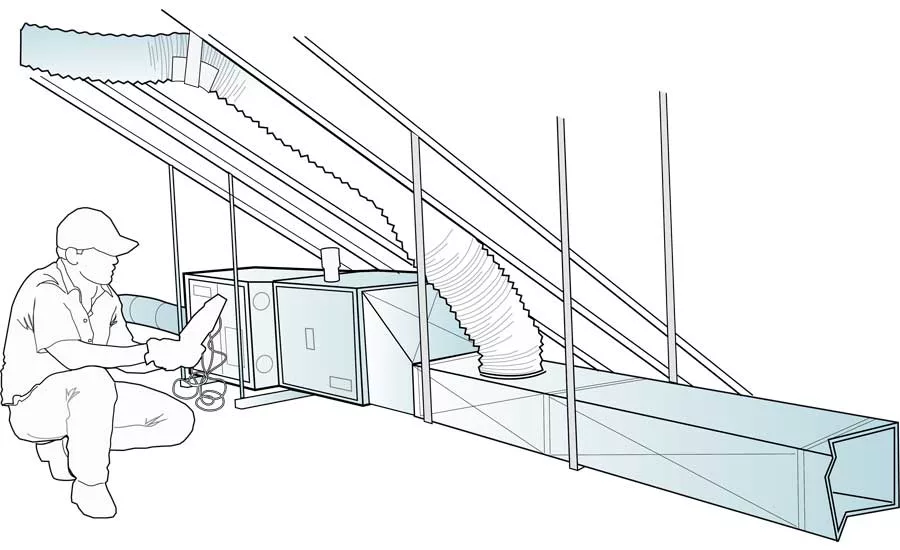
Adding the airside to an equipment start-up doesn’t have to be hard. Yet it does need a written process that’s easy to follow and consistent.
June 10, 2020

Most of us have rushed through an equipment start-up. It’s not right, but we’ve done it. We take the basic readings such as refrigerant pressures, suction and liquid line temperatures, equipment temperature change (∆t), and we’re on our way.

Unfortunately, these are the systems we often go back on. In our haste to get the job done, we forget vital steps that may prevent a callback. Many of these callbacks are airflow related issues. However, we missed them because we didn’t have the right information.

Adding the airside to an equipment start-up doesn’t have to be hard. Yet it does need a written process that’s easy to follow and consistent. Let’s look at some information you can add to your equipment start-ups to assure you don’t overlook an airside problem.

READ MORE ABOUT

• Ventilation

• Airflow Management


Nameplate Data

Nameplate data provides you with important airside information that’s easy to overlook. You can find a lot of issues upfront as you gather it. Start at the air-handling equipment and locate the indoor nameplate.

Look for the model number first. Be aware that every manufacturer uses a different method to identify their equipment. So, it’s a good idea to have the manufacturer’s installation instructions on hand. Use the model number to identify fan tonnage and equipment airflow capacity. Also, look for the maximum-rated total external static pressure (TESP). It’s the baseline for your measured static pressure.

Next, look at the indoor coil model number. You need it to locate the correct coil pressure drop tables. Use them to see what coil pressure drop should be at the required fan airflow when wet or dry.

Once you have the indoor equipment information, go to the outdoor unit, and get its model number. You'll need to interpret tonnage from the model number to establish airflow requirements. Look in the equipment manufacturer's instructions to assure you correctly read this number.

Looking for quick answers on air conditioning, heating and refrigeration topics? Try Ask ACHR NEWS, our new smart AI search tool. Ask ACHR NEWS →


Fan Settings

To find the fan settings, first, check to see what type of blower is in the equipment. The three most common types are constant speed, variable-speed, and constant-torque.

Once you identify the blower type, record the fan-speed settings for heating and cooling operation. Constant-speed blowers often have two to four speed-tap options plugged into quarter-inch tabs on a relay or control board. Variable-speed blowers use dip switches or jumpers on a control board. Finally, constant-torque blowers use a low-voltage tap labeled one through five. You'll need the equipment installation instructions and/or a wiring diagram to interpret these settings.


Filter Sizes and Media Type

While you're at the air-handling equipment, go ahead and get the filter information. You'll want to record filter height, width, and thickness. It's also a good idea to record the media type and manufacturer.

It’s a good idea to document the filter’s installation date (on its border) so there’s no doubt about the last filter change. If the system has return air-filter grilles, record the media size and type in each filter grille in case they change.


Static Pressure Readings

After you record the equipment information, measure static pressure. Before you test, you'll need to install test ports into the equipment and duct system. Look at the equipment type and location to determine correct locations. Most systems need four test ports.

Next, take your static pressure readings. TESP is the first test to measure and record. Measure pressure entering and exiting the equipment and then add them together. Compare your measured TESP to the maximum rated TESP. If measured TESP is high, the system’s operating conditions could be restrictive. It's important to remember this reading will tell you if there is a problem, but it won't identify what it is.

Filter pressure drop is the next static pressure test. Measure pressure before and after the filter and then subtract them. If filter pressure drop exceeds 20 percent of maximum rated TESP, there's a good chance the filter is too restrictive.

Next, measure coil pressure drop. Measure pressures before and after the coil and then subtract them. Note the coil’s wet or dry condition, because there can be a huge difference between the two. Ideally, coil pressure drop shouldn't exceed 40 percent of maximum rated TESP. However, it can be hard to find a coil that fits these recommendations.

Finally, record the supply and return duct pressures. This is a single reading taken in the plenum of each duct system. It represents the pressure on that side of the duct system and shouldn't exceed 20 percent of maximum rated TESP.

If you're lucky, all pressure measurements are within these values. If they are excessive, it can indicate airflow restrictions. You need to investigate and discover why the pressures are so high.


Plot Fan Airflow

Once you have your static pressure measurements, locate the manufacturer's fan table so you can plot fan airflow. This is a simple and quick way to estimate equipment airflow.

To plot fan airflow, use the correct fan table, your measured TESP, and the operating fan speed. Locate the measured TESP and fan speed on the fan table and intersect the lines. Where they come together is the plotted fan airflow. It should be plus or minus 10 percent of required airflow.


Job Photos

After you take your static pressure measurements and plot fan airflow, it's a good idea to take photos of the system installation. Document installation conditions and what the equipment looks like for future reference. Technicians who go back to maintain and service the equipment will thank you for them.

Without the photos, the test measurements only tell part of the story. The readings bring the photos to life. Consider taking photos of nameplates and different system components. It's also a good idea to take photos of the duct system, return grille locations, and the outdoor unit.

If there are additional areas of concern, document them with photos and show the customer.


Add Something More

Take a little extra time now and go one step further to reduce future headaches. With a little practice, you can add these simple steps to your startup procedures. As a result, you will reduce your headaches and callbacks.

KEYWORDS: airflow management Duct Dynasty ductwork HVAC service ventilation control

Share This Story

Looking for a reprint of this article?
From high-res PDFs to custom plaques, order your copy today!


David richardson
David Richardson serves the HVAC industry as Vice President of Training for National Comfort Institute, Inc. (NCI). NCI specializes in training focused on improving, measuring, and verifying HVAC and Building Performance. If you’re an HVAC contractor or technician interested in learning more about building science applied to HVAC, contact David at ncilink.com/ContactMe.

Recommended Content

JOIN TODAY
To unlock your recommendations.

Already have an account? Sign In

  • HVAC-enrollment

    The Trades Are Back: HVACR Programs See Nearly 30% Enrollment Spike

    A new wave of future technicians is entering the pipeline.  
    Training and Education
    By: Matt Jachman
  • 2025 Top 40 Under 40

    2025 Top 40 Under 40 HVACR Professionals List

    The 11th annual Top 40 Under 40 list highlights those...
    HVAC Residential Market
    By: Hannah Belloli-Oster
  • LG Ductless Mini-Split Systems

    The 9 Types of Heat Pumps

    As the U.S. moves toward electrification, heat pumps are...
    Ground Source Heat Pumps
    By: Joanna R. Turpin
Subscription Center
  • Create an Account
  • Start a Subscription
  • Manage My Account
  • Sign Up for Newsletters
  • Visit Customer Service
  • Update Preferences

More Videos

Sponsored Content

Sponsored Content is a special paid section where industry companies provide high quality, objective, non-commercial content around topics of interest to The News audience. All Sponsored Content is supplied by the advertising company and any opinions expressed in this article are those of the author and not necessarily reflect the views of The News or its parent company, BNP Media. Interested in participating in our Sponsored Content section? Contact your local rep!

close
  • Piggy Bank
    Sponsored byWatercress Financial

    Energy Prices, Inflation, and HVAC: What Today’s Homeowners Care About

  • Refrigerated Food
    Sponsored bySolstice Advanced Materials

    R-455A Refrigeration: A Cold Storage Solution for the Future

  • Airex Rooftop Units
    Sponsored byAirex Manufacturing Inc

    Consolidating Roof Penetrations: A Growing Trend in Multifamily HVAC Design

Popular Stories

Lennox equipment

Platinum Equity to Sell Heat Controller to Lennox

HVAC-tech-van.jpg

Report: Only 65% of HVAC Technician Time is Billable Hours

HVAC Minute retail refrigeration system

EPA Final Rule’s Impact on R-410A Deadlines

Trade groups challenge EPA refrigerant rule

HVACR Trade Groups Challenge EPA Refrigerant Rule in Federal Court

heat-pump-tech-customer.jpg

DOE Updates $8.8B Home Energy Rebate Program Guidance

View The ACHR NEWS
Centennial Anniversary Timeline

The ACHR News Timeline Chart
Submit a Letter
Submit a letter to our editors.

Events

November 6, 2025

Next-Gen Data Center Cooling: HVAC Innovation and Real-World Solutions

On Demand As AI workloads and high-density computing push traditional cooling methods to their limits, the data center industry is accelerating the adoption of next-generation HVAC technologies.

July 28, 2026

How Top Home Services Companies Turn Every Conversation Into Predictable Revenue

In this webinar, we'll outline how top contractors are turning every conversation into predictable revenue by coaching every comfort advisor visit, not just the ones a manager rides along on.

View All Submit An Event

Poll

Summer Staff

Are you fully staffed for the summer season?
View Results Poll Archive

Products

BNI Mechanical/Electrical Square Foot Costbook, 2026 Edition

BNI Mechanical/Electrical Square Foot Costbook, 2026 Edition

See More Products
Designing Systems Using A2L Refrigerant - Free Webinar - 7/22/2026

Related Articles

  • Seasonal Start-ups: They're Not as Simple as You Think

    See More
  • Duct Dynasty

    Add Air Diagnostics to Your Company in Eight Steps

    See More
  • Combustion Testing

    How to Add Combustion Testing Services to Your Company

    See More

Related Products

See More Products
  • front cover only.jpg

    How to Market Your HVAC Business

  • potentialrelaysdvd.jpg

    Understanding Potential Relays and Start Capacitors DVD

  • new cover.jpg

    Profit is An Attitude: The Strategies You Need to Optimize Profits

See More Products

Related Directories

  • UPE Co.

    End of life HVAC services, recovery & purchasing of Lithium Bromide Solution and refrigerants. We purchase air-cooled, absorption, centrifugal chillers and Rooftop Package Units. Do not scrap your old equipment until you speak to us.
×

Sign Up. Stay Informed.

The #1 trusted source for the HVACR industry since 1926

SUBSCRIBE
  • RESOURCES
    • Advertise
    • Contact Us
    • Advisory Board
    • Classifieds
    • Submit a Letter
    • Directories
    • Store
  • ACCOUNT CENTER
    • Create an Account
    • Start a Subscription
    • Manage My Account
    • Sign Up for Newsletters
    • Visit Customer Service
    • Update Preferences
  • SERVICES
    • Marketing Services
    • Reprints
    • Market Research
    • List Rental
    • Survey/Respondent Access
  • STAY CONNECTED
    • LinkedIn
    • Facebook
    • Instagram
    • YouTube
    • X (Twitter)
  • PRIVACY
    • PRIVACY POLICY
    • TERMS & CONDITIONS
    • DO NOT SELL MY PERSONAL INFORMATION
    • PRIVACY REQUEST
    • ACCESSIBILITY

Copyright ©2026. All Rights Reserved BNP Media, Inc. and BNP Media II, LLC.

Design, CMS, Hosting & Web Development :: ePublishing