Don’t Confuse a Frosted Evaporator Coil With Refrigerant Overcharge
Never add or subtract refrigerant from a system until the problem is determined
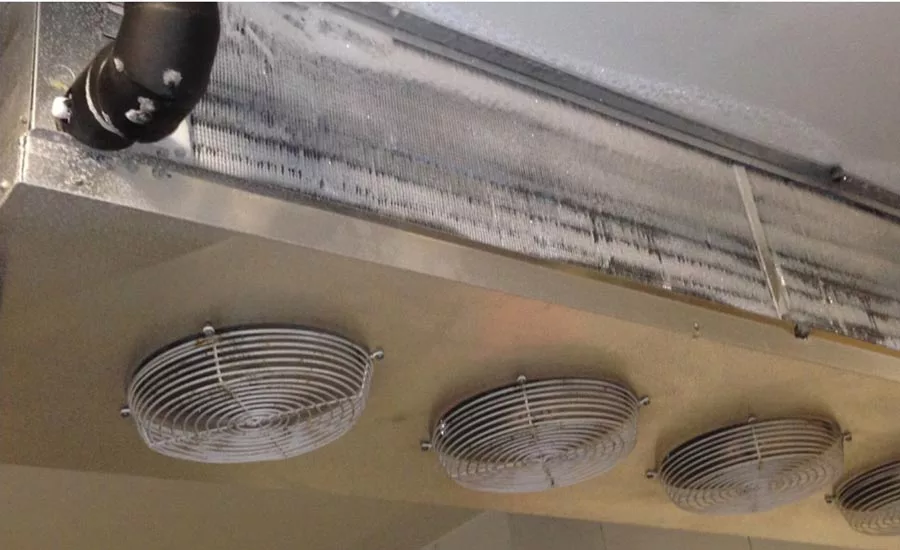
Technicians often confuse symptoms of a refrigeration system that has a frosted evaporator coil with a system that is severely overcharged with refrigerant. Hopefully, this article can clear up any misconceptions between these two system problems.
Let’s look at what happens as frost starts to accumulate on an evaporator coil. Frost on an evaporator coil will prevent the correct amount of airflow across the coil. Anytime the evaporator coil sees reduced airflow across its face, there will be a reduced heat load on the coil. Low airflow and less heat load across the evaporator coil can cause much of the refrigerant in the coil to remain a liquid and not vaporize as fast. Some liquid refrigerant may travel past the evaporator coil, through the suction line, and eventually get to the compressor. Compressor damage will soon occur from compressor flooding and/or slugging.
A dirty evaporator coil can also cause a reduced airflow across the evaporator, which will in turn cause a reduced heat loading on the refrigeration system. So, for practical purposes, a dirty evaporator coil and a frosted evaporator coil will have the same symptoms.
There are several system problems that can reduce the airflow and heat loading across an evaporator coil and cause frost to accumulate. They include an inoperative defrost heater, a burned-out evaporator fan, not enough heat load on the evaporator coil, a dirty evaporator coil, high humidity situation from door openings, defrost intervals set too far apart, and defrost component malfunctions, to name a few.
FROST
The dew point temperature is the temperature at which dew starts to form. When the evaporator’s coil temperature drops below the dew point temperature, dew will begin to collect on the evaporator’s cool surface. If the temperature of the evaporator coil continues to drop below the freezing point of water, the moisture on the evaporator’s coil will begin to freeze into a thin layer of ice.
The first thin layer of solid ice on the evaporator coil will actually enhance the evaporator’s efficiency; however, as more ice forms on the evaporator’s coil, it becomes more porous. This more porous type of ice is often referred to as frost. Frost insulates the evaporator coil from heat loads trying to be absorbed by the vaporizing refrigerant within the evaporator’s coil. As frost accumulates, the evaporator will see less heat being absorbed from the refrigerated space. This will cause the evaporator (suction) pressure, thus evaporator temperature, to drop and the evaporator coil will become colder. The drop in suction pressure will then cause higher compression ratios, which will cause lower compressor volumetric efficiencies, less dense refrigerant return gases entering the compressor, reduced mass flow rates of refrigerant, and loss of system capacity.
Severe cases of evaporator frosting can cause liquid refrigerant to return to the compressor. As mentioned above, a result of this insulating effect is a lower evaporator pressure, causing the temperature of the evaporator coil to be reduced to maintain the same desired refrigerated space temperature. The temperature difference (TD) between the evaporator coil and the refrigerated space will then be greater.
Looking for quick answers on air conditioning, heating and refrigeration topics? Try Ask ACHR NEWS, our new smart AI search tool. Ask ACHR NEWS
INTERNAL PROBLEMS
The compressor is often the major component in the refrigeration system that will suffer from a severely frosted evaporator coil. Many times, a service technician will change out a compressor because of broken internal parts and not find the actual cause of the problem. That’s because the compressor with broken parts is not the cause of the problem. The cause could have been a faulty time clock or an open defrost heater not letting the system defrost properly. This would frost the evaporator coil, causing flooding or slugging of the compressor. This frosting of the evaporator coil would probably then have caused the broken internal parts in the compressor.
If the technician did not perform a system check list and run the system through its modes after changing the compressor, the new compressor is sure to fail for the same reasons.
Compressor manufacturers often ask technicians to examine the broken-down compressors for the cause of failure. Opening a semi-hermetic compressor and examining its internal parts does not void the warranty as long as all of the parts are returned with the old compressor.
The technician should make a list of the causes that could be blamed for this failure and eliminate them one by one once the system is up and running. For example, an electrically open defrost heater could be the cause for a frosted evaporator coil and ruined compressor. If the system is not run and put through the defrost mode, or systematically checked with an ohmmeter and voltmeter, the real problem of an electrically open defrost heater will never be found, and the replacement compressor will soon fail.
SEVERELY FROSTED COIL
Below is a system checklist for an R-134a medium-temperature refrigeration system that is suffering from a severely frosted evaporator coil. It has a thermostatic expansion valve (TXV) metering device incorporating a receiver:
- Compressor discharge temperature: 88°F
- Condenser outlet temperature: 82°F
- Evaporator outlet temperature: -9°F
- Compressor inlet temperature: -9°F
- Ambient temperature : 75°F
- Refrigerated box temperature: 44°F
- Compressor amperage: High
- Evaporating pressure: 2.2 psig (-9°F)
- Condensing pressure: 104 psig (90°F)
- Condenser split: 15°F
- Condenser subcooling : 8°F
- Evaporator superheat: 0°F
- Compressor superheat: 0°F
Symptoms for a system with a severely frosted evaporator coil:
- Low discharge temperatures;
- Low head pressures;
- Low condenser splits;
- Normal condenser subcooling;
- Low to normal evaporator (suction) pressures;
- Low superheats;
- Cold compressor crankcase; and
- High to normal amp draw.
Since both evaporator and compressor superheats are extremely low, the evaporator is flooded with refrigerant, and the compressor will soon be flooding. The compression stroke could soon contain liquid entrained with vapor (wet compression). The heat of compression will hopefully vaporize any liquid. This vaporization process needs heat and will get it from the heat of compression. This will take heat away from the compressor’s cylinder and leave a colder discharge temperature. Also, with no heat load to be rejected in the condenser, the condensing pressure and temperature do not have to elevate to reject heat to the ambient. Low condensing pressures are the result. With condensing pressures and temperatures low, the condensing split will be low. The condenser does not have to elevate its temperature to reject the small heat load, and the condenser subcooling will be normal.
Because the evaporator coil is experiencing a reduced heat load, the refrigerant vaporization rate will be reduced. This will give lower vapor pressures in the low side of the system. Since the heat load on the evaporator coil is reduced, not much refrigerant will be vaporizing. The 100 percent saturated vapor point in the evaporator will crawl down past the end of the evaporator, and the TXV will usually lose control. Compressors can slug and/or flood in these situations.
There will be liquid refrigerant in the compressor’s crankcase boiling off. This will flash the oil and eventually cause compressor damage. It is the boiling of refrigerant in the crankcase that will make the crankcase cold to the touch. The crankcase may even sweat or frost if conditions are right. Since droplets of liquid refrigerant will be entrained with the suction vapors, the amp draw may be a bit high depending on the severity of the flooding or slugging.
SEVERELY OVERCHARGED SYSTEM
Let’s compare the frosted evaporator coil system above with a system that is severely overcharged with refrigerant. This system is also a medium-temperature, TXV/receiver system with R-134a as the refrigerant:
- Compressor discharge temperature: 220°F
- Condenser outlet temperature: 90°F
- Evaporator outlet temperature: 35°F
- Compressor inlet temperature: 37°F
- Ambient temperature : 70°F
- Box temperature: 42°F
- Low side (evaporator) pressure: 30.4 psig (35°F)
- High side (condensing) pressure: 199 psig (130°F)
- Condenser split: 60°F
- Condenser subcooling : 40°F
- Evaporator superheat: 0°F
- Compressor superheat: 2°F
Symptoms for a severely overcharged system:
- High discharge temperature;
- High condenser subcooling;
- High condensing pressures;
- Higher condenser splits;
- High evaporator pressures; and
- Low superheats.
Liquid refrigerant backed up in the condenser from the severe overcharge of refrigerant will flood much of the condenser’s internal volume, causing high head pressures, high condenser splits, and high condenser subcooling. Remember, any liquid in the condenser lower than the condensing temperature is considered subcooling. This can be measured at the condenser outlet with a thermometer or thermocouple. Subtract the condensing outlet temperature from the condensing temperature to get the amount of liquid subcooling in the condenser.
A forced air condenser used in refrigeration should have at least 6-8°F of liquid subcooling in the condenser; however, subcooling amounts do depend on system piping configurations and liquid line static and friction pressure drops. Condenser subcooling is an excellent indicator of the system’s refrigerant charge: the lower the refrigerant charge, the lower the subcooling, and the higher the refrigerant charge, the higher the subcooling.
The condenser split is the difference between the condensing temperature and the ambient temperature. Higher condensing temperatures give higher condenser splits. A dirty condenser will also give a system high condenser splits, but the condenser subcooling will not be as high as with an overcharged system.
When the refrigerant overcharge is excessive, the evaporator’s higher pressure will be caused by the decreased mass flow rate through the compressor from high compression ratios, causing low volumetric efficiencies. The evaporator will have a harder time keeping up with the higher heat loads from the warmer entering-air temperature. The TXV will also have a tendency to overfeed refrigerant to the evaporator on its opening stroke due to the high head pressures causing low superheats.
SYSTEM COMPARISON
As can be seen by looking at the system checks for both systems, the evaporator superheats and compressor superheats are low in both scenarios. This means that the TXV has lost control and is about to flood — or is flooding — the evaporators and compressors. Often, technicians will see low superheat and automatically think the system is overcharged with refrigerant; however, the technician must also look at the system’s condenser subcooling and evaporator pressure before making a decision as to whether the system is overcharged.
It is the high condenser subcooling amount (40°F) in the overcharged system that differentiates it from the lower subcooling (8°F) in the system with the frosted coil. Liquid refrigerant backed up in the condenser from the severe overcharge of refrigerant will flood much of the condenser’s internal volume, causing high head pressures, high condenser splits, and high condenser subcooling.
A system with a frosted evaporator coil will have normal condenser subcooling. Many technicians will take refrigerant out of the system with a frosted coil when it is actually properly charged — the system simply has a frosted coil that is causing the low superheats, not an overcharge of refrigerant. So remember, low or no superheats at the evaporator and compressor doesn’t necessarily mean an overcharged system.
Another parameter to look at with both systems is the evaporator or low-side pressure. A system with a frosted coil has an evaporator insulated from external heat loadings, so its pressure will be low. Notice the low evaporator pressure of 2.2 psig (minus 9°F) in the system check for a frosted evaporator coil. Compare that to the evaporator pressure of 30.4 psig (35°F) for the overcharged system. The evaporator coil in the overcharged system has no frost and is experiencing a heavy heat loading from a refrigerated box temperature of 42°F. It also has a coil flooded with refrigerant from the TXV losing control. Both of these factors will generate high evaporator (suction) pressures.
In conclusion, the system with a frosted coil will experience low suction pressures and normal subcooling, whereas the severely overcharged system will experience high suction pressures with high subcooling. Never add or subtract refrigerant from a system unless a system check is performed and analyzed.
See more articles from this issue here!
Looking for a reprint of this article?
From high-res PDFs to custom plaques, order your copy today!