Understanding Energy Recovery in Rotary Heat Exchangers
Key technical elements that affect energy efficiency

Understanding Energy recovery in rotary heat exchangers- Key technical elements that affect energy efficiency
Heat recovery systems can be divided into two categories based on the thermal parameters of the system: Systems for energy recovery and conversion from waste heat with high thermal parameters (above 70oC) and systems for energy recovery and conversion from waste heat with low thermal parameters (below 70oC).
Heat recovery and energy conversion systems above 70oC are used in technological processes that take place in the energy, food, chemical, and other process-based industries where large amounts of waste heat are released. This waste heat with high thermal parameters can be used to improve the energy and economic efficiency of enterprises by directly heating air in ventilation systems or by augmenting technological processes requiring higher temperatures (e.g. the heat source for heat pumps used for pasteurization in the food industry, or for the production of electricity in the organic Rankine Cycle or Kalina Cycle systems). Waste heat with such elevated thermal parameters can also be used for refrigeration and air-conditioning processes (e.g. converting thermal energy into chilled water using absorption or adsorption chillers).
Heat recovery and energy conversion systems below 70oC are most often used for heating purposes in residential buildings (e.g. underfloor heating with the use of heat pumps) or commercial buildings (e.g. in air handling units (AHU) for heating "fresh" or “outdoor” air by recovering heat from "used" or “exhaust” air). This article will focus on commercial building applications.
Heat recovery systems in air handling units are based on two systems that, depending on the type of solution adopted in the unit's design, consume electricity (active systems) or not (passive systems). Active heat recovery systems in air handling units include, for example, systems based on rotary heat exchangers or reversible heat pumps. Passive heat recovery systems include cross and hexagonal heat exchangers. Characteristic for heat recovery in ventilation systems is that heat is recovered at small temperature differences between the higher temperature air stream and the lower temperature air stream, with the higher temperature air rarely exceeding 30oC (in commercial buildings, heat recovery takes place even at lower air temperatures).
Most often, heat recovery in ventilation and air-conditioning units is carried out using rotary or cross-flow (hexagonal) heat exchangers, less often using heat pumps. Rotary heat exchangers are used in AHUs where mass exchange between inlet and outlet air in the AHU is allowed (these are usually public buildings). Cross-flow and hexagonal heat exchangers are used in air handling units where mass exchange between fresh and used air cannot be allowed (e.g. hospitals). Reversible heat pumps are used when high temperature supply air is required for heating purposes.
Mass and energy balance in heat exchangers used in air handling units
When calculating rotary heat exchanger performance for heat recovery in air handling units, in addition to energy balance, an appropriate mass balance is required. The following are energy and mass balance equations for steady-state flow conditions with the following assumption. Periodic parameter changes resulting from the exchanger's rotational movement are averaged in the overall energy and moisture balance — that is, periodic local changes in temperature and humidity on the surface of the rotating wheel are insignificant and thus omitted in the calculations.
a) Mass, concentration, and energy balance for rotary heat exchangers:
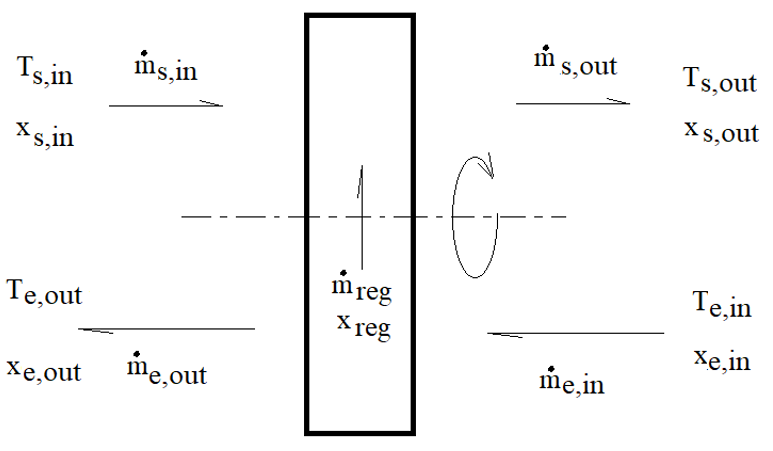
Click calculations to enlarge
Diagram of calculation parameters for rotary heat exchangers
Mass balances for outdoor air (supply air)
ṁs,out = ṁs,in + ṁreg
Looking for quick answers on air conditioning, heating and refrigeration topics? Try Ask ACHR NEWS, our new smart AI search tool. Ask ACHR NEWS
Mass balances for exhaust air
ṁe,out = ṁe,in - ṁreg
Mass concentration of water and air (for humid outdoor air)
xs.outṁs,out = xs.inṁs,in + xs.regṁreg
Mass and air mass concentration balances (for moist and exhaust air)
xe.outṁe,out = xe.inṁe,in - xs.regṁreg
Total energy balance excluding energy supplied to the rotary heat exchanger drive
ṁe,inh(Te,in,xe,in) - ṁe,outh(Te,out,xe,out) + ṁs,inh(Ts,in,xs,in) - ṁx,outh(Ts,out,Xs,out) = 0
To additionally obtain parameters related to the selection of heat exchange surfaces for rotary exchangers, in both cases the equations related to logarithmic temperature should be used. In the case of a rotary heat exchanger, which additionally allows for absorption and recovery of moisture, one can also determine the required absorber surface from equations related to the logarithmic concentration difference by analogy of heat exchange and diffusion mass movement.
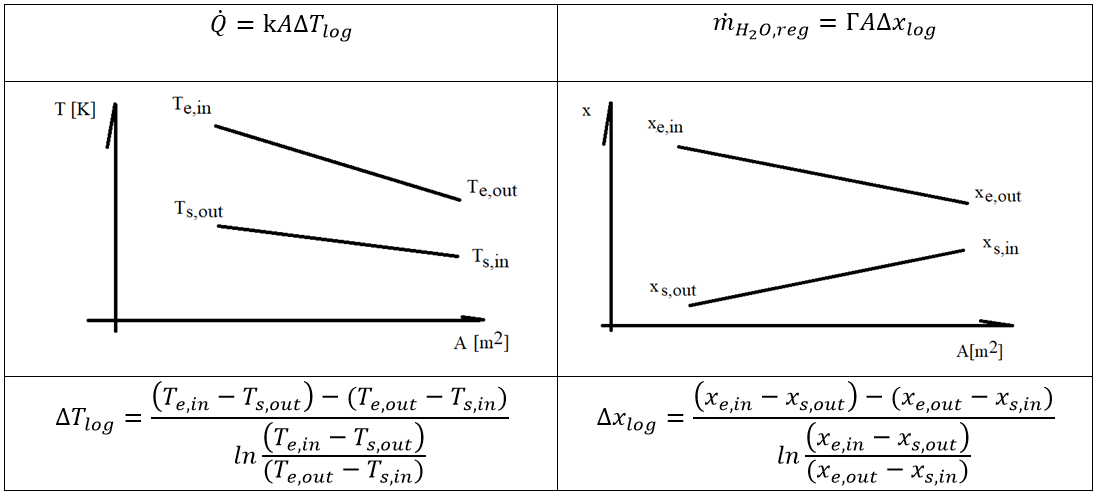
Click calculations to enlarge
For a proper description of the process of moisture absorption from the air into the absorber layer and vice versa, it is necessary to know the mass transport factor Γ (mass transfer), which may be dependent (similar to heat transfer) on such parameters as:
- exchanger rotations
- density of the absorbing substance (r)
- absorber layer thickness (or absorber diffusion layer thickness), (d)
- moisture diffusion coefficient in the air (Dg)
- moisture diffusion coefficient in the absorber layer (Da)
- Schmidt numbers (Sc)
- absorber layer temperature (T)
- Reynolds numbers (Re)
- and others
For the purpose of selecting a heat exchange surface, knowledge of the heat transfer coefficient k [W / (m2 K)] is required, which largely depends on:
- heat exchanger rotation speed
- values of heat transfer coefficients (largely dependent on the Reynolds number)
- wall thicknesses that store heat
- thermal conductivity of the material used in the heat exchanger (aluminum, copper)
Regenerative heat exchangers — construction and impact of structural elements
The rotary heat exchanger is made of corrugated aluminum foil wound around the rotation axis. The alternating coils of film thus form a set of micro channels. By conductivity, the aluminum heats up in contact with a warm air stream. The higher temperature air flows through the exchanger, heating it, then as the exchanger rotates, it makes contact with the colder air stream, which is then heated. In either heating or air conditioning applications, energy is recovered that would otherwise be wasted. Similarly, moisture recovery in a rotary exchanger is obtained by covering the exchanger with a hygroscopic substance (absorbing water from humid air and desorbing it in drier air, again depending on building requirements for humidification [heating] or dehumidification [cooling]).
The rotary exchanger generally rotates in the range of 3-20 revolutions per minute. The use of variable speed drives or electrically commutated motors in conjunction with sophisticated algorithms can adjust the rotational speed to optimize the performance of the exchanger while maintaining the desired temperature and humidity parameters of the supply air to the building.
The thinner the sheet metal used for the rotary heat exchanger and the smaller the channels, the higher the heat exchanger efficiency. Unfortunately, reducing the size of the hydraulic diameter of the channels can result in increased airflow resistance and thus higher airside pressure drop. In the production process of these exchangers, an optimum is sought that maximizes energy recovery and minimizes the air flow resistance through the rotary exchanger.
The inflow surface to the rotary exchanger is constructed so as to avoid dead zones where heat exchange is not carried out. This increases the effective surface area of the energy recovery device, which increases the overall energy recovery performance per square meter of airflow face area of the device.
Building design requirements and climate conditions, in addition to the various factors noted above, can significantly impact the performance of a rotary energy recovery device. Therefore, it is recommended that experts knowledgeable in the application of such devices be consulted when designing energy recovery systems for commercial buildings.
Looking for a reprint of this article?
From high-res PDFs to custom plaques, order your copy today!