Engineering Tomorrow Helps Make Heating Costs Affordable
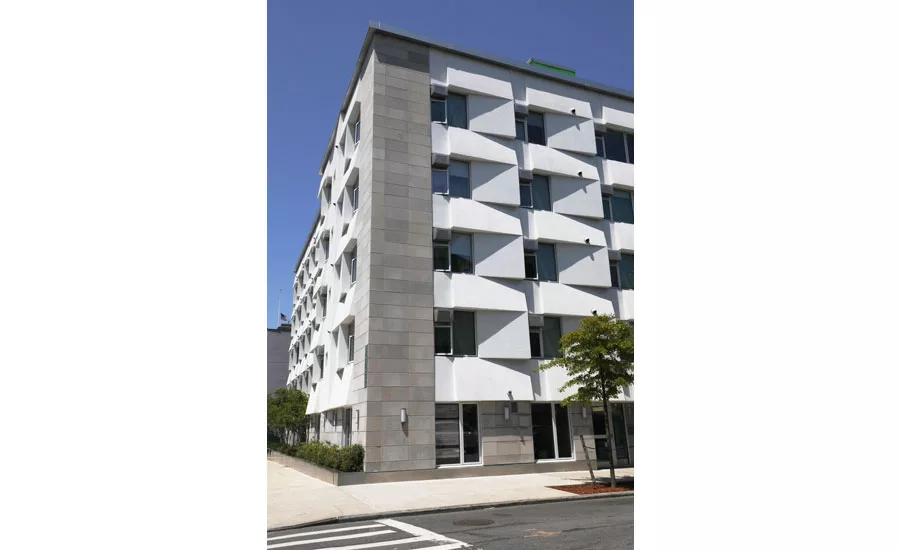
In recent years, average rent for a one-bedroom apartment in Brooklyn’s Bushwick neighborhood has skyrocketed to more than $3,000 a month, excluding utilities. That’s why New York City’s Department of Housing Preservation and Development (HPD) and Ridgewood Bushwick Senior Citizens Council (RBSCC) came together to develop Knickerbocker Commons.
RBSCC also wanted to cut tenant utility costs radically without compromising comfort. So, they called upon Chris Benedict, R.A., to design an ultra-low energy building. Henry Gifford, who works for Chris Benedict, designed the mechanical systems for the building. The team combined several technologies, such as continuous exterior insulation, energy recovery ventilators, sealed combustion boilers, and individual room thermostat controls, including Danfoss thermostatic radiator valves (TRVs). According to Gifford, the result is 90 percent lower energy consumption than comparable buildings — and heating costs below $50 per apartment per year.
“The 803 Knickerbocker Avenue building was completed in 2014,” says Gifford. “We used proven building-science concepts that could be applied to any high-performance building. No energy-efficiency rebates defrayed the cost of the low-energy technology we used. In fact, we delivered an extreme level of efficiency and comfort without adding to the construction cost.”
MAKING A "PASSIVE HOUSE" FEEL AT HOME IN NEW YORK CITY
Known for his life-long passion for building science, Henry Gifford attended the first class in the U.S. on ultra-low-energy building principles known as “Passive House.” According to Gifford, who recently published the book Buildings Don’t Lie: Better Buildings by Understanding Basic Building Science, “If you understand the underlying science, you’ll have the tools to improve buildings from the start.”
The Passive House principles use a continuous air barrier and exterior insulation. These construction techniques eliminate thermal bridging, creating an interior space that can maintain a comfortable temperature. Natural light and human activities keep the space generally warm; mechanical systems handle domestic hot water production and extreme hot and cold conditions.
When energy prices in Europe more than quintupled in the early 2000s, the “Passivhaus” idea took off — with more than 25,000 buildings on the continent meeting the voluntary, ultra-low energy building standard by 2010.
Looking for quick answers on air conditioning, heating and refrigeration topics? Try Ask ACHR NEWS, our new smart AI search tool. Ask ACHR NEWS
In the U.S., energy cost hikes were not that extreme, but rising. In 2011, Gifford and Benedict were presented with two projects ideal for the unique design approach, one of which was Knickerbocker Commons.
“It’s not merely about meeting a standard, but simply implementing the smartest possible building-science principles,” says Gifford. “That means integrating all building systems — insulation, water, lighting, and heating, cooling, and ventilating — into a cost-effective, holistic solution. That’s why a device like the Danfoss thermostatic radiator valve plays a big role in creating a comfortable, energy-efficient building.”
A THERMOSTAT FOR EACH ROOM
One of Gifford’s design principles is that each room should have its own thermostat.
Gifford explains: “If a simple building with only two rooms is located where the sun shines from one direction and the wind blows from another direction, the heating and cooling loads will vary between
rooms. Putting a single thermostat in one room will keep that room warm, but leave the other too hot or cold. Plus, internal loads will vary depending on cooking, showering, computers, and lighting. The temperature imbalance becomes very noticeable if the building is well insulated. People will run space heaters in winter to heat up the cold room, and/or open windows in a hot room. That’s a huge waste of energy, and it makes the air dry and unhealthy.”
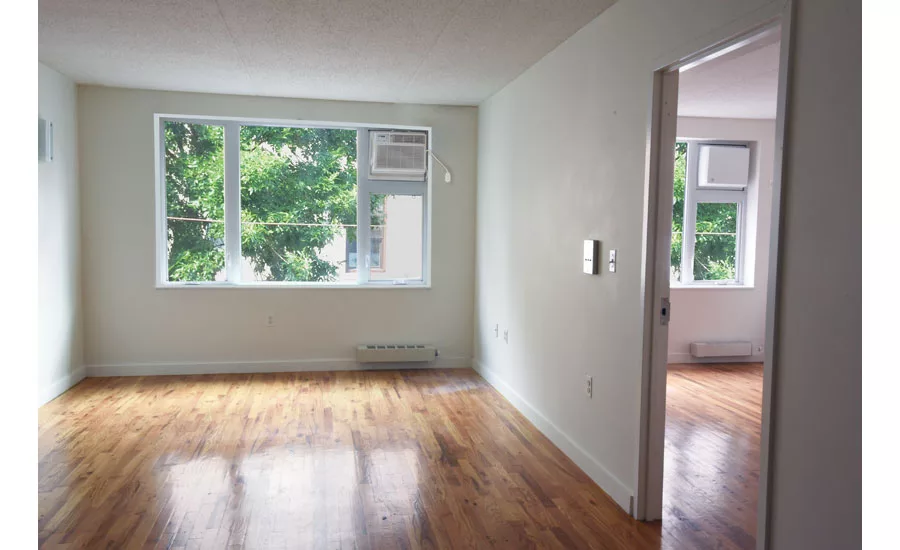
To avoid balance problems, Gifford provided each room at 803 Knickerbocker with a radiator controlled by its own individual thermostat.
Gifford observes that “individual room temperature control makes the whole apartment comfortable without wasting energy by overheating or overcooling. This allows the system to be downsized, which
saves enough money to more than pay for the additional thermostats.”
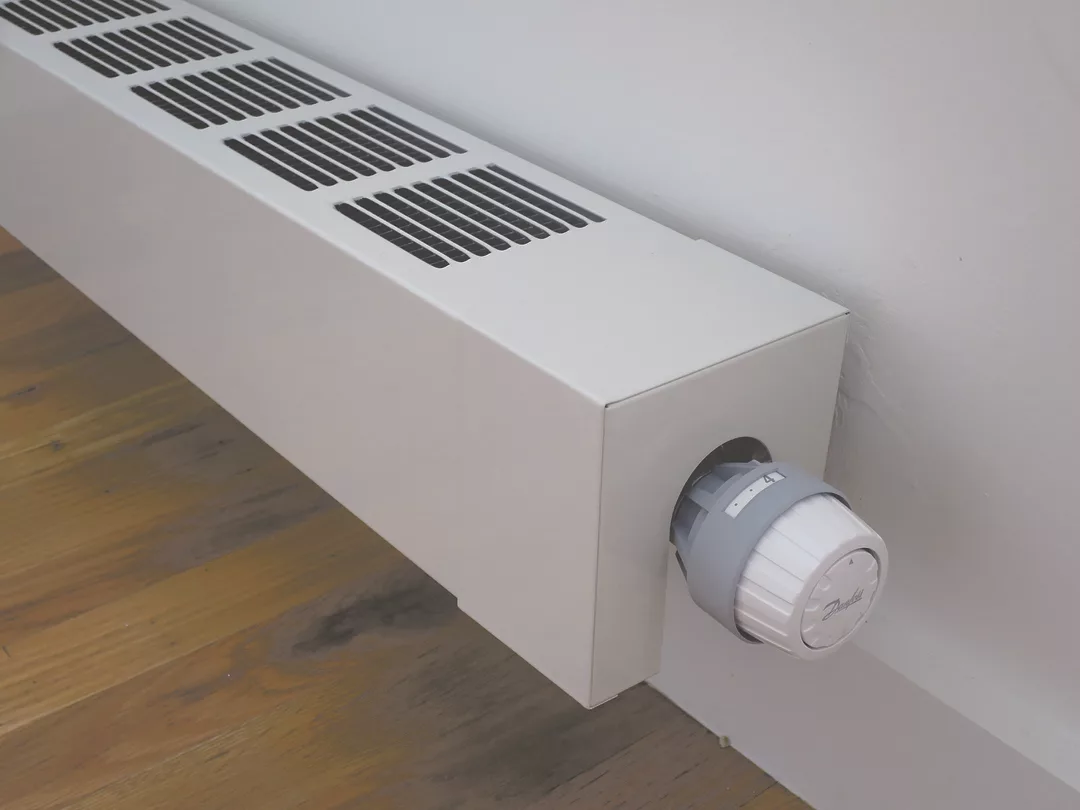
To regulate the flow of hot water through the radiators, Gifford employed Danfoss RA2000 TRVs with a tamper-resistant non-electric operator. The RA2000 TRV is designed for hot water or low-pressure steam. In this case, Gifford applied the valves on wall-mounted baseboard radiators to avoid coordination hassles between flooring installers and plumbers.
The TRV regulates hot water flow by using an integrated thermostat and valve assembly. A white knob containing a sealed capsule filled with a heat-sensitive vapor charge functions as the thermostat. If the room is too warm, the rise of temperature increases the vapor pressure in the bellows, closing the valve;
if cold, the pressure decreases, opening the valve. In typical operation, the valve is not either fully opened or closed. Rather, it modulates between open, closed, or partly open based on a proportional difference between actual and desired temperatures.
With the TRV, controlling space temperature is easy; the apartment resident turns the knob to the desired temperature. The dial is scaled in five increments about 5°F apart, ranging from 57°F to 79°F. Gifford set the upper temperature limit to 73°F, but residents can lower the temperature setting, if desired.
“Psychological studies show that when people have control over room temperature, they tend to be more satisfied with their environment,” he notes. “That’s particularly valuable in mild weather when controlling temperature is difficult and a lot of energy is wasted due to overheating.”
TRVS TURN IN REWARDING ENERGY SAVINGS
Utilizing room thermostat control into the integrated building design has produced extraordinary energy savings. Despite its 34,581 square feet, the property’s peak heating load is only 127,000 BTU/hour.
“This is an incredibly low heat load for a building of this size,” says Gifford. “But, just because the load for space heating goes down doesn’t mean the domestic hot water load is reduced. We put two small, sealed-combustion gas boilers in a mechanical room on the roof. The boiler capacity is primarily used to make domestic hot water and, secondarily, heat the building — which is opposite from the responsibility of most boilers in other buildings. We have four storage tanks for the domestic hot water, and we use the smallest, most efficient pumps possible to circulate water in the hydronic loop.”
A 1/8-horsepower pump supplies a two-pipe hot water system, which runs whenever the outdoor temperature is lower than 55°F, serving the entire building. The Danfoss valves on each radiator control flow through each radiator.
The bottom line for the Passive House design: The space heating cost per apartment averages about $44 per year in a building constructed for the same cost per square foot as any other NYC affordable housing facility.
The ultra-low energy performance, comfort, and aesthetics of 803 Knickerbocker have been widely recognized. It was the first midsized apartment building in the U.S. to be certified to the Passive House standard, and was recognized in New York City Mayor Bill de Blasio’s One City Built To Last program as an innovative approach to reducing the city’s carbon footprint.
The building is further proof that an integrated, holistic approach to design is practical. It also has helped spur changes in NYC building code and zoning regulations to enable construction of more ultra-low energy buildings.
However, most important to Gifford is the legacy of comfortable tenants and property owners. Gifford notes, “Danfoss TRVs have been successfully used for decades, especially in Europe, where it seems almost every room has its own radiator control. Since 803 Knickerbocker opened in 2014, there have been zero tenant complaints about heating. When you can make both tenants and property owners happy in Brooklyn, it shows using thermostatic radiator valves for every room really works.”
Publication date: 11/19/2018
Want more HVAC industry news and information? Join The NEWS on Facebook, Twitter, and LinkedIn today!
Looking for a reprint of this article?
From high-res PDFs to custom plaques, order your copy today!