HFO Sightings: Refrigerant Retrofits Becoming More Common in Supermarkets
Best practices help ensure supermarket transitions to low-GWP blends go smoothly
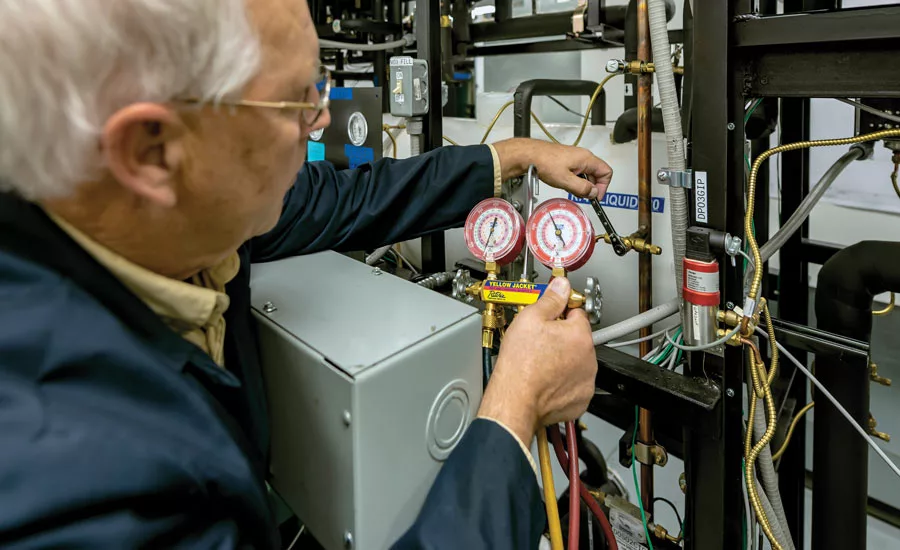
R-22 will officially be phased out at the end of next year, and it is likely that HFCs will be phased down in the years ahead. For these reasons, many supermarket owners are starting to transition to lower-GWP refrigerants, particularly if they are still using HCFCs. Retrofitting an entire store with equipment that uses CO2 or ammonia can be prohibitively expensive, which is why many store owners are choosing to transition their existing equipment to HFO blends.
HFO blends are not drop-in refrigerants, and modifications usually have to be made to the equipment before they are used. However, following the guidelines from experts in the industry can help ensure a smooth transition.
REASONS TO RETROFIT
Price volatility and availability concerns of refrigerants have motivated many end users to transition to HFO blends, noted Charles (Chuck) Allgood, refrigerants technology leader, Chemours Inc.
“Also, a move to energy-efficient and more environmentally friendly low-GWP, non-ODP refrigerants is desirable to many retailers for sustainability reasons,” he said. “HFO blends like R-449A offer the lowest GWP, non-flammable refrigerant solution that can be used in existing equipment, so this represents the easiest, quickest, and most cost-effective way for end users to reduce their carbon footprint.”
In terms of performance, efficiency, and cost, HFO blends generally compare very well to HFCs, coming within ±5 to 10 percent in all these areas, according to Adam Ciesielski, engineering manager - refrigeration systems division, Zero Zone Inc.
“The largest advantage of HFOs over HFCs is a 50 percent or more reduction in GWP,” he said. “The cost of HFO blends is currently greater than HFCs but may normalize as HFCs are phased out.”
When considering a retrofit, it is important to remember that HFOs are blended refrigerants, which have very different characteristics than a single-component HFC or HCFC, noted Andre Patenaude, director of food retail marketing and growth strategy, cold chain, Emerson.
Looking for quick answers on air conditioning, heating and refrigeration topics? Try Ask ACHR NEWS, our new smart AI search tool. Ask ACHR NEWS
“Some HFOs are classified as A1, while others fall into the A2L (mildly flammable) category; many of these have a glide characteristic to consider,” he said.
In addition, many HFO blends have been developed to replace specific HFC refrigerants — for example, R-448A and R-449A are designed to replace R-404A — and there are small capacity and efficiency differences that may vary based on the specific application and temperature range, added Patenaude.
“Recent HFO offerings even have an added fire suppressant, and that may also potentially impact system performance,” he said. “For the A2L varieties, there is a 500-gram charge limit in place, which will add mitigation requirements and can possibly restrict a system’s capacity potential.”
MAKING THE CHANGE
If a supermarket owner is interested in transitioning to an HFO blend, it is very important to first find out if the refrigeration equipment is compatible with the new refrigerant.
Most HFCs have a recommended HFO replacement based on the equipment type and the cooling application, noted Ciesielski; however, not all HFCs can be replaced with an HFO, and some equipment may require major modifications.
“Each case should be carefully reviewed by the equipment manufacturer and refrigerant vendor for compatibility,” Ciesielski said.
Indeed, lubrication, discharge temperatures, capacities, efficiencies, and superheat are just a few of the factors that must be considered and evaluated against the manufacturer’s guidelines before transitioning to any new refrigerant, added Patenaude.
“At Emerson, compressors and other system components must first undergo a stringent research, development, and testing process before they are deemed ‘ready to use’ with a particular refrigerant,” he said.
In addition, manufacturer warranties are often based on specific use conditions, so unless the equipment was designed to handle multiple refrigerants, the warranty may no longer apply after the retrofit, said Patenaude.
“Check with your equipment manufacturer before performing a retrofit to make sure you understand all warranty implications,” he said.
Changing refrigerants also does not magically fix equipment problems or stop leaks, noted Allgood. However, there are many systems that can continue to operate reliably for years with efficient and sustainable refrigerants like HFO blends. That said, the age and condition of a system should always be assessed to determine if it is a good candidate for a refrigerant retrofit, he added.
After verifying with the manufacturer that an HFO blend is compatible with the equipment, Ciesielski offers the following overview of the retrofit process:
- Review system type, design, and application;
- Choose a compatible HFO blend;
- Recover and properly dispose of old refrigerant;
- If current refrigerant oil is compatible with the retrofit HFO refrigerant, perform oil analysis and clean or replace refrigerant oil as necessary. If oil incompatibility exists, remove old oil, clean system of residual oil, and charge with new oil;
- If oil retrofit occurs, check the compatibility of all seals and gaskets and replace as required;
- Perform system evacuation;
- Charge new HFO into refrigeration system;
- Start system and continue charging; and
- Adjust expansion valves, mechanical pressure control valves, and any electronic pressure control set points to optimize performance and efficiency, as HFO refrigerants vary in operating pressures and temperatures.
As far as oil compatibility is concerned, in R-22 systems, it needs to be changed from mineral oil to POE lubricant, and any critical seals should be changed when converting to an HFO blend, said Allgood.
“For R-404A systems, the existing oil and seals should be compatible, and no changes are typically required,” he said. “Chemours publishes detailed retrofit guidelines and videos on our website that we strongly urge end users to consult.”
When charging a system with an HFO blend, the procedure is the same as that of a blended HFC, said Patenaude, in that the contractor should charge the refrigerant in its liquid state to ensure that the blended mixture is charged in its entirety.
“Proper refrigerant recovery and evacuation still apply, regardless of the type of refrigerant used,” he said.
No two retrofits and no two refrigerants are alike, stressed Patenaude, so operators must consider the specific characteristics of each application, the replacement refrigerant, and its impacts on system performance. For example, when moving from R-404A to R-448A, the discharge temperature of R-448A may run hotter than when R-404A was used, which may require supplemental compressor cooling that may not have been needed previously.
“It’s extremely important to check the compressor manufacturer’s application engineering bulletin for specific recommendations to make sure that you’re operating the compressor within the design specifications and limitations,” Patenaude said.
Expansion and solenoid valve capacities may also differ from one refrigerant to another, so contractors should confirm the capacities meet their application requirements, as expansion valves or the power head charge may need to be changed, depending on the specific HFO being used, he added.
“Condensers are also directly impacted by the glide characteristic of blended refrigerants like HFOs,” said Patenaude. “If the condenser is marginally sized in the HFC system, it may be undersized when you transition to an HFO. Again, check with the condenser manufacturer to confirm it’s rated for your particular application.”
While regulations surrounding refrigerants continue to evolve, Allgood contends that HFO blends are the best long-term solution for most of the large installed base of refrigeration equipment.
“HFO blends allow the systems to continue to operate with a safe and environmentally sustainable liquid, and conversion of the existing base of R-22 and R-404A systems to low-GWP HFO blends is the quickest and cheapest way to achieve large overall reductions in the carbon footprint,” he said.
For these reasons, more supermarket owners will likely turn to their contractors in the coming years to help them decide whether retrofitting their existing refrigeration equipment to HFO blends makes the most sense for them.
Publication date: 10/1/2018
Want more HVAC industry news and information? Join The NEWS on Facebook, Twitter, and LinkedIn today!
Looking for a reprint of this article?
From high-res PDFs to custom plaques, order your copy today!