Five Simple Solutions for Solving the HVACR Technician Shortage
For contractors, it’s better to light one candle than to curse the darkness
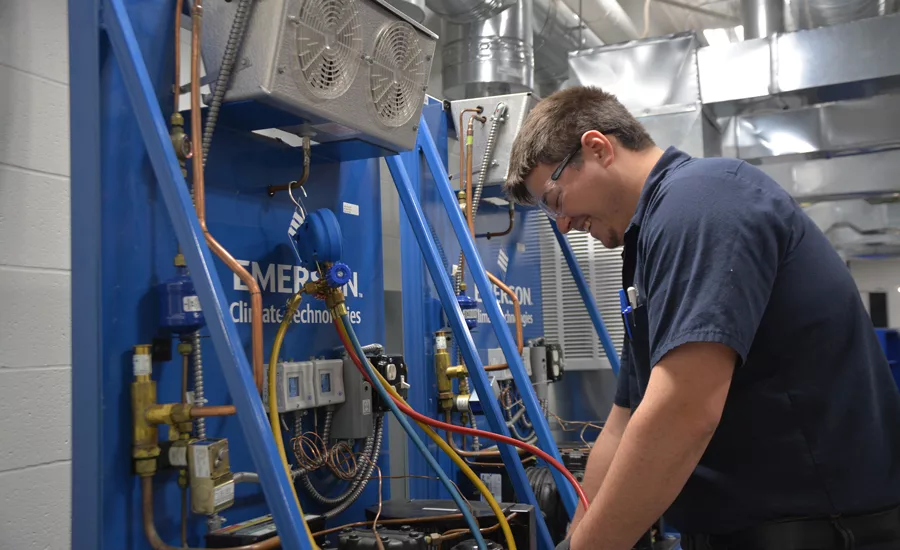
IN THE LAB: Daringer Bernardi, a senior in HVACR and a pre-apprentice for Slagle Mechanical in Sidney, Ohio, uses manifold gauges on an Emerson trainer in the HVACR lab at Upper Valley Career Center. Photo courtesy of Tony Trapp, Upper Valley Career Center
William R. Alger, an American author and poet, once said, “For every problem there is a solution, and the soul’s indefeasible duty is to be of good cheer.”
Though he was not a refrigeration contractor, his words may resonate with contractors today when the topic turns — as it inevitably does — to the technician shortage.
Unfortunately, much of what has been said and written in terms of the labor shortage takes the form of gloom-and-doom statistics and anecdotes that just serve to increase contractors’ worries. But, as Alger points out, for every problem there is a solution. So, here, instead of grim statistics, we’ll take a look at some things contractors can do to help ease the technician shortage. Action is always better than worry.
FIVE SOLUTIONS
Bruce Campbell, national accounts manager, supermarkets, United Refrigeration Inc., proposed building a technician workforce in a climate of shifting demographics.
“There isn’t a week that goes by that a contractor doesn’t talk to me about the shortage of good, qualified refrigeration service technicians,” Campbell said.
But, in the face of the industry’s most pervasive problem, Campbell offered five potential solutions for the industry to apply:
- Create internship programs to give candidates the experience of working as technicians;
- Pass on your knowledge and experience. Teach and mentor a candidate who shows aptitude;
- Encourage your state to develop a professional licensing program for HVACR technicians;
- Develop e-learning courses in refrigeration and make them available to vo-tech schools and other educational programs; and
- Partner with community colleges, and promote the development of more associate degree programs in HVACR technology.
DEVELOP YOUR OWN TALENT
Martin Luckcuck, director, north division facility maintenance, City Facilities Management (FL) LLC, Jacksonville, Florida, said he encourages contractors to be positive about developing their own talent. Contractors historically cite four negatives around training techs as opposed to hiring already skilled techs. They include:
- There is no good ‘raw material’ (i.e.; unskilled but eager people) out there;
- I can’t afford to train somebody;
- Customers won’t pay for two technicians on what are generally considered one-man jobs; and
- If I invest in training, my employee will quit once he or she learns the trade to get a few bucks more somewhere else.
However, Luckcuck refutes each of these.
Looking for quick answers on air conditioning, heating and refrigeration topics? Try Ask ACHR NEWS, our new smart AI search tool. Ask ACHR NEWS
- There is no good ‘raw material’ out there — “There are plenty of technical programs out there teaching the fundamentals of HVACR, but unless you make the time and effort to engage them, you won’t be able to make contact with the best students,” Luckcuck said. “Placement officers are helpful, but often their job performance is based on total placement and not the best fit for specific jobs. Relationships must be built with the teachers. This will take a commitment.”
He noted that taking classes on a ‘field trip’ was a successful tool he used when he worked with a major supermarket chain. He also used to go to the school and do presentations, showing students about a part of the industry that they may not be aware of.
“Highlighting how technology and computers have been incorporated into our industry is important, as many young people are into anything related to the Internet of Things,” Luckcuck said. “Another key option here is family, relatives, and friends. Word of mouth is one of the most powerful advertisements out there. Companies must have robust referral policies in place to help drive this.”
- I can’t afford to train somebody — “The bottom line is that companies can’t afford not to train,” Luckcuck told The NEWS. “Everything from YouTube videos to supply house-sponsored events are out there for the taking. Also, current techs must be enthusiastic about sharing their knowledge, and that requires commitment from the company with some sort of reward for successfully contributing being offered. In addition, human resources (HR) needs to make sure that skilled, current employees understand the benefit to them of being part of the training process.”
- Customers won’t pay for two technicians on what are generally considered one-man jobs — The old argument was that you can’t send a new guy out alone, because you don’t know until you get there whether it’s a minor or major problem. While this can be true, advances in technology help to reduce the risk.
“Cell phones, the internet, and FaceTime are tools available to most businesses and can be used to guide less experienced techs, even if it’s just to take some initial steps while another tech responds to provide support,” Luckcuck noted.
He added that the way the new tech is introduced to the customer is also important. The key is in explaining qualified and experienced in a positive way.
“Many industries, including HVACR and grocery, often hire people with core skills and passion and then add industry-specific training so that they are qualified to perform the service needed,” Luckcuck said. “We would all like to have a team of fully tenured technicians, but that is not the reality of our industry. The experience will come, but customers need to know the time and effort have been invested to ensure the technicians at their store are qualified.
“There will be costs associated with bringing a less skilled person on board, but once some basics are understood, a tech should be able to make good short-term decisions,” he continued.
- If I invest in training, my employee will quit on me once he or she knows something, to get a few bucks more from some other shop — A key to avoiding this scenario is to have fair and realistic pay advancement policies in place.
“If a company offers good benefits, cares about work-life balance, and clearly lays out the advantages of staying with them, turnover can be minimized,” Luckcuck said. “Personally, I believe that a tech who learns and develops at the pace needed to be successful should be paid as an ‘experienced’ tech within about three years. If the new tech thinks he is going to be paid below the competitive rate for five-plus years, he or she is going to move on. If, on the other hand, the tech is seeing significant pay increases as learning is demonstrated, he or she will see the path to pay equity more clearly.”
GET INVOLVED
Tony Trapp, the school-to-work apprenticeship coordinator at Upper Valley Career Center in Piqua, Ohio, said one way contractors can help address the technician shortage is to get involved with their local vocational programs. Upper Valley Career Center has 25 career tech programs, of which about nine use the center’s school-to-work apprenticeship program.
“Our apprenticeship program is a work-based learning program,” Trapp explained. “Students come here and learn a skilled trade throughout their junior year, and then, during their senior year, they spend time both in the classroom and on the job. One of the goals of the program is to share with students early in their junior year the opportunity that this program offers them in their senior year — that they’ll be learning and earning and will, in effect, be paid to go to school.”
To enter the program, students must meet prerequisites, such as maintaining a certain GPA, achieving good attendance, and displaying a positive attitude.
“All the basic things a company would think of when they’re going to hire somebody,” Trapp noted.
A key to the success of the program is its advisory committee members, and this is where contractors and others in the HVACR industry can become involved.
Trapp said advisory committee members come from any background in the HVACR industry. In fact, having members representing a mix of backgrounds makes it interesting for the members and students alike.
“All of our advisory committee members do something different; the key component is they all advise and help our instructors,” Trapp said. “For example, our instructors must have a minimum of five years in their trade and must have a certification to be a career tech teacher. However, not being in the field daily, they may not see some of the newest technology right away. So, the advisory committee members can help with that by sharing what the local trends are.”
Another way for committee members to help is to donate equipment and supplies. And, of course, they can provide employment opportunities for students as they graduate from the apprenticeship program.
Trapp noted that a key for contractors and others who would like to work with local schools as advisory committee members is to keep things positive and work in tangible ways that will help create opportunities for students.
“I’ve been fortunate to travel across the country and speak nationally to share what we do at Upper Valley Career Center,” Trapp said. “I’ve seen some advisory committees that are just three or four guys that meet and gripe about what’s going on. It’s important if you’re going to get into this that you’re committed to keeping things moving forward.
In addition, although Upper Valley is fortunate to be in close proximity to Emerson and to count Emerson among its leading supporters, a program’s success does not depend on any one member.
“Maybe Emerson is the anchor, but it takes more than an anchor to make a ship,” he said, “It takes everybody pulling together to win. If you don’t do something, the HVAC and refrigeration industries are going to be really hurting in the coming years. I always say, ‘If you do what you’ve always done, you’ll get what you always get.’ So, be prepared to put more into it.”
IT ALL STARTS WITH RECRUITMENT
Becky Hoelscher, director, AC aftermarket, Emerson, said HVACR contractors can help alleviate the technician shortage through four basic steps: recruit, mentor, train, and retain. Of these, the most important may be recruitment — without that step, none of the others are possible.
A key to improving the industry’s recruitment, she said, is to start early so that students and their parents are aware of the HVACR industry and the great opportunities it offers.
“I drove by Copeland almost every day for 15 years, and I didn’t know what they did here,” Hoelscher admitted. “I had no idea how important the HVACR industry is. Like most people, I just took it for granted.”
That’s why getting the word out about the industry is so important.
“Parents know if they have a son or daughter who is eager to grow but doesn’t like sitting in a classroom all day reading books,” Hoelscher said. “So, from the parents’ perspective, the HVACR industry offers an opportunity for their child to develop a skill that will allow them to become independent, contributing adults. That seems to always hit.
“And from the students’ perspective, it’s important to make them aware that this is a growing trade they have an opportunity to be a part of,” she continued. “I think there are a lot of kids out there going into debt and spending money on careers they don’t really have interest in or can’t find jobs in.”
Like Trapp, Hoelscher strongly urges contractors and others in the industry to work on advisory committees for local HVACR trade schools, tech schools, and universities. She said an advisory council’s responsibility for student recruitment can include:
- Recruiting students in the community;
- Participating in career fairs;
- Speaking at open houses and orientations;
- Conducting events to recognize students, employers, or others active in aiding the program or school;
- Being a classroom speaker; and
- Hosting luncheons for guidance counselors in the local school district.
Of these opportunities, contractors might be surprised by how impactful it is to be a classroom speaker. She recommended seeking out such opportunities at local high schools, junior high schools, vocational schools, and career centers.
“Kids get tired of hearing from the same instructor every day,” Hoelscher said. “When they see that a local employer is showing an interest in them and their class, it gives the students the ability to network and to become professionals in their own right. For many, it might be the first time they’re being treated as adults.”
Hoelscher added other advisory committee efforts at tech schools can be remembered through the acronym HVACR:
H — Help with the curriculum;
V — Verify future service needs;
A — Advocate for legislation to supply monetary aid to programs;
C — Collaborate with surrounding businesses, schools, and other industry experts ; and
R — Recruit new students.
“We need to let kids know that when it comes to the HVACR industry, they can get out of it what they put into it,” she continued. “If they want to be that top person and own their own businesses, they can do that in this trade. With all the opportunities this industry offers, it’s really surprising that we have a shortage of technicians, but people simply don’t understand. That’s why HVACR contractors need to go out and recruit. They need to share the message.”
Publication date: 3/5/2018
Looking for a reprint of this article?
From high-res PDFs to custom plaques, order your copy today!