Compressor Overheating is One of the Most Serious Field Problems
Components in series mean many factors can play a role in compressor overheating
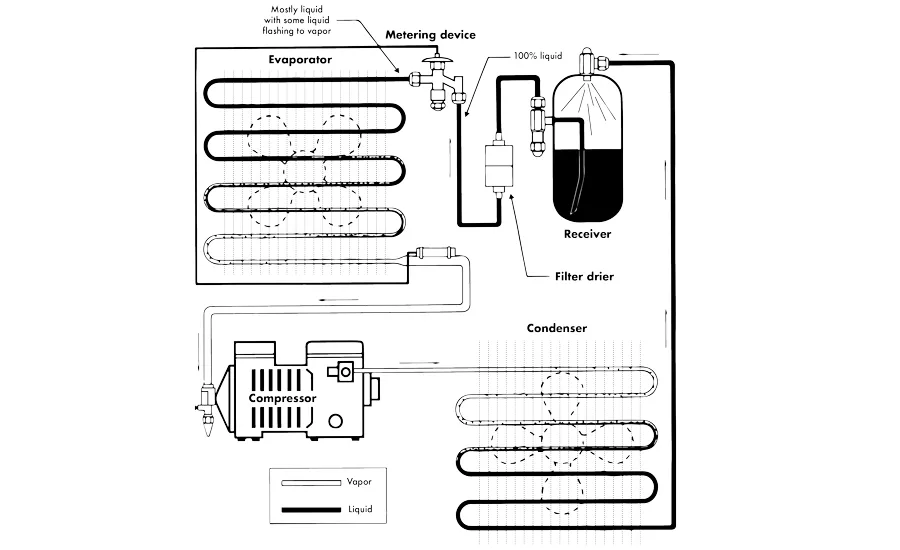
FIGURE 1: Because the components in a refrigeration system are in series with one another, if one of the major components is not working properly, the entire system is affected. Photo courtesy of ESCO Press
Refrigeration systems are made up of major components in series with one another (see Figure 1). As most of us are well aware, the major components are the compressor, discharge line, condenser, liquid line, metering device, evaporator, and suction line.
Because these components are in series with one another, the refrigerant that flows through one component must flow through the other components as well. If one of these major components is not working properly — damaged, kinked, plugged, dirty, restricted, frosted, or starved of refrigerant — the entire system is affected. And, since the compressor is considered the heart of the refrigeration system, it is the most sensitive to any other major component malfunctioning.
This article will look at the multiple causes from other major components in the system that can lead to compressor overheating, which is considered today’s most serious field problem.
THE ROLE OF THE COMPRESSOR
The compressor is a refrigerant pump; its main function is to circulate refrigerant. In return, this allows other major components to perform their heat transfer or metering functions. In order for refrigerant to flow, there must be a pressure difference in the refrigeration system. It is the compressor that initially causes this pressure difference. The compressor also separates the low- and high-pressure sides of the refrigeration system.
The compressor elevates the refrigerant gas to a temperature above the ambient temperature, so heat can be rejected in the discharge line and condenser. The compressor also increases the density of the refrigerant vapors through compression. Increasing the density of the refrigerant vapors packs the vapor molecules closer together, preparing them for condensation in the condenser. It is for these reasons that compressors must be kept running at their performance.
One way to diagnose a compressor is by examining its discharge temperature. The compressor’s discharge temperature can tell a service technician much of what is going on inside a refrigeration system. The compressor’s discharge temperature is a reflection of the hottest part of a refrigeration system, and there are limits as to how hot a discharge temperature should be.
The discharge temperature is a measure of the superheated refrigerant’s vapor temperature. Since the compressor’s discharge temperature is a superheated vapor temperature measurement, a pressure/temperature relationship does not exist, and a pressure gauge cannot be used for its measurement. Pressure gauges can only be used for a pressure/temperature relationship when a saturation temperature (evaporating and/or condensing) is wanted. An insulated thermistor or thermometer must be used to measure this temperature at least 2 inches from the compressor’s shell on the discharge line.
Looking for quick answers on air conditioning, heating and refrigeration topics? Try Ask ACHR NEWS, our new smart AI search tool. Ask ACHR NEWS
The discharge line temperature, when measured 2 inches from the compressor, is approximately 75°F lower than the discharge valve temperature. So, adding 75° to the discharge line temperature reading will allow a technician to arrive at an approximate discharge valve temperature. System lubricating oils may start to break down and vaporize at 350°. If this occurs, serious overheating problems will result. And, since compressor overheating problems are today’s most serious compressor field problems, service technicians must carefully monitor compressor discharge line temperatures and keep them below 275° (275° + 75° = 350°).
The main reasons for high compressor discharge temperatures are low suction pressures, high condensing pressures, high compression ratios, and high compressor superheats. Let’s take a look at the causes of these four reasons.
CAUSES OF LOW SUCTION PRESSURES
Low suction pressures can be caused by a kinked suction line, plugged suction line, plugged compressor inlet screens, undercharged systems, thermostatic expansion valve (TXV) or capillary tubes underfeeding, low evaporator heat loads, end of the cycle, frosted evaporator coils, evaporator fan out, plugged liquid line filters, and kinked liquid lines.
These causes mean more work and more heat of compression will be generated in compressing a lower suction pressure to the condensing pressure.
CAUSES OF HIGH CONDENSING PRESSURES
High condensing pressures can be caused by broken fan belts, undersized condenser coils, high ambient temperature, recirculated air over the condenser, dirty condenser coils, burned out condenser fans, overcharge of refrigerant, and noncondensables in the system.
A high condensing temperature causes high condensing pressure. Now, the compressor must work harder and generate more heat of compression in compressing the suction pressure to the higher condensing pressures.
CAUSES OF HIGH COMPRESSION RATIOS
Causes of high compression ratios include low suction pressures, high head pressures, or a combination of both low suction and high head pressure.
Compression ratio is defined as the absolute discharge pressure divided by the absolute suction pressure. A gauge is calibrated to read zero at atmosphere pressure, but, in reality, there is 14.7 psi (standard atmospheric pressure) of pressure being applied to it. This is called a gauge pressure, and it is not a true pressure. To attain the true or absolute pressure, one must add 14.7 to the gauge reading. A true pressure must be used when using any equation like the one below.
Compression ratio =
Absolute discharge pressure
Absolute suction pressure
For example, determine the compression ratio for a system with the following pressures:
Discharge pressure = 150 psig.
Suction pressure = 10 psig.
Solution:
Compression Ratio =
150 psig + 14.7 psi = 164.7 psia
10 psig + 14.7 psi = 24.7 psia
= 6.67:1
This means that the discharge pressure is 6.67 times the magnitude of the suction pressure. The higher the compression ratio, the higher the compressor’s discharge temperature will be. This happens because more heat of compression will be generated when compressing the gases through a greater pressure range.
CAUSES OF HIGH COMPRESSOR SUPERHEATS
Compressor superheat is a combination of evaporator superheat and suction line superheat. It is all of the superheat that the compressor sees. High compressor superheats can be caused by the evaporator being starved of refrigerant. Other causes include refrigerant undercharge, plugged filter drier, kinked liquid lines, TXV or capillary tube underfeeding, restricted liquid line, uninsulated suction line, and too long of a suction line.
As one can see, the interaction of major components can and will affect the entire refrigeration system — especially the compressor.
Compressor overheating is today’s most serious field problem because of its multiple causes.
Looking for a reprint of this article?
From high-res PDFs to custom plaques, order your copy today!