Refrigerant Detection in Hotel Room Applications: Reviewing US Regulatory and Practical Concerns
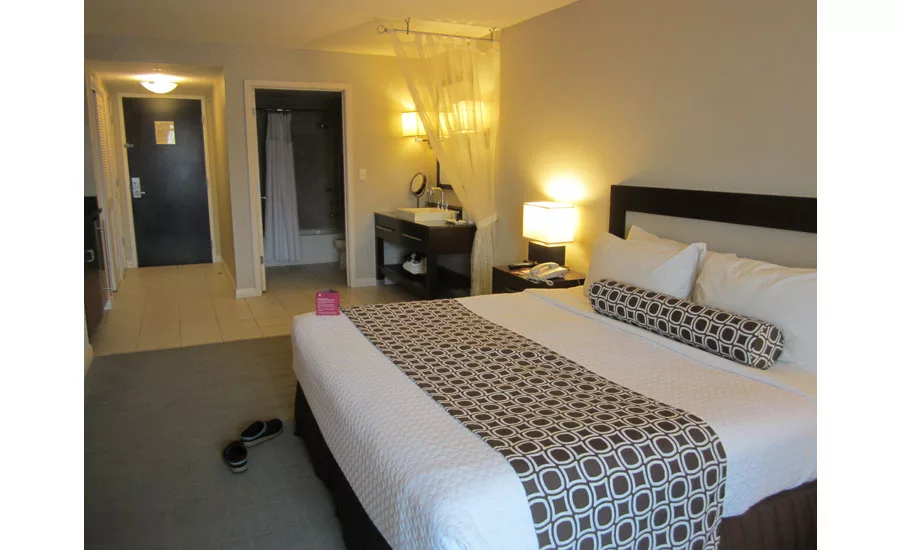
Photo courtesy of Ann: http://bit.ly/ACHRHOTEL
Modern refrigerant systems are designed to be efficient and leak free. Refrigerant systems are pressurized and, in reality, it is widely accepted that no pressurized system is entirely leak free; it is simply a case of how much and where the system is leaking. Often these leaks may be minimal and barely detectable, but improper installations, inadvertent damage, mechanical wear, and a lack of maintenance can result in larger leaks that require mitigation. A larger refrigerant leak has a number of undesirable consequences for hotel owners and occupants, including:
- Inefficient HVAC system energy use and associated cost increases;
- Ineffective HVAC system operation and associated repair costs;
- Failed HVAC system operation and lost revenue resulting from unsaleable rooms;
- Emissions of environmentally harmful refrigerant gas to the atmosphere; and
- A danger to the safety of occupants
Since introduction in the early 1980s, variable refrigerant volume (VRV) and variable refrigerant flow (VRF) types of HVAC systems have become increasingly prevalent in their use in the hotel sector. They present advantages including per-room control of temperature, cost-effective and efficient installation, and both cooling and heating capability. The design of these systems is such that, in the event of a leak, the refrigerant charge that could leak into an occupied space is higher than in older types of HVAC systems, which increases the risk of the undesirable safety, environmental, and efficiency/cost consequences mentioned above.
It is now possible to detect refrigerant leaks in occupied space, hotel room applications with instruments designed specifically with the application in mind. These instruments can provide local alerts to the room occupants, connect to centralized facilities/building management systems, and instigate immediate automated mitigatory actions. Modern design creates easily installed, aesthetically unobtrusive and easily maintained instrumentation. The factors combine to enhance safety for the occupants, effective and efficient operation of the HVAC system, and minimize environmental impact.
Refrigerant Regulations in the USA
The primary standard relating to refrigerant use in the USA is ASHRAE 15-2013. The stated scope of the standard is to is establish safeguards for life, limb, health and property and prescribe safety requirements. Typically, it must be referenced in conjunction with ASHRAE 34-2013, which establishes safety classifications for refrigerants and determines refrigerant concentration limits. The ASHRAE standard is classed as a “National Voluntary Consensus Standard”. This means that while it represents best practice within the application, it is not mandatory code thus meaning significant engineering judgement can be applied when designing a system. Local and state codes must be reviewed when implementing a system design, and it is good practice to work with the Authority Having Jurisdiction (AHJ). There may be variations in interpretations of these codes between jurisdictions, so it’s always important to check with local jurisdiction authorities.
While the high-volume design of modern VRV/VRF systems are contributing to high efficiencies, they can present challenges for the HVAC system specifiers and architects when considering the maximum system charge calculations derived from section 7 of ASHRAE 15-2013.
Most modern HVAC systems use the refrigerant R410A, which as stipulated in ASHRAE 34-2013 has an 8-hour Occupational Exposure Limit (OEL) of 1,000ppm (parts per million), which is the maximum level for human exposure over the designated period. ASHRAE 34 stipulates a Refrigerant Concentration Limit (RCL) of 140,000ppm, the level at which the refrigerant gas is deemed to present an immediate danger to health. In the case of R410A, this is because 140,000ppm is the oxygen depletion level (ODL), where there is risk of asphyxiation, as stipulated in ASHRAE 34, clause 7.1.2. As clarified in ASHRAE 34, Appendix G.F.1, the ODL becomes the RCL in the case of R410A because the danger of acute toxicity is actually at a higher level, of 170,000ppm, than the danger of asphyxiation.
The RCL for R410A equates to a limit of 26lb of refrigerant per 1,000ft3 of occupied space, as detailed with the standards. The RCL applies to hotel rooms, which are explicitly classified as “Residential Occupancy” by ASHRAE 15-2013, clause 4.1.3.
Looking for quick answers on air conditioning, heating and refrigeration topics? Try Ask ACHR NEWS, our new smart AI search tool. Ask ACHR NEWS
Ultimately, an HVAC system specifier when applying the equation below derived from section 7 of ASHRAE 15-2013, may find that the refrigerant’s RCL is exceeded when considering VRF-type systems for relative small occupied spaces such as an office or hotel room.
The volume of the occupied space should be calculated in line with the guidance in ASHRAE 15-2013, section 7.3.
It is possible to design around the RCL and system charge limitations by using multiple smaller systems across the hotel. However, this may incur larger capital outlay, a more complex installation, and increased maintenance demands and costs over time.
These provisions are outlined to protect life, limb, health and property as per the scope of the standard. Essentially, it designates safety requirements for those personnel who may be in the machinery room where refrigerant may leak and where the total system charge of refrigerant may exceed the RCL. Clause 8.11.2.1 states that:
- Each refrigerating machinery room shall contain a detector, located in an area where refrigerant from a leak will concentrate, that actuates an alarm and mechanical ventilation in accordance with Section 8.11.4 at a value not greater than the corresponding TLV-TWA (or toxicity measure consistent therewith). The alarm shall annunciate visual and audible alarms inside the refrigerating machinery room and outside each entrance to the refrigerating machinery room. The alarms required in this section shall be of the manual reset type with the reset located inside the refrigerating machinery room.
To transpose this onto a hotel room application, one can consider that a refrigerant leak detector should actuate an audible and visual alarm to the room occupant, and to the building/facility management team at a level not greater than 1,000ppm R410A. This approach also aligns with other standards applied internationally, such as EN 378:2016 which is enforced throughout the European Union.
The implementation of refrigerant detection in hotel room applications should be reviewed with the AHJ for approval, but can be seen to meet best practice within refrigerant applications through the increased safety it provides for hotel room occupants.
Applying Refrigerant Leak Detection in a Hotel
The application of refrigerant detection in a hotel room presents some unique design challenges. First of all, it must be considered that the detector should be placed in a location where the refrigerant is most likely to concentrate. As most VRV/VRF refrigerants are significantly denser than air, in the event of a leak it can sink to near ground level and accumulate there depending upon room ventilation. This means that a refrigerant detector should generally be at a level 10-12 inches from the ground. In practical terms, this means generally being aligned with typical socket heights for electrical and telephone outlets, meaning the detector cannot be easily hidden from view in an area where it is still likely to be effective. As such, an aesthetically considered design which remains unobtrusive to the occupant is highly desirable.
For ease of installation, it makes sense to combine this aesthetic design consideration into a footprint that can install in standard electrical back boxes, sitting flush to the wall and allowing for easy conformance to building and electrical codes.
In the event of a leak occurring, it is important that building management can immediately identify in which room the issue has arisen in order to effectively initiate mitigation of the leak. Therefore, the communications and connectivity of refrigerant detection instruments should be considered. Communication protocols such as Modbus are readily integrated into building management systems, and can also deliver a wealth of additional information on instrument state, diagnostics and configuration. Additional connectivity may include local volt-free contacts to initiate immediate mitigation via the indoor HVAC unit in the affected room.
Maintenance of a system is important, and therefore should be trouble-free and require no special training. Innovations such as plug-and-play pre-calibrated sensor modules with poke-yoke design can deliver a fool-proof method for ensuring the correct operation of refrigerant sensors. Simply triggered automated calibration routines can also be used to ensure performance of instrumentation.
Summary
Pressurized HVAC systems are subject to leaking over time; it is simply a question of how much, when and where it leaks. Innovative, application-specific design can make refrigerant detection an easily selected and implemented option for hotels installing modern, high volume-high efficiency HVAC systems. By following best practice widely used in the refrigeration industry, designated through widely respected and applied standards, operators can enhance occupant safety, HVAC effectiveness, energy efficiency and environmental protection.
Publication sate: 11/6/2017
Want more HVAC industry news and information? Join The NEWS on Facebook, Twitter, and LinkedIn today!
Looking for a reprint of this article?
From high-res PDFs to custom plaques, order your copy today!