What Most Techs Get Wrong About Wire Sizing
When a 10-gauge wire on a 50-amp breaker is OK

CARRIER TAG: A data tag showing a 50-amp max breaker with a 31.4 minimum ampacity, which still allows a No. 10 circuit with a 75°C wire and termination rating.

CONTACTOR: A contactor data tag displaying the 75°C connection rating when properly torqued.
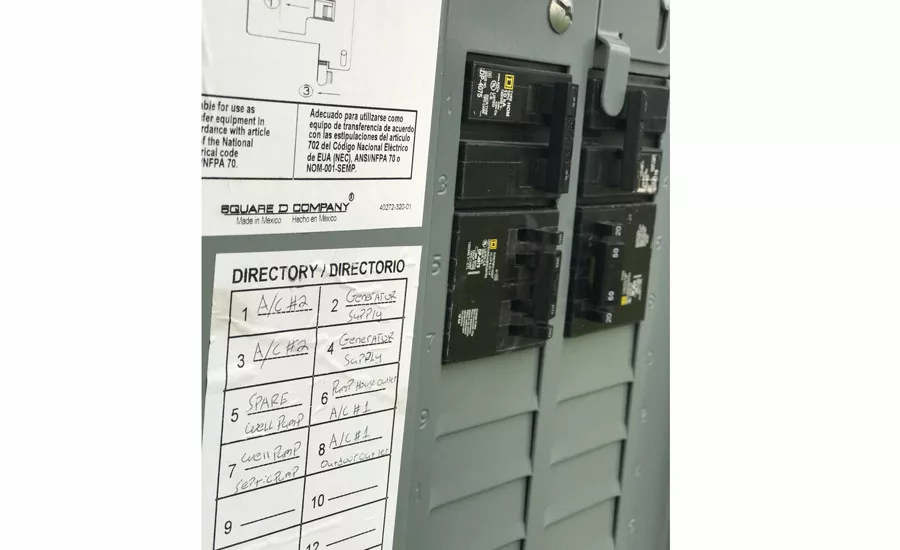
ELECTRICAL PANEL: A properly marked outdoor electrical panel is pictured above.
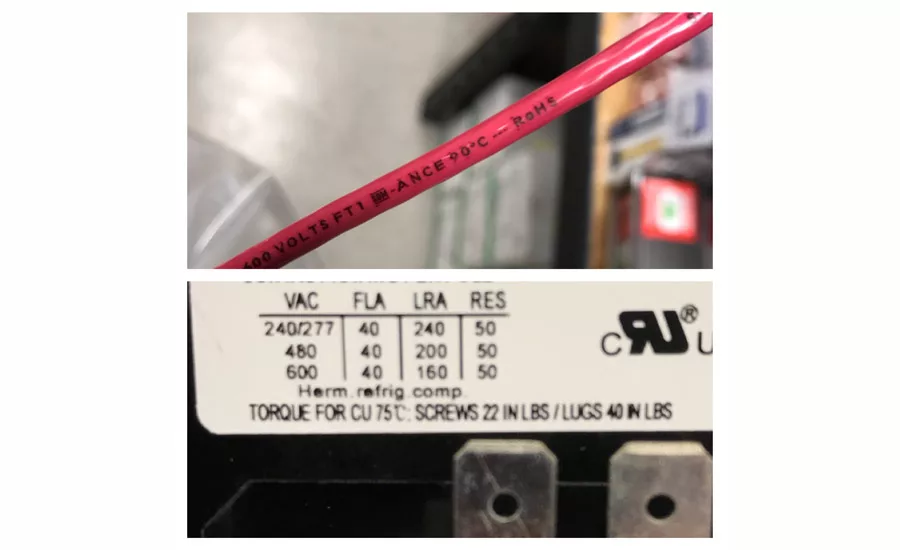
WIRE CONTACTOR: A wire and contactor displaying the 90°C rating on the wire and 75°C rating on the contactor (when properly torqued).
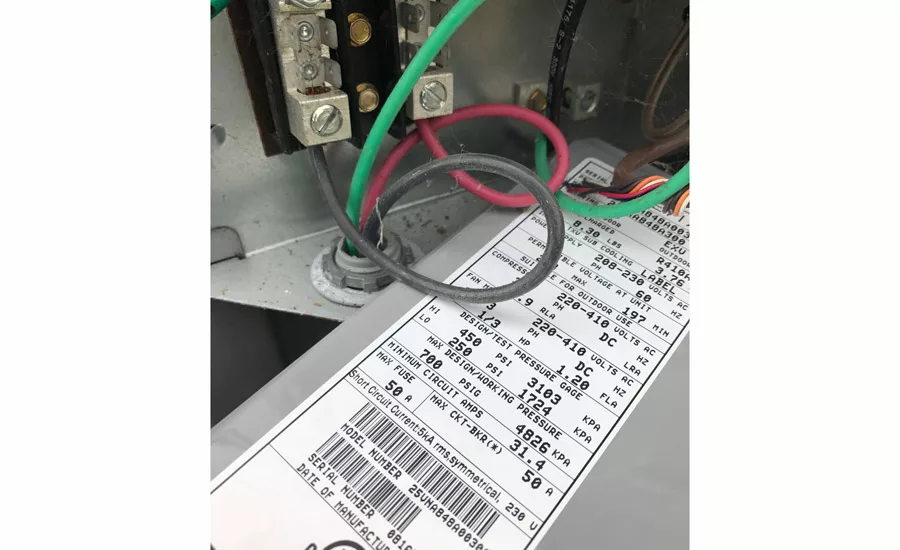
NO. 10 ON A 50-A BREAKER: The data tag and the wiring of the air conditioner in Orr’s home, which includes a No. 10 wire on a 50-amp breaker.
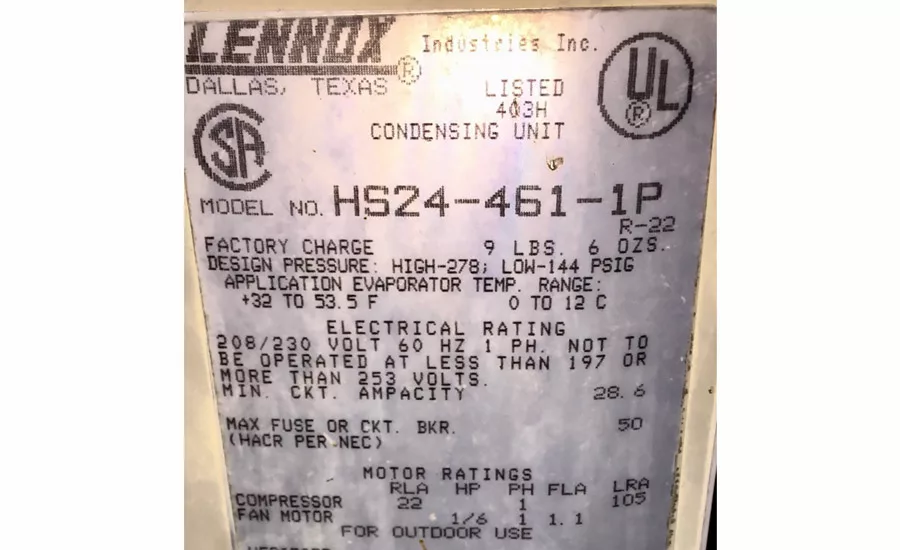
LENNOX TAG: A data tag showing a 50-amp max breaker with a 28.6 minimum ampacity.
My first job in the trades was as an electrician’s apprentice doing tasks, such as pulling wire, building light fixtures, and moving scaffolding in grocery store renovations. I moved into HVACR and now serve as an HVACR contractor, instructor, and electrician.
Growing up in a family surrounded by electricians, we were always discussing codes and theory around the house. Much of what I know came second-hand through my dad but also through Mike Holt, a well-known electrical author and instructor I now have the privilege of calling a friend.
Over and over again, I have heard HVACR technicians and electricians quote rules of thumb regarding wiring sizing, and I have witnessed and participated in many heated debates on the topic.
Before we get too deep into this topic of wire sizing, let’s acknowledge that while detailed conductor sizing is the job of engineers and electricians (not HVACR technicians), there are many cases where contractors are tasked with assessing whether a breaker or conductor (wire) is adequate in both retrofit and service situations.
During service calls, being able to identify undersized conductors can help resolve compressor start issues or intermittent trips of breakers or fuses. Knowing appropriate and inappropriate breaker and conductor sizes will save you and your customers time and money.
I am certainly not suggesting HVACR techs engage in performing work outside of their skills or licensures, but, in many cases, being able to identify the problem and making the repair are two different things.
RULES OF THUMB
Many techs will repeat these rules of thumb and rely on them in all circumstances:
“Twelve-gauge wire is good for 20 amps, 10-gauge wire is good for 30 amps, 8-gauge is good for 40 amps, and 6-gauge is good for 55 amps,” and “The circuit breaker or fuse is always sized to protect the conductor [wire].”
Looking for quick answers on air conditioning, heating and refrigeration topics? Try Ask ACHR NEWS, our new smart AI search tool. Ask ACHR NEWS
These rules of thumb are referring to the amperage capacity or “ampacity” of the conductor (wire) and are often correct. Sometimes, these general rules lead technicians to believe that if an appliance is rated for 50-amp breaker/fuse maximum overcurrent circuit protector (MOCP), you must use 6-gauge wire and a 50-amp circuit breaker.
It’s not that simple according to National Electrical Code (NEC) NFPA 70 for several reasons. Here are some additional factors to be considered:
- What is the conductor made of? Is it aluminum, copper, or something else?
- What is the ambient rating of the conductor (wire) and its termination (connection) points?
- What type of load is being controlled?
- What other thermal de-rating conditions exist? Are there multiple conductors in a raceway, high ambient conditions, etc.?
- What is the allowable voltage drop based on wire length? This is not dictated by the NEC but rather by the requirements of the connected load.
PROPERLY SIZING A CONDUCTOR
When we use a rule of thumb, we are missing two main areas as it relates to the conductor.
Is the conductor aluminum or copper, and is the insulation rating 60°C (140°F) or greater?
Aluminum wire has a lower ampacity than the same gauge copper wire, meaning aluminum must be larger to accomplish the same ampacity job as copper wire. The rule-of-thumb sizes rely on the lowest allowable temperature rating of the wire; in some cases, the circuit may have a higher ampacity if the insulation on the wire and the connection endpoints are all rated at 75°C (167°F) or 90°C (194°F).
All of these ratings can be found in NEC (NFPA 70) Table 310.15(B)(16) in detail, but as an example, according to this NEC chart, a 6-gauge copper circuit rated at 90°C (194°F) has an ampacity of 75 amps while a 6-gauge aluminum conductor rated at 60°C (140°F) has an ampacity of 40 amps. Of course, there are other considerations in addition to this, but it is clear the rules of thumb we often use can get us in trouble if we aren’t aware that exceptions exist and what those exceptions are.
Keep in mind that for a circuit to have a rating above 60°C (140°F), the wire as well as the breaker, disconnect lugs, and connection lugs in the equipment must all be rated at a temperature at or above the temperature rating being used. If any portion of the circuit utilizes non-metallic (NM) cabling — often known by the trade name Romex® — it must be rated at 60°C (140°F) according to article 334.80 of the NEC.
MOCP VS. MCA
In air conditioning, we are given a gift by equipment manufacturers on the equipment data tags: the minimum circuit ampacity (MCA) and MOCP or max fuse/max circuit breaker rating.
These ratings on the data tag tell us exactly what minimum ampacity the circuit must be capable of carrying as well as the maximum size the circuit breaker or fuse may be able to protect the circuit against in an overcurrent condition.
Take a look at the Lennox air conditioning condensing unit tag on Page 19. Notice that the MCA is 28.6 amps and the maximum fuse or circuit breaker is 50 amps. This means it is allowable to install this unit on a circuit breaker rated at 50 amps and a conductor rated at 28.6 amps, according to the NEC’s NFPA 70.
I know this goes against what many of you have been told and understood your entire career, but take a deep breath and read on.
NEC article 440 was added because air conditioning and refrigeration systems are different from typical loads, like lights and heaters. Air conditioner compressor and fan motors are largely inductive (magnetic) loads and have different characteristics than purely resistive circuits. Article 440 has specific guidelines for HVAC and refrigeration equipment manufacturers to follow when writing the equipment data tags as well as for electricians when sizing conductors.
There is a lot there, but here are two highlights that directly apply to you as an HVACR professional. This comes from the 2017 edition of the NEC NFPA 70.
440.32 Single Motor-Compressor — Branch-circuit conductors supplying a single-motor compressor shall have an ampacity not less than 125 percent of either the motor compressor-rated load current or the branch-circuit selection current, whichever is greater.
And the maximum breaker size (MOCP) is dictated by the following article from the 2017 NEC.
440.22 Application and Selection (A) Rating or Setting for Individual Motor-Compressors — The motor compressor branch-circuit short-circuit and ground-fault protective device shall be capable of carrying the starting current of the motor. A protective device having a rating or setting not exceeding 175 percent of the motor compressor’s rated-load current or branch-circuit selection current, whichever is greater, shall be permitted, provided that, where the protection specified is not sufficient for the starting current of the motor, the rating or setting shall be permitted to be increased but shall not exceed 225 percent of the motor rated-load current or branch-circuit selection current, whichever is greater.
This 225 percent of motor load/branch circuit allowance for breaker sizing is to allow for motor starting without nuisance trips while still providing circuit protection against short circuit conditions.
If you hesitate at the thought of doing this math for every system you work on, the NEC Article 110.3(B) states: Listed or labeled equipment shall be installed and used in accordance with any instructions included in the listing or labeling.
For every piece of equipment that lists MOCP and MCA, you are given the breaker size and minimum wire ampacity. As above, the MOCP is usually significantly higher than the MCA, but this is to allow for the spike in amp draw upon motor start.
Many will ask what protects the circuit in an overload condition between the MCA and MOCP ratings? In these overload conditions, the overload protections on the motors themselves are designed to protect the circuit. If the overload protection on the compressor or fan motor fails, the windings in the motors have a far lower ampacity than the branch circuit and will fail open or shorted before the branch conductor will fail. In the case of any significant ground-fault short, the overcurrent protector (breaker or fuse) will still protect the circuit.
In some cases, contractors have stated that certain municipalities are requiring that conductors be sized based on the breaker size instead of the MCA. This is not uncommon, but it is usually a matter of a respectful conversation about the above NEC articles. The “authority having jurisdiction” or AHJ is responsible for interpreting the code, and they can make any standard they see fit. While certain local legislation may supersede the NEC with additional regulations, the NEC is a nationally recognized standard throughout the U.S. It is rare that a building department will ignore entire articles of the NEC when it is brought to their attention in a respectful manner.
The key is to reference NEC NFPA 70 Table 310.15(B)(16) to find the ampacity of a conductor and size that conductor according to the MCA listed on the unit label. When this is done, the conductor will be properly sized according to the NEC.
While no standard is perfect, I have found that knowing the NEC and looking carefully at manufacturer listings and labels can save you time, your customers money, and help keep everyone safe.
Looking for a reprint of this article?
From high-res PDFs to custom plaques, order your copy today!


.webp?height=200&t=1770064997&width=200 "A2L service")