ACHR News
search
Ask ACHR NEWS AI
cart
facebook twitter instagram linkedin youtube
  • Sign In
  • Subscribe
  • Sign Out
  • My Account
ACHR News
  • NEWS
    • Breaking News
    • New HVAC Products
    • Featured Products
    • Manufacturer Reports
    • HVAC Data
    • Legislation
    • ACHR NEWS Centennial
  • RESIDENTIAL
    • Air Conditioners
    • Furnaces
    • Residential Heat Pumps
    • Ductless
    • Residential IAQ
    • Testing, Monitoring, Tools
    • Components & Accessories
  • COMMERCIAL
    • Air Handlers
    • Rooftop Units
    • Chillers and Cooling Towers
    • Commercial Heat Pumps
    • Boilers and Hydronics
    • VRF/Ductless
    • Commercial IAQ
  • REFRIGERATION
    • Refrigerants
    • Refrigerant Regulations
    • Leak Management
  • CONTRACTOR PRO
    • Geothermal
    • Homeowner Study
    • VRF and VRV Ductless
    • Unitary Trends
  • EDUCATION
    • Training and Education
    • Business Management
    • Service and Maintenance
    • Continuing Education
    • Market Research >
      • HVAC Brand Awareness Report
      • VRV, VRF, VRVZ Report
      • Unitary Trends Report
      • Water Heat Professionals Report
    • Webinars
    • Sponsor Insights
    • eProducts Info
    • White Papers
  • EVENTS
    • HVAC Contractor Forum
    • Industry Events and Webinars
  • MEDIA
    • Videos
    • AHR Expo 2025 Videos
    • Podcasts >
      • ACHR News Podcast
      • HARDI Podcasts
      • AHR Expo Podcasts
      • ACCA Podcasts
    • Interactive Spotlights
    • Quizzes
    • eBooks
    • HVAC Talkback
  • HVAC GROUP
    • ACHR NEWS >
      • Current Issue
      • Digital Edition
      • Subscribe
    • Distribution Trends
    • SNIPS NEWS >
      • Join SNIPS NEWS
    • Engineered Systems News >
      • Join ES News
    • HVACR Directory
    • Contests
    • Newsletters
    • Contact
    • Advertise
    • My Account
HVAC Residential MarketHVAC Commercial MarketRefrigerationRefrigerants

Low-GWP Refrigerants a ‘Megatrend’ in Commercial HVAC

When it comes to refrigerants, change is a constant
By Ron Rajecki
Figure 1

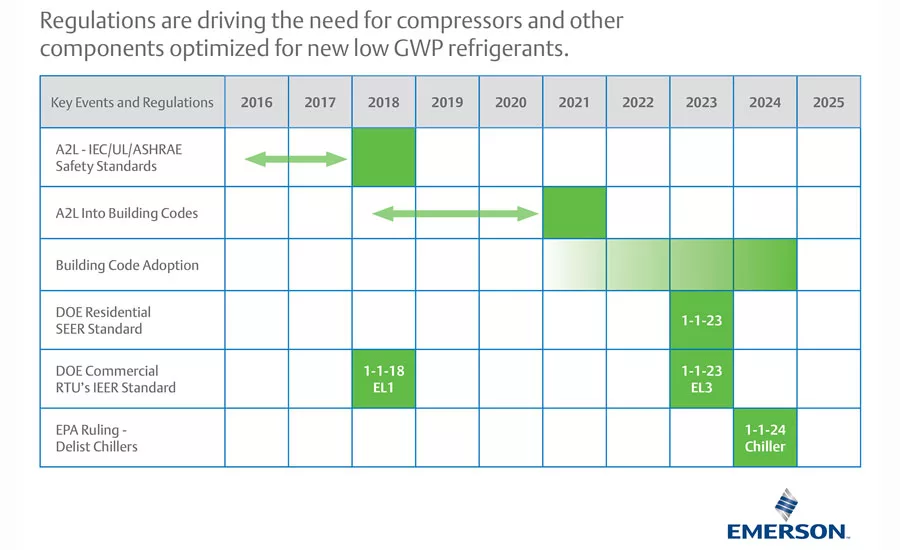
FIGURE 1 - TIMELINE: This graphic illustrates how equipment manufacturers must “work backwards” from the implementation date of various regulations if they are to supply components optimized for low-GWP (global warming potential) refrigerants. GRAPHIC COURTESY OF EMERSON

March 6, 2017

When it comes to the “megatrends” that are affecting the commercial HVAC sector, changes in refrigerants are near the top of the list. That’s the word from Shane Angle, vice president and general manager, commercial air conditioning, Emerson.

Speaking at Emerson’s E360 regulatory breakfast at the 2017 AHR Expo in Las Vegas, Angle pointed out three megatrends affecting the approximately 5.5 million commercial buildings in the United States: building automation and connectivity, energy efficiency and sustainability, and comfort and air quality. The responses to these megatrends include modulation technologies for compressors; efficiency retrofits as, according to Angle, only about 15 percent of the 5.5 million buildings have building automation or management systems that control the HVAC systems; air management systems; and a focus on the refrigerants that will represent the future of HVAC in commercial buildings.

Angle pointed out there is an ongoing pursuit of alternatives to replace R-410A and R-134a, which have been used for years in chillers. However, these popular refrigerants will be delisted in chiller applications effective Jan. 1, 2024, under the U.S. Environmental Protection Agency’s (EPA’s) Significant New Alternatives Policy (SNAP) program.

As of right now, Angle said, the only viable, EPA-approved, low-GWP (global warming potential) candidates to replace R-410A and R-134a in air conditioning applications are the mildly flammable A2L molecules and blends. This presents some challenges, and the industry is working hard to advance and update safety standards, which presumably would lead to updates to the building codes.

“There’s a great deal of attention right now about updating safety standards,” Angle said. “These include international, regional, and UL standards. The goal is to have much of that work completed by the end of 2017, because the building code cycle opens up in 2018.”

Angle explained the next building code cycle runs from 2018 to 2021, and the safety standards must be updated to include A2Ls if these refrigerants are to be included in the next building code revision. Unfortunately, getting the building codes updated is where it gets a little fuzzy, Angle said.

“How fast will the states and other entities adopt these new building codes?” Angle asked. “That will impact the timeline by which new equipment using A2L fluids can be commercialized and sold in the market in the U.S.”

Looking for quick answers on air conditioning, heating and refrigeration topics? Try Ask ACHR NEWS, our new smart AI search tool. Ask ACHR NEWS →

Adding to the pressure on equipment manufacturers, the U.S. Department of Energy (DOE) has set the lofty goal of reducing energy consumption in commercial buildings by 45 percent per square foot by 2030.

The DOE’s rooftop unit regulations set new federal minimums for IEER. Effective Jan. 1, 2018, the first phase of the regulations will go into effect, representing an approximately 15 percent increase over the existing energy-efficiency ratings. An even more dramatic impact will occur in the second phase of the regulations, slated for 2023, in which another 15 percent increase will result in an overall 30 percent increase from the current regulations.

As fate would have it, this second phase of the DOE’s new energy-efficiency standards for rooftop equipment dovetails with the EPA’s 2024 phaseout timeline for new chillers using R-410A or R-134a.

“Rooftop efficiency standards and low-GWP refrigerants are key dynamics in commercial HVAC,” Angle said. “As manufacturers move to redesign systems to meet the new energy standards, it would be ideal if they could also redesign their systems around these new A2L fluids at the same time. The challenge is completing the safety standard and building code work so that those systems could be sold here in the U.S. and applied in buildings.”

If there’s a saving grace for chiller manufacturers compared to rooftop unit manufacturers, it’s that the SNAP delisting date for the use of R-410A and R-134a in chillers is a known quantity. So, for chiller manufacturers and the companies that supply components to them, the next steps are reasonably clear, though they’re not necessarily easy.

“Chillers are very big machines, and the design cycle is not quick,” Angle said. “So, even though the delisting of R-410A and R-134a isn’t until Jan. 1, 2024, if we look at the timeline (see Figure 1) and work backwards, you’ll see we have to get started now in terms of optimizing components around A2L refrigerants. Then, the chiller manufacturers can design the components into their chillers.”

Globally, certain HVAC applications in specific regions are already incorporating flammable and mildly flammable refrigerants.

“In Europe, a handful of chillers have been released that are utilizing mildly flammable fluids, such as the hydrofluoroolefin [HFO] refrigerant 1234ze,” Angle said. “Those systems essentially have been designed to existing A2 standards or A2 codes. It depends on the region, but there are some systems on the market today that utilize flammable or mildly flammable refrigerants.

“In the U.S., the EPA has approved the use of R-32 for low-charge units, such as window units and packaged terminal air conditioners,” he added. “With these very low-charge units, it’s a little bit simpler to ensure the units are safe as opposed to the larger units, where it takes a great deal of work to figure out exactly what safety provisions need to be made.”

So, the bottom line in the commercial HVAC market is there’s much change on the horizon, a lot of work in progress, and much yet to be done. And, not surprisingly, refrigerants find themselves prominently circulating throughout it all.

Publication date: 3/6/2017

Want more HVAC industry news and information? Join The NEWS on Facebook, Twitter, and LinkedIn today!

KEYWORDS: GWP (Global Warming Potential) refrigerants regulations for HVACR Trends in HVACR

Share This Story

Looking for a reprint of this article?
From high-res PDFs to custom plaques, order your copy today!


Ron Rajecki is the marketing content specialist for Aquatherm North America. 

Recommended Content

JOIN TODAY
To unlock your recommendations.

Already have an account? Sign In

  • HVAC-enrollment

    The Trades Are Back: HVACR Programs See Nearly 30% Enrollment Spike

    A new wave of future technicians is entering the pipeline.  
    Training and Education
    By: Matt Jachman
  • 2025 Top 40 Under 40

    2025 Top 40 Under 40 HVACR Professionals List

    The 11th annual Top 40 Under 40 list highlights those...
    HVAC Commercial Market
    By: Hannah Belloli-Oster
  • LG Ductless Mini-Split Systems

    The 9 Types of Heat Pumps

    As the U.S. moves toward electrification, heat pumps are...
    Ground Source Heat Pumps
    By: Joanna R. Turpin
Subscription Center
  • Create an Account
  • Start a Subscription
  • Manage My Account
  • Sign Up for Newsletters
  • Visit Customer Service
  • Update Preferences

More Videos

Sponsored Content

Sponsored Content is a special paid section where industry companies provide high quality, objective, non-commercial content around topics of interest to The News audience. All Sponsored Content is supplied by the advertising company and any opinions expressed in this article are those of the author and not necessarily reflect the views of The News or its parent company, BNP Media. Interested in participating in our Sponsored Content section? Contact your local rep!

close
  • Piggy Bank
    Sponsored byWatercress Financial

    Energy Prices, Inflation, and HVAC: What Today’s Homeowners Care About

  • Refrigerated Food
    Sponsored bySolstice Advanced Materials

    R-455A Refrigeration: A Cold Storage Solution for the Future

  • Airex Rooftop Units
    Sponsored byAirex Manufacturing Inc

    Consolidating Roof Penetrations: A Growing Trend in Multifamily HVAC Design

Popular Stories

Refrigerants-and-gauge.jpg

HVAC Industry Warns of Counterfeit Refrigerants Entering U.S. Supply Chain

Data_Center_facility.jpg

HVAC Manufacturers Respond to Growing Data Center Backlash

Lennox equipment

Platinum Equity to Sell Heat Controller to Lennox

HVAC Minute retail refrigeration system

EPA Final Rule’s Impact on R-410A Deadlines

HVAC-tech-van.jpg

Report: Only 65% of HVAC Technician Time is Billable Hours

View The ACHR NEWS
Centennial Anniversary Timeline

The ACHR News Timeline Chart
Submit a Letter
Submit a letter to our editors.

Events

November 6, 2025

Next-Gen Data Center Cooling: HVAC Innovation and Real-World Solutions

On Demand As AI workloads and high-density computing push traditional cooling methods to their limits, the data center industry is accelerating the adoption of next-generation HVAC technologies.

July 28, 2026

How Top Home Services Companies Turn Every Conversation Into Predictable Revenue

In this webinar, we'll outline how top contractors are turning every conversation into predictable revenue by coaching every comfort advisor visit, not just the ones a manager rides along on.

View All Submit An Event

Poll

Summer Staff

Are you fully staffed for the summer season?
View Results Poll Archive

Products

BNI Mechanical/Electrical Square Foot Costbook, 2026 Edition

BNI Mechanical/Electrical Square Foot Costbook, 2026 Edition

See More Products
Designing Systems Using A2L Refrigerant - Free Webinar - 7/22/2026

Related Articles

  • FROSTlines

    New Developments Drive Adoption of Low-GWP Refrigerants In Commercial Refrigeration

    See More
  • HVAC Industry Invests in Low-GWP Refrigerants

    See More
  • Chemours Introduces Two New Low-GWP Refrigerants in the US

    See More

Related Products

See More Products
  • low grade.png

    Low GWP Refrigerant Safety: Flammable & Mildly Flammable Refrigerants Manual

  • Lessons Learned in a Boiler Room: A common sense approach to servicing and installing commercial boilers

See More Products

Related Directories

  • Trane, Commercial HVAC

    Trane® is a world leader in air conditioning systems, services and solutions. Trane helps customers succeed by providing innovative solutions that optimize indoor environments through a broad portfolio.
  • Carrier, Commercial HVAC Americas

    Founded by the inventor of modern air conditioning, Carrier is a world leader in high-technology heating, air-conditioning and refrigeration solutions.
  • Lennox Commercial HVAC

    Lennox Commercial is a leading provider of high-efficiency packaged rooftop units, VRF, split systems, HVAC controls, furnaces and IAQ products for the light commercial industry.
×

Sign Up. Stay Informed.

The #1 trusted source for the HVACR industry since 1926

SUBSCRIBE
  • RESOURCES
    • Advertise
    • Contact Us
    • Advisory Board
    • Classifieds
    • Submit a Letter
    • Directories
    • Store
  • ACCOUNT CENTER
    • Create an Account
    • Start a Subscription
    • Manage My Account
    • Sign Up for Newsletters
    • Visit Customer Service
    • Update Preferences
  • SERVICES
    • Marketing Services
    • Reprints
    • Market Research
    • List Rental
    • Survey/Respondent Access
  • STAY CONNECTED
    • LinkedIn
    • Facebook
    • Instagram
    • YouTube
    • X (Twitter)
  • PRIVACY
    • PRIVACY POLICY
    • TERMS & CONDITIONS
    • DO NOT SELL MY PERSONAL INFORMATION
    • PRIVACY REQUEST
    • ACCESSIBILITY

Copyright ©2026. All Rights Reserved BNP Media, Inc. and BNP Media II, LLC.

Design, CMS, Hosting & Web Development :: ePublishing