ACHR News
search
Ask ACHR NEWS AI
cart
facebook twitter instagram linkedin youtube
  • Sign In
  • Subscribe
  • Sign Out
  • My Account
ACHR News
  • NEWS
    • Breaking News
    • New HVAC Products
    • Featured Products
    • Manufacturer Reports
    • HVAC Data
    • Legislation
    • ACHR NEWS Centennial
  • RESIDENTIAL
    • Air Conditioners
    • Furnaces
    • Residential Heat Pumps
    • Ductless
    • Residential IAQ
    • Testing, Monitoring, Tools
    • Components & Accessories
  • COMMERCIAL
    • Air Handlers
    • Rooftop Units
    • Chillers and Cooling Towers
    • Commercial Heat Pumps
    • Boilers and Hydronics
    • VRF/Ductless
    • Commercial IAQ
  • REFRIGERATION
    • Refrigerants
    • Refrigerant Regulations
    • Leak Management
  • CONTRACTOR PRO
    • Geothermal
    • Homeowner Study
    • VRF and VRV Ductless
    • Unitary Trends
  • EDUCATION
    • Training and Education
    • Business Management
    • Service and Maintenance
    • Continuing Education
    • Market Research >
      • HVAC Brand Awareness Report
      • VRV, VRF, VRVZ Report
      • Unitary Trends Report
      • Water Heat Professionals Report
    • Webinars
    • Sponsor Insights
    • eProducts Info
    • White Papers
  • EVENTS
    • HVAC Contractor Forum
    • Industry Events and Webinars
  • MEDIA
    • Videos
    • AHR Expo 2025 Videos
    • Podcasts >
      • ACHR News Podcast
      • HARDI Podcasts
      • AHR Expo Podcasts
      • ACCA Podcasts
    • Interactive Spotlights
    • Quizzes
    • eBooks
    • HVAC Talkback
  • HVAC GROUP
    • ACHR NEWS >
      • Current Issue
      • Digital Edition
      • Subscribe
    • Distribution Trends
    • SNIPS NEWS >
      • Join SNIPS NEWS
    • Engineered Systems News >
      • Join ES News
    • HVACR Directory
    • Contests
    • Newsletters
    • Contact
    • Advertise
    • My Account
RefrigerationRefrigerantsCompressors

Why R-32 May Be the Refrigerant of the Future

All options have pros and cons, but R-32 makes a good case for itself
By Don Prather
Properties of Refrigernats

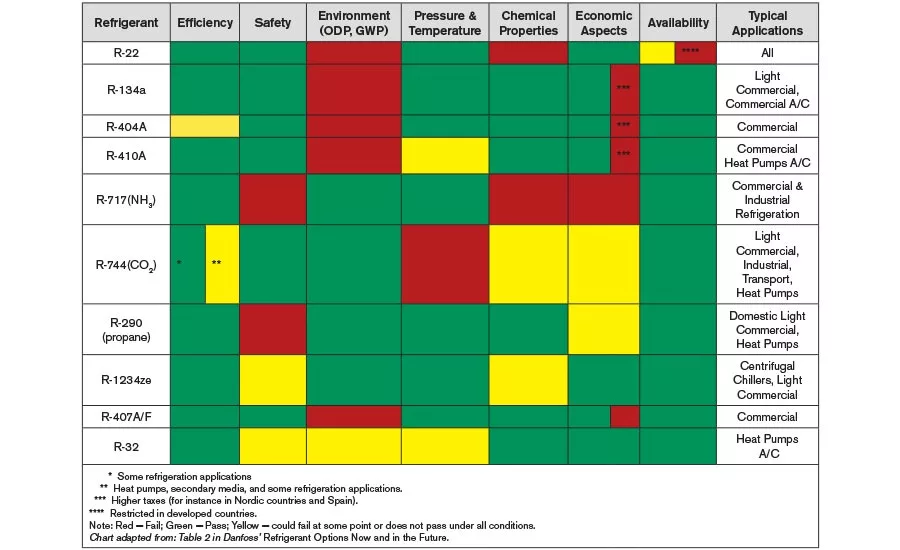
TABLE 1: Properties of various refrigerants for refrigeration, air conditioning, and heat pump applications.

January 9, 2017

In the late 1980s, those of us of a certain age became familiar with an international agreement called the Montreal Protocol. The goal of this agreement was the phaseout of ozone-depleting chlorofluorocarbon (CFC) refrigerants. Then, in 1999, Title VI of the U.S. Clean Air Act was modified to phase out high global-warming hydrofluorocarbon (HFC) refrigerants. Now, once again, the fix has been deemed inadequate, and we are being asked to jump into a new generation of refrigerants.

In the past, each generation of refrigerants was considered to be the optimum one to use.

From todays’ perspective, what would the ideal/dream refrigerant be? It would be a safe compound (or blend of compounds) with no toxicity or zero flammability risk. It would have no compatibility problems with materials of construction, be inexpensive to produce, and provide a capacity greater than the existing R-22 and R-410A refrigerants. To be absolutely perfect, it would be available as a drop-in refrigerant that operates more efficiently than current refrigerants do in existing systems.

Unfortunately, the odds of a chemical engineering breakthrough that will provide the perfect refrigerant is minuscule. All of the possible next-generation options have pluses and minuses as they seek to satisfy the U.S. Environmental Protection Agency’s (EPA’s) regulatory hurdles. Hence, tradeoffs will need to happen when the looming refrigerant change is made. Table 1, which is adapted from Danfoss’s “Refrigerant Options Now and in the Future,” identifies some existing refrigerants and the leading proposed replacements. The values shown in green on the table meet the goals listed below:

• Ozone depletion potential (ODP): Zero is the goal;

• Global-warming potential (GWP): Zero is the goal;

• Flammability: The goal is it will not burn;

Looking for quick answers on air conditioning, heating and refrigeration topics? Try Ask ACHR NEWS, our new smart AI search tool. Ask ACHR NEWS →

• Toxicity: The goal is that it is nontoxic;

• Equipment cost: The goal is to make the equipment no more expensive to build than existing HVACR equipment; and

• Efficiency: The goal is to be at least as efficient as current refrigerants.

The yellow values in Table 1 somewhat meet the requirements, and the red highlights show where a proposed refrigerant fails to meet the goals listed above. Looking at the table, it’s obvious there is not a proposed refrigerant that lines up all in the green range. Thus, tradeoffs need to be understood when a refrigerant change is considered.

HFO OPTIONS

Hydrofluoroolefin (HFO) refrigerants are made up of hydrogen, fluorine, and carbon. This refrigerant class has double-bonded carbon molecules in its structure. There are a number of HFO refrigerants currently under development or going through the approval process. Thus, R-1234, with a set of alphabet letters after the numbers, will be available on the market soon. These refrigerants are listed as marginal for flammability and equipment cost. However, they earn much closer to a passing grade for practical usage. Hence, their viability as replacement options remains. Two that are first out of the approval gate are HFO R-1234yf  (2,3,3,3- Tetrafluoropropene) and HFO R-1234ze (Trans-1,3,3,3-Tetrafluoroprop-1-ene). The main concern from a user’s perspective is they will be expensive refrigerants because the compounds are more difficult to produce than HFCs were.

R-32

R-32 is an HFC refrigerant that has a GWP of 675 over the 100-year duration period by which refrigerants are rated. For comparison, the GWP for R-22 — a hydrochlorofluorocarbon (HCFC) — is 1,810; for R-410A (an HFC), it is 2,090. R-32 has an ODP of 0. When coupled with its lower GWP, it’s a winner when compared to R-22 and R-410A. With relatively minor retrofitting, R-32 can be manufactured in existing R-22 facilities, and it is cheaper than today’s price for the original R-22. So, why was R-32 not considered before? The answer: It has a flammability rating per ISO Standard 817 and is listed as a 2L refrigerant in ASHRAE Standard 34. However, it has a relatively low burning velocity that is actually slightly lower than ammonia’s burning velocity. Thus, it’s not explosive, like butane or pure hydrogen. A spark will not ignite R-32; it takes an open flame to ignite it. Since flammability is the only negative, and it represents a very small risk, R-32 would appear to be a good option. In fact, R-32 would be the undisputed candidate except for one small detail: 2L refrigerants are currently not allowed to be used in U.S. building codes. Additionally, equipment instructions and industry usage standards need to be updated. It should be noted that R-32 is used in many applications outside of the U.S.

CO2 (R-744)

Carbon dioxide (CO2) makes an excellent replacement refrigerant except for one major detail: The operating pressures required are so high that the compressor efficiency suffers tremendously and piping thickness needs to be greatly increased. Additionally, relevant working pressures at 2,000 psi make the systems more dangerous to work on.

AMMONIA (R-717)

Due to the decreasing price of natural gas in the U.S., ammonia- or lithium bromide-based absorption systems may make a comeback. Thus, they remain on the list of possible refrigerants of the future.

PROPANE (R-290)

Propane fails the flammability safety requirement completely. However, since it passes all of the other requirements, it’s often included on the list of possible replacement refrigerants. It’s currently allowed by the EPA for stand-alone, small charge, retail food refrigerators and freezers. Warning: R-290 has been marketed as a direct drop-in replacement for R-22, but it is illegal to use R-290 in comfort cooling applications.

AND THE WINNER IS . . .

In conclusion, per this limited perspective, HFO blends appear to be the answer. It looks like the next generation of replacement refrigerants will come from new HFO blends, and — once U.S. codes are updated — R-32. Additionally, ammonia-based absorption systems may have some niche markets where natural gas is cheap and readily available. Contractors and other industry practitioners should regularly monitor which alternative refrigerant producers and equipment manufacturers are planning on releasing.

My best guess is that common sense will prevail, the industry will work to get our existing codes to approve the use of R-32, and it will become the refrigerant of choice over the more expensive HFO blends.

Publication date: 1/9/2017

Want more HVAC industry news and information? Join The NEWS on Facebook, Twitter, and LinkedIn today!

KEYWORDS: alternative refrigerants ammonia refrigeration HFO refrigerant propane refrigerant Refrigerant Phasedown

Share This Story

Looking for a reprint of this article?
From high-res PDFs to custom plaques, order your copy today!


Headshot prather

Donald Prather is technical services manager for ACCA. He is the author of “Technician’s Guide for Quality Installations” and “Manual B Balancing and Testing Air and Hydronic Systems,” licensed as a master HVAC contractor in Florida, and holds a first-class stationary engineer license in Maryland. Contact him at don.prather@acca.org or 703-824-8867. 

Recommended Content

JOIN TODAY
To unlock your recommendations.

Already have an account? Sign In

  • HVAC-enrollment

    The Trades Are Back: HVACR Programs See Nearly 30% Enrollment Spike

    A new wave of future technicians is entering the pipeline.  
    News
    By: Matt Jachman
  • 2025 Top 40 Under 40

    2025 Top 40 Under 40 HVACR Professionals List

    The 11th annual Top 40 Under 40 list highlights those...
    HVAC Commercial Market
    By: Hannah Belloli-Oster
  • LG Ductless Mini-Split Systems

    The 9 Types of Heat Pumps

    As the U.S. moves toward electrification, heat pumps are...
    HVAC Commercial Market
    By: Joanna R. Turpin
Subscription Center
  • Create an Account
  • Start a Subscription
  • Manage My Account
  • Sign Up for Newsletters
  • Visit Customer Service
  • Update Preferences

More Videos

Sponsored Content

Sponsored Content is a special paid section where industry companies provide high quality, objective, non-commercial content around topics of interest to The News audience. All Sponsored Content is supplied by the advertising company and any opinions expressed in this article are those of the author and not necessarily reflect the views of The News or its parent company, BNP Media. Interested in participating in our Sponsored Content section? Contact your local rep!

close
  • Piggy Bank
    Sponsored byWatercress Financial

    Energy Prices, Inflation, and HVAC: What Today’s Homeowners Care About

  • Refrigerated Food
    Sponsored bySolstice Advanced Materials

    R-455A Refrigeration: A Cold Storage Solution for the Future

  • Airex Rooftop Units
    Sponsored byAirex Manufacturing Inc

    Consolidating Roof Penetrations: A Growing Trend in Multifamily HVAC Design

Popular Stories

HVAC-Price-Increase-graphic

HVAC Price Increase List: June 2026

Trump-Section-232.jpg

Trump Reduces Section 232 Tariffs on HVAC Equipment to 15%

R410A-Refrigerant-Cylinder.jpg

Refrigerant Recovery is a Revenue Opportunity

Heat-pump-cutaway.jpg

PFAS Rules and A2L Building Codes Continue to Evolve

Kroger.jpg

Kroger to Spend $100 Million to Reduce Refrigerant Leaks

View The ACHR NEWS
Centennial Anniversary Timeline

The ACHR News Timeline Chart
Submit a Letter
Submit a letter to our editors.

Events

November 6, 2025

Next-Gen Data Center Cooling: HVAC Innovation and Real-World Solutions

On Demand As AI workloads and high-density computing push traditional cooling methods to their limits, the data center industry is accelerating the adoption of next-generation HVAC technologies.

June 9, 2026

Before You Go All In on AI: Set Up Your Business to Actually Win

In this webinar, we'll walk you through exactly what to get in place before you add AI to your business. You'll leave with a clear picture of where you stand today and a practical action plan to set yourself up for real results.

View All Submit An Event

Poll

Summer Staff

Are you fully staffed for the summer season?
View Results Poll Archive

Products

BNI Mechanical/Electrical Square Foot Costbook, 2026 Edition

BNI Mechanical/Electrical Square Foot Costbook, 2026 Edition

See More Products
A2L Refrigerants - Free Webinar - May 21, 2026

Related Articles

  • Doug Donovan.

    New Educational Models Mean that a Generation of Digital Natives May Be the Future of the Skilled Trades

    See More
  • Kate Houghton at HARDI Conference

    The Future of Refrigerant Reclamation

    See More
  • Best News for Contractors May be the Summer Weather

    See More

Events

View AllSubmit An Event
  • May 21, 2026

    The A2L Genie is Out of the Refrigerant Canister – What Now?

    On Demand Join this webinar to learn about key updates to refrigerant regulations. We will cover practical installation and servicing content gathered from thousands of our interactions with contractors across the US and Canada.
View AllSubmit An Event

Related Directories

  • The Chemours Co., Refrigerants by Chemours

    Trade NamesFreon™ RefrigerantsISCEON™ RefrigerantsOpteon™ RefrigerantsRefrigetants by Chemours™Suva™ Refrigerants
×

Sign Up. Stay Informed.

The #1 trusted source for the HVACR industry since 1926

SUBSCRIBE
  • RESOURCES
    • Advertise
    • Contact Us
    • Advisory Board
    • Classifieds
    • Submit a Letter
    • Directories
    • Store
  • ACCOUNT CENTER
    • Create an Account
    • Start a Subscription
    • Manage My Account
    • Sign Up for Newsletters
    • Visit Customer Service
    • Update Preferences
  • SERVICES
    • Marketing Services
    • Reprints
    • Market Research
    • List Rental
    • Survey/Respondent Access
  • STAY CONNECTED
    • LinkedIn
    • Facebook
    • Instagram
    • YouTube
    • X (Twitter)
  • PRIVACY
    • PRIVACY POLICY
    • TERMS & CONDITIONS
    • DO NOT SELL MY PERSONAL INFORMATION
    • PRIVACY REQUEST
    • ACCESSIBILITY

Copyright ©2026. All Rights Reserved BNP Media, Inc. and BNP Media II, LLC.

Design, CMS, Hosting & Web Development :: ePublishing