ACHR News
search
Ask ACHR NEWS AI
cart
facebook twitter instagram linkedin youtube
  • Sign In
  • Subscribe
  • Sign Out
  • My Account
ACHR News
  • NEWS
    • Breaking News
    • New HVAC Products
    • Featured Products
    • Manufacturer Reports
    • HVAC Data
    • Legislation
    • ACHR NEWS Centennial
  • RESIDENTIAL
    • Air Conditioners
    • Furnaces
    • Residential Heat Pumps
    • Ductless
    • Residential IAQ
    • Testing, Monitoring, Tools
    • Components & Accessories
  • COMMERCIAL
    • Air Handlers
    • Rooftop Units
    • Chillers and Cooling Towers
    • Commercial Heat Pumps
    • Boilers and Hydronics
    • VRF/Ductless
    • Commercial IAQ
  • REFRIGERATION
    • Refrigerants
    • Refrigerant Regulations
    • Leak Management
  • CONTRACTOR PRO
    • Geothermal
    • Homeowner Study
    • VRF and VRV Ductless
    • Unitary Trends
  • EDUCATION
    • Training and Education
    • Business Management
    • Service and Maintenance
    • Continuing Education
    • Market Research >
      • HVAC Brand Awareness Report
      • VRV, VRF, VRVZ Report
      • Unitary Trends Report
      • Water Heat Professionals Report
    • Webinars
    • Sponsor Insights
    • eProducts Info
    • White Papers
  • EVENTS
    • HVAC Contractor Forum
    • Industry Events and Webinars
  • MEDIA
    • Videos
    • AHR Expo 2025 Videos
    • Podcasts >
      • ACHR News Podcast
      • HARDI Podcasts
      • AHR Expo Podcasts
      • ACCA Podcasts
    • Interactive Spotlights
    • Quizzes
    • eBooks
    • HVAC Talkback
  • HVAC GROUP
    • ACHR NEWS >
      • Current Issue
      • Digital Edition
      • Subscribe
    • Distribution Trends
    • SNIPS NEWS >
      • Join SNIPS NEWS
    • Engineered Systems News >
      • Join ES News
    • HVACR Directory
    • Contests
    • Newsletters
    • Contact
    • Advertise
    • My Account
HVAC Residential MarketHeat PumpsRefrigerationVentilationAir ConditionersCondensing UnitsAir Source Heat Pumps

Duct Dynasty: Prevent Airflow Problems with Replacement Indoor Coils

Be sure to accurately measure pressure drop and acknowledge the number of fins per inch
By David Richardson
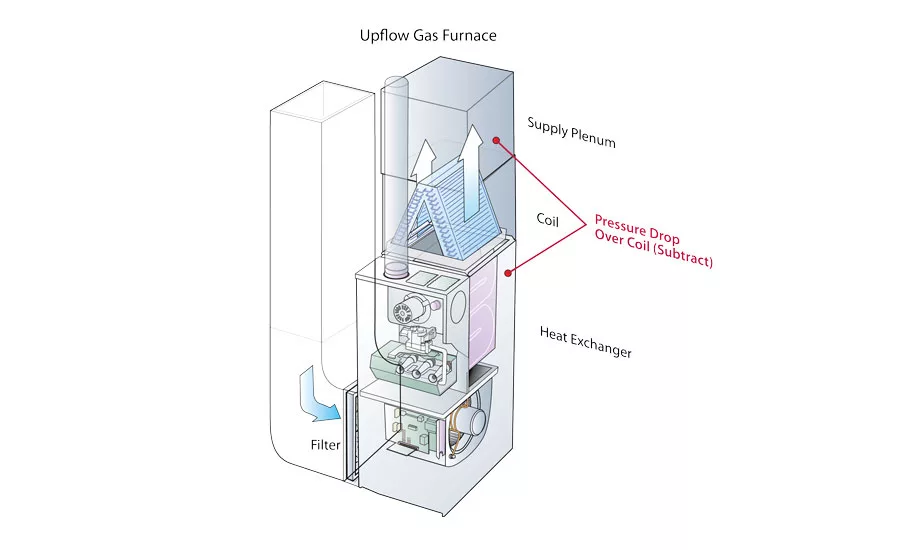
By taking two pressure measurements across the coil, you can quickly determine if it will significantly restrict airflow.

TAKE TWO: By taking two pressure measurements across the coil, you can quickly determine if it will significantly restrict airflow.

June 13, 2016

Many homeowners had a surprise this summer when they switched their thermostats to cooling. They expected cool air to blow out their supply registers, but instead, the air that came out was room temperature. The existing cooling system lived its useful life and was ready for a replacement. Time to change the indoor coil and outdoor unit.

While this sounds like an average day in the life of an HVAC professional, an unforeseen airflow problem could be lurking in this routine replacement. Let’s look at what could cause this issue and how you can ensure you don’t create this problem for your customers.

THE INDOOR COIL’S INFLUENCE

Newer high-efficiency indoor coils are being manufactured with more fins per inch than ever before. Older, low-efficiency coils often contain eight to 10 fins per inch while newer, high-efficiency coils have 14-16 fins per inch. In recent years, some manufacturers have made the move to 24 or more fins per inch.

This change has resulted in many newer coils being restrictive to airflow. When a new restrictive coil replaces an older, less restrictive coil, total external static pressure (resistance to airflow) of the equipment can increase as much as 200 percent of the equipment’s listed rating. This is often the cause for cracked heat exchangers and compressor failure. How can you avoid this problem?

DO YOUR RESEARCH UPFRONT

It’s important to determine the rated pressure drop of the replacement coil at required system airflow. Be sure you use the rated pressure drop of the coil when wet. A wet coil will have more pressure drop than a dry one. Coil pressure drop is available from each equipment manufacturer in its installation instructions or engineering data for the model you plan on using.

According to National Comfort Institute (NCI) studies of properly performing HVAC systems, coil pressure drop shouldn’t exceed 40 percent of the equipment’s rated total external static pressure. If equipment is rated at 0.50 inches of water column, the indoor coil pressure drop shouldn’t exceed 40 percent of a 0.50-inch rated fan or 0.20 inch of water column.

When researching coil rated pressure drop at required airflow, you’ll find coil rated pressure drops as high as 0.50 inch of water column. If the replacement coil has the same amount of pressure drop that the equipment is rated for, no available static pressure is left for the duct system and air filter.

Looking for quick answers on air conditioning, heating and refrigeration topics? Try Ask ACHR NEWS, our new smart AI search tool. Ask ACHR NEWS →

You may need to consider other options to overcome the higher amounts of pressure drop found with some new coils. One such option is to recommend equipment replacement with a stronger variable-speed fan. Up to a certain limit, these fans can handle higher pressures, assuming the duct system and air filter are sized properly.

Once the replacement coil is chosen, it’s time to complete the installation. You’ll need to verify pressure drop across the replacement coil matches the rated pressure drop used to select it.

MEASURING INDOOR COIL PRESSURE DROP

Measuring pressure drop over an indoor coil requires a simple test, similar to measuring pressure drop over an air filter. Test ports need to be installed on both the entering and exiting air side of the coil.

The best time to install these ports is before installing the coil. That’s when you have access to the entire system and can see where your test ports will end up. You won’t have to worry about accidentally drilling into the new coil.

Before you can measure coil pressure drop, make sure you have the proper test instruments and accessories on hand. You’ll need the following:

• Manometer (analog or
digital);

• Test hoses (3/16-inch inner diameter);

• Static pressure tips;

• 3/8-inch drill bit with protective sheath;

• 3/8-inch test port plugs; and

• Manufacturer coil pressure drop data.

Once you have the proper test instruments, accessories, and coil data, you can begin testing. To measure coil pressure drop, follow these six steps:

1. Turn the system on at the thermostat. When testing in the cooling mode, be sure the equipment runs long enough to get the coil wet. If the system has a variable-speed fan, allow it adequate time to go through its ramping profile, too. It should be operating at 100 percent of programmed airflow;

2. Install a test port into the air handling equipment on the entering air side of the coil by drilling a 3/8-inch test hole. This will be your pressure measurement before the coil as air enters it;

3. Install a test port into the supply plenum or duct on the exiting air side of the coil by drilling a 3/8-inch test hole. This will be your pressure measurement after the coil as air leaves it;

4. Setup your manometer in an easily accessible location. If you’re tool of choice is an analog manometer, level and zero it before using. Attach a hose to each pressure tap on the manometer and insert a static pressure tip into the opposite end of each hose;

5. Insert the static pressure tips into the 3/8-inch test ports you drilled on each side of the coil. Be sure to face the static pressure tips into the airflow; and

6. The operating pressure drop over the coil will appear on the display of your manometer. Record this reading to compare against manufacturer rated pressure drop. Record the model number of the coil and install test plugs in your test ports when finished.

COMPARE MEASURED PRESSURE DROP TO MANUFACTURER DATA

Once you know the coil’s condition (wet or dry) and the measured pressure drop, you can determine if the pressure drop is in an acceptable range for the coil. Measured pressure drop should be close to rated pressure drop if the fan is moving the proper amount of airflow.

Using the manufacturer’s coil data, locate the model number matching the installed coil. Next, find the required airflow across the coil and locate the column representing the condition of the coil in its current operating mode, wet or dry.

Next, connect the two plotted points from the wet/dry coil condition and the fan airflow column to determine your target pressure drop. The point where the two lines intersect is the amount of pressure drop the coil should have if the required fan airflow is moving across it. This value should be very close to your measured pressure drop.

For the best results, verify the airflow moving through the coil matches system design airflow. Leaving this step out may cause you to misinterpret your test results.

WHAT IF THE PRESSURE DROP IS OUT OF RANGE?

There will be times when the rated coil pressure drop doesn’t match the actual pressure drop measured in the field. This can happen for several reasons — many of which are installation-related. These include:

• Fan airflow is set incorrectly;

• Flanges are not bent up on the coil cabinet;

• Restrictive duct transitions at the coil;

• Improperly blocked-off sections on the coil discharge;

• Plastic caught in the coil;

• Improper determination of fan airflow (not enough or too much); and

• Wrong model number coil used.

One last note: Be careful when using coil pressure drop tables to determine fan airflow on a coil. Plotting airflow from a coil pressure drop measurement on a restricted coil will show much higher airflow than the system actually possesses. When you need to determine fan airflow, this isn’t the method to use.

Publication date: 6/13/2016

Want more HVAC industry news and information? Join The NEWS on Facebook, Twitter, and LinkedIn today!

KEYWORDS: bypass damper energy efficiency energy management Title 24 zoning market

Share This Story

Looking for a reprint of this article?
From high-res PDFs to custom plaques, order your copy today!


David richardson
David Richardson serves the HVAC industry as Vice President of Training for National Comfort Institute, Inc. (NCI). NCI specializes in training focused on improving, measuring, and verifying HVAC and Building Performance. If you’re an HVAC contractor or technician interested in learning more about building science applied to HVAC, contact David at ncilink.com/ContactMe.

Recommended Content

JOIN TODAY
To unlock your recommendations.

Already have an account? Sign In

  • HVAC-enrollment

    The Trades Are Back: HVACR Programs See Nearly 30% Enrollment Spike

    A new wave of future technicians is entering the pipeline.  
    Training and Education
    By: Matt Jachman
  • 2025 Top 40 Under 40

    2025 Top 40 Under 40 HVACR Professionals List

    The 11th annual Top 40 Under 40 list highlights those...
    HVAC Residential Market
    By: Hannah Belloli-Oster
  • LG Ductless Mini-Split Systems

    The 9 Types of Heat Pumps

    As the U.S. moves toward electrification, heat pumps are...
    Heat Pumps
    By: Joanna R. Turpin
Subscription Center
  • Create an Account
  • Start a Subscription
  • Manage My Account
  • Sign Up for Newsletters
  • Visit Customer Service
  • Update Preferences

More Videos

Sponsored Content

Sponsored Content is a special paid section where industry companies provide high quality, objective, non-commercial content around topics of interest to The News audience. All Sponsored Content is supplied by the advertising company and any opinions expressed in this article are those of the author and not necessarily reflect the views of The News or its parent company, BNP Media. Interested in participating in our Sponsored Content section? Contact your local rep!

close
  • Piggy Bank
    Sponsored byWatercress Financial

    Energy Prices, Inflation, and HVAC: What Today’s Homeowners Care About

  • Refrigerated Food
    Sponsored bySolstice Advanced Materials

    R-455A Refrigeration: A Cold Storage Solution for the Future

  • Airex Rooftop Units
    Sponsored byAirex Manufacturing Inc

    Consolidating Roof Penetrations: A Growing Trend in Multifamily HVAC Design

Popular Stories

Refrigerants-and-gauge.jpg

HVAC Industry Warns of Counterfeit Refrigerants Entering U.S. Supply Chain

U.S. Supreme Court building

95% Furnace Efficiency Rule to Get New Hearing

Midea-training.jpg

HVAC Workforce Crisis Expands Beyond Technicians to Instructor Shortages

Data_Center_facility.jpg

HVAC Manufacturers Respond to Growing Data Center Backlash

HVAC Minute retail refrigeration system

EPA Final Rule’s Impact on R-410A Deadlines

View The ACHR NEWS
Centennial Anniversary Timeline

The ACHR News Timeline Chart
Submit a Letter
Submit a letter to our editors.

Events

November 6, 2025

Next-Gen Data Center Cooling: HVAC Innovation and Real-World Solutions

On Demand As AI workloads and high-density computing push traditional cooling methods to their limits, the data center industry is accelerating the adoption of next-generation HVAC technologies.

June 23, 2026

HVAC Duct Sealing Mastics: Why Selection Matters

In this webinar we will detail what HVAC material buyers and technicians need to know when selecting duct mastics, including matching mastic to substrate, alternatives to liquid mastic, and where UL 181 Listings fit into real world installations.

View All Submit An Event

Poll

Summer Staff

Are you fully staffed for the summer season?
View Results Poll Archive

Products

BNI Mechanical/Electrical Square Foot Costbook, 2026 Edition

BNI Mechanical/Electrical Square Foot Costbook, 2026 Edition

See More Products
HVAC Duct Sealing Mastics: Why Selection Matters - Free Webinar - 6/23/2026

Related Articles

  • Duct Dynasty: Duct Design and Proper Airflow

    See More
  • Duct Dynasty: Air Leakage, Two-story Cooling Problems

    See More
  • Airflow upgrades give reputable contractors an opportunity to profitably repair duct systems that we all often joke about.

    Duct Dynasty: Differentiate Your Company with Airflow Upgrades

    See More

Related Products

See More Products
  • Evaluating-and-Troubleshooting-Refrigeration-Systems-Video-Cover-210x300.jpg

    Evaluating Refrigeration Systems Troubleshooting & Identifying Problems CONTINUED

  • 0880690186-228x228.jpg

    Airflow in Ducts

  • understandingD.jpg

    Understanding Manual D® — Residential Duct Systems

See More Products

Related Directories

  • Indoor Air Quality Assn.

    IAQA is dedicated to bringing practitioners together to prevent and solve indoor environmental problems for the benefit of consumers and the public.
  • Carrier, Replacement Components

    Replacements Components is the parts division of Carrier dedicated to after sale support of the Carrier/Bryant/Payne/ICP equipment brands.
  • LRC Coil Co.

    LRC Coil specializes in specialty refrigeration applications for Wine, Cigar, Cheese, and many other types of products. We also make Custom, OEM, and Replacement coils.
×

Sign Up. Stay Informed.

The #1 trusted source for the HVACR industry since 1926

SUBSCRIBE
  • RESOURCES
    • Advertise
    • Contact Us
    • Advisory Board
    • Classifieds
    • Submit a Letter
    • Directories
    • Store
  • ACCOUNT CENTER
    • Create an Account
    • Start a Subscription
    • Manage My Account
    • Sign Up for Newsletters
    • Visit Customer Service
    • Update Preferences
  • SERVICES
    • Marketing Services
    • Reprints
    • Market Research
    • List Rental
    • Survey/Respondent Access
  • STAY CONNECTED
    • LinkedIn
    • Facebook
    • Instagram
    • YouTube
    • X (Twitter)
  • PRIVACY
    • PRIVACY POLICY
    • TERMS & CONDITIONS
    • DO NOT SELL MY PERSONAL INFORMATION
    • PRIVACY REQUEST
    • ACCESSIBILITY

Copyright ©2026. All Rights Reserved BNP Media, Inc. and BNP Media II, LLC.

Design, CMS, Hosting & Web Development :: ePublishing