ACHR News
search
Ask ACHR NEWS AI
cart
facebook twitter instagram linkedin youtube
  • Sign In
  • Subscribe
  • Sign Out
  • My Account
ACHR News
  • NEWS
    • Breaking News
    • New HVAC Products
    • Featured Products
    • Manufacturer Reports
    • HVAC Data
    • Legislation
    • ACHR NEWS Centennial
  • RESIDENTIAL
    • Air Conditioners
    • Furnaces
    • Residential Heat Pumps
    • Ductless
    • Residential IAQ
    • Testing, Monitoring, Tools
    • Components & Accessories
  • COMMERCIAL
    • Air Handlers
    • Rooftop Units
    • Chillers and Cooling Towers
    • Commercial Heat Pumps
    • Boilers and Hydronics
    • VRF/Ductless
    • Commercial IAQ
  • REFRIGERATION
    • Refrigerants
    • Refrigerant Regulations
    • Leak Management
  • CONTRACTOR PRO
    • Geothermal
    • Homeowner Study
    • VRF and VRV Ductless
    • Unitary Trends
  • EDUCATION
    • Training and Education
    • Business Management
    • Service and Maintenance
    • Continuing Education
    • Market Research >
      • HVAC Brand Awareness Report
      • VRV, VRF, VRVZ Report
      • Unitary Trends Report
      • Water Heat Professionals Report
    • Webinars
    • Sponsor Insights
    • eProducts Info
    • White Papers
  • EVENTS
    • HVAC Contractor Forum
    • Industry Events and Webinars
  • MEDIA
    • Videos
    • AHR Expo 2025 Videos
    • Podcasts >
      • ACHR News Podcast
      • HARDI Podcasts
      • AHR Expo Podcasts
      • ACCA Podcasts
    • Interactive Spotlights
    • Quizzes
    • eBooks
    • HVAC Talkback
  • HVAC GROUP
    • ACHR NEWS >
      • Current Issue
      • Digital Edition
      • Subscribe
    • Distribution Trends
    • SNIPS NEWS >
      • Join SNIPS NEWS
    • Engineered Systems News >
      • Join ES News
    • HVACR Directory
    • Contests
    • Newsletters
    • Contact
    • Advertise
    • My Account
HVAC Residential MarketHeat PumpsFurnacesAir Source Heat PumpsGround Source Heat Pumps

The CAZ Razzmatazz

Failed CAZ tests should be evaluated by licensed professionals
By Don Prather
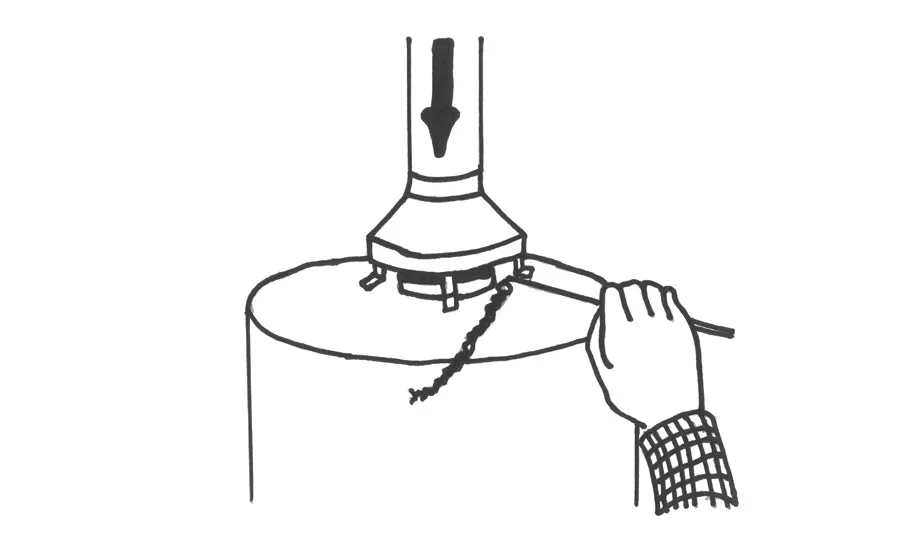
Backdrafting shown with a smoke stick.

FAULTY COMBUSTION: Backdrafting shown with a smoke stick.

March 7, 2016

Everyone has now figured out what happens when you tightly seal up a room with a combustion appliance in it: Tightening a home’s envelope may reduce the air supply needed for combustion, and when there’s not enough combustion air, equipment could have combustion ventilation problems. Thus, the people who sealed up homes (often referred to as the weatherization industry) needed a way to determine if sealing a home up would undermine the safe operation of combustion equipment. To meet this safety need, they embraced combustion appliance zone (CAZ) depressurization testing.

The basis for the CAZ test, as we now know it, was two documents: ASTM International Standard Guide for Assessing Depressurization-Induced Backdrafting and Spillage from Vented Combustion Appliances — designated as E1998-02 — that has been reapproved numerous times. Additionally, a Canadian depressurization test standard, CAN/CGSB-51.71, was recalled and is no longer in use.

Like many tests done in the field, the results of a CAZ test are only good for the conditions in place on the day and time it was performed. Kind of like judging the whole year’s weather around conditions you saw from the porch at sunset on Oct. 3. Thus, for CAZ testing, the result is: It is safe today, hopefully, which means it will be safe later today and for ever more.

Fortunately, if the combustion system is operating unsafely all of the time, or at the time of testing, the combustion equipment will fail the CAZ test. When one of the three main combustion problem indicators are found — backdraft, combustion spillage, or flame rollout — weatherization specialists have generally called in HVAC experts to resolve the issue. In many instances, there may be a point score provided. The tests commonly used do not report failures at equivalent levels of depressurization. However, a failure is a failure, and the underlying cause needs to be fixed.

After any failed CAZ test, all HVAC-related equipment evaluations and the related combustion analysis testing should be completed by a professionally licensed HVAC contractor who employs qualified technicians with the appropriate certifications and training. Hence, the CAZ razzmatazz, since the original conditions for the test can rarely be duplicated and may not be the same when an HVAC technician gets there. Further, HVAC technicians should be told how the failure was determined and what the operating conditions were (outside temperature, wind direction and speed, what combustion equipment was operating, etc.).

When called to a CAZ test that has failed, the HVAC expert may need to become a home-performance expert to diagnose the real problem. For example, a failed CAZ test indicates there is a problem, not where the problem is or what is causing it. Often, the potential performance problem can be with the venting, in the appliance, or it can be related to the way appliances were installed and/or the operating conditions. Once identified, the cause of a CAZ test failure may be a combination of unrelated factors. Thus, the furnace is often operating properly. If the HVAC technician does a combustion analysis and simply reports the furnace is OK and leaves, the homeowner still has a problem. Why miss the opportunity to investigate and find a cause and a solution for the customer?

For example, one set of new homes was failing the CAZ tests, and, worse yet, homeowners were suffering from carbon monoxide poisoning. You should be able to guess who got the blame and the first callback. The homes had condensing furnaces with their own combustion air and exhaust venting, so they were not the problem. Unfortunately, when it comes to CO, HVAC contractors are often considered guilty until proven innocent. In the case of these new homes, the hot water heaters, gas dryers, and gas ovens did not have any combustion air provided when they were installed. Thus, the solution was to design a venting system that could provide more combustion air when the other appliances were in use (or open the windows when they were in use). By identifying the problem and developing a solution, the HVAC contractor avoided the danger of letting the judicial system try to figure out who was at fault. Additionally, their relationship with the homeowners was repaired and strengthened.

Looking for quick answers on air conditioning, heating and refrigeration topics? Try Ask ACHR NEWS, our new smart AI search tool. Ask ACHR NEWS →

For detailed information on CAZ testing, ACCA members can download the “Understanding CAZ Depressurization Testing” technical bulletin. The CAZ testing information is also included as part of ACCA’s Qtech basic home-performance training course, which is available online.

Publication date: 3/7/2016

Want more HVAC industry news and information? Join The NEWS on Facebook, Twitter, and LinkedIn today!

KEYWORDS: ACCA (Air Conditioning Contractors of America) ventilation products

Share This Story

Looking for a reprint of this article?
From high-res PDFs to custom plaques, order your copy today!


Headshot prather

Donald Prather is technical services manager for ACCA. He is the author of “Technician’s Guide for Quality Installations” and “Manual B Balancing and Testing Air and Hydronic Systems,” licensed as a master HVAC contractor in Florida, and holds a first-class stationary engineer license in Maryland. Contact him at don.prather@acca.org or 703-824-8867. 

Recommended Content

JOIN TODAY
To unlock your recommendations.

Already have an account? Sign In

  • HVAC-enrollment

    The Trades Are Back: HVACR Programs See Nearly 30% Enrollment Spike

    A new wave of future technicians is entering the pipeline.  
    News
    By: Matt Jachman
  • 2025 Top 40 Under 40

    2025 Top 40 Under 40 HVACR Professionals List

    The 11th annual Top 40 Under 40 list highlights those...
    HVAC Light Commercial Market
    By: Hannah Belloli-Oster
  • LG Ductless Mini-Split Systems

    The 9 Types of Heat Pumps

    As the U.S. moves toward electrification, heat pumps are...
    HVAC Residential Market
    By: Joanna R. Turpin
Subscription Center
  • Create an Account
  • Start a Subscription
  • Manage My Account
  • Sign Up for Newsletters
  • Visit Customer Service
  • Update Preferences

More Videos

Sponsored Content

Sponsored Content is a special paid section where industry companies provide high quality, objective, non-commercial content around topics of interest to The News audience. All Sponsored Content is supplied by the advertising company and any opinions expressed in this article are those of the author and not necessarily reflect the views of The News or its parent company, BNP Media. Interested in participating in our Sponsored Content section? Contact your local rep!

close
  • Piggy Bank
    Sponsored byWatercress Financial

    Energy Prices, Inflation, and HVAC: What Today’s Homeowners Care About

  • Refrigerated Food
    Sponsored bySolstice Advanced Materials

    R-455A Refrigeration: A Cold Storage Solution for the Future

  • Airex Rooftop Units
    Sponsored byAirex Manufacturing Inc

    Consolidating Roof Penetrations: A Growing Trend in Multifamily HVAC Design

Popular Stories

Refrigerants-and-gauge.jpg

HVAC Industry Warns of Counterfeit Refrigerants Entering U.S. Supply Chain

U.S. Supreme Court building

95% Furnace Efficiency Rule to Get New Hearing

Midea-training.jpg

HVAC Workforce Crisis Expands Beyond Technicians to Instructor Shortages

Data_Center_facility.jpg

HVAC Manufacturers Respond to Growing Data Center Backlash

HVAC Minute retail refrigeration system

EPA Final Rule’s Impact on R-410A Deadlines

View The ACHR NEWS
Centennial Anniversary Timeline

The ACHR News Timeline Chart
Submit a Letter
Submit a letter to our editors.

Events

November 6, 2025

Next-Gen Data Center Cooling: HVAC Innovation and Real-World Solutions

On Demand As AI workloads and high-density computing push traditional cooling methods to their limits, the data center industry is accelerating the adoption of next-generation HVAC technologies.

June 23, 2026

HVAC Duct Sealing Mastics: Why Selection Matters

In this webinar we will detail what HVAC material buyers and technicians need to know when selecting duct mastics, including matching mastic to substrate, alternatives to liquid mastic, and where UL 181 Listings fit into real world installations.

View All Submit An Event

Poll

Summer Staff

Are you fully staffed for the summer season?
View Results Poll Archive

Products

BNI Mechanical/Electrical Square Foot Costbook, 2026 Edition

BNI Mechanical/Electrical Square Foot Costbook, 2026 Edition

See More Products
HVAC Duct Sealing Mastics: Why Selection Matters - Free Webinar - 6/23/2026

Related Articles

  • Properties of Refrigernats

    Why R-32 May Be the Refrigerant of the Future

    See More
  • Sept. 28, 2012: ACCA Publishes New Technical Bulletin on CAZ Depressurization Testing

    See More
  • Products That Break the Energy Star Barrier

    See More

Related Products

See More Products
  • Uncomplicating The Heat Pump: Refrigeration & Air Flow Systems DVD

See More Products

Related Directories

  • The Whalen Co.

    The Whalen Company is the pioneering manufacturer of HVAC vertical stack riser heat-exchanger fan coil units and water-source heat pumps for hotels, apartments and other multi-story buildings.
×

Sign Up. Stay Informed.

The #1 trusted source for the HVACR industry since 1926

SUBSCRIBE
  • RESOURCES
    • Advertise
    • Contact Us
    • Advisory Board
    • Classifieds
    • Submit a Letter
    • Directories
    • Store
  • ACCOUNT CENTER
    • Create an Account
    • Start a Subscription
    • Manage My Account
    • Sign Up for Newsletters
    • Visit Customer Service
    • Update Preferences
  • SERVICES
    • Marketing Services
    • Reprints
    • Market Research
    • List Rental
    • Survey/Respondent Access
  • STAY CONNECTED
    • LinkedIn
    • Facebook
    • Instagram
    • YouTube
    • X (Twitter)
  • PRIVACY
    • PRIVACY POLICY
    • TERMS & CONDITIONS
    • DO NOT SELL MY PERSONAL INFORMATION
    • PRIVACY REQUEST
    • ACCESSIBILITY

Copyright ©2026. All Rights Reserved BNP Media, Inc. and BNP Media II, LLC.

Design, CMS, Hosting & Web Development :: ePublishing