Chimney Fundamentals: The Science of Venting Flue Gases - Part 3
How to Keep Your Customers Safe as Well as Comfortable
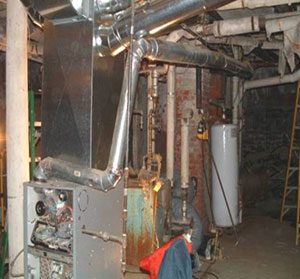
|
| For Category I venting, use “B” vent as the connector from the appliance to the flue. |
Water is a byproduct of combustion. If the proper venting of flue gases is neglected — as is so often the case, unfortunately, in our industry — water in the form of condensation triggers serious safety and comfort issues for our customers.
As professionals, we must pay more attention to flue gas temperatures and the conditions of the flue during our service calls.
A fundamental fact stands the test of time concerning water transformation for the bulk of equipment in service today, i.e., Category I appliances. (Category II and Category III appliances, discussed in earlier articles, are rarely found in service today. High-efficiency Category IV appliances are already engineered to remove water from within the secondary heat exchanger and flue).
Category I appliances must maintain water in a gaseous state within the flue. A gaseous state exists when the flue heats to the right temperature. In this state, water will correctly remain a gas and exit the flue into the atmosphere. This happens ideally when the flue is properly lined. However, since many flues were never lined initially, there is a chronic problem of unlined flues in every locale.
With an unlined flue, the stage is set for weak venting of flue gases. Water in its gaseous state will become a vapor state. Water will then condense inside the flue, drip down and raise havoc on equipment. As a serious safety issue, this condensation will often lead to back drafting of flue gases, and possible carbon monoxide poisoning. Cumulative, low level carbon monoxide poisoning is widespread today due to such systems.
In short, interior rain is never a good solution.
Maintaining the correct flue temperature to avoid this situation requires a knowledge of the characteristics of the equipment.
Looking for quick answers on air conditioning, heating and refrigeration topics? Try Ask ACHR NEWS, our new smart AI search tool. Ask ACHR NEWS
Annual fuel utilization efficiency (AFUE) 60-70 percent furnaces:
These furnaces create 21 cubic feet of flue gases for every one cubic foot of natural gas burned. A draft diverter adds in another 10 cubic feet of air with these flue gases. While this is a far cry from early furnaces that used to add 100 cubic feet of air, this introduction of air reduces efficiency of any mixture of dilution gases. More heat goes up the chimney at very high temperatures, in the range of 450° - 600°F.
Such red-hot dilution gases reduce the relative humidity and increase the dew point of the system. The sheer heat level maintained the gaseous state of water, so condensation is less of a problem.
With these furnaces, a draft hood is critical to install correctly in order to minimize draft fluctuation and to prevent back draft from affecting the burner.
AFUE 78 percent and 80 percent furnaces:
With these improved efficiency furnaces — the most widely prevalent in service today — a draft induced fan does not force flue gases into the vent. Therefore the flue must be carefully designed, maintained, and installed, especially if this furnace replaced earlier equipment. With better efficiency, more heat remains in the building, which is good. But less heat goes up the chimney. The chimney is now colder. The cycle time on these furnaces is longer to adequately warm the flue and to keep moisture in the important gaseous state.
How do you ensure that a chimney will warm properly for any furnace? Calculations as well as flue construction will provide the answer. Take the time to review the equipment in front of you each time.
Consider a 100,000 Btuh system. At a firing rate of 100,000 Btuh with SSE = 75 percent, then 75,000 Btuh goes to the distribution system and the remaining 25,000 Btuh goes through the vent. If the burner on-cycle is 12 minutes, or .2/hour, during one cycle the flue vent receives 5,000 Btu/cycle (.2 hr. x 25,000 Btuh).
Now consider the chimney, or flue, and its construction. Flues are either masonry or steel; each has a different calculation for warm-up.
A masonry chimney comprised of block or brick plus a tile liner requires about 4,570 Btu/ft. to heat up from zero degrees to 120°. Thus on a very cold day, about one foot of masonry chimney will be warmed in one burner cycle: 5,000 Btu/cycle @ 4,570Btu/ft. equals one foot per cycle.
Six-inch type “B” vent chimney, which is the most common in the U.S., requires about 90 Btu per foot for a temperature rise from zero degrees to 120°. Thus, on a very cold day, 55 feet of Type B chimney will be warmed in one burner cycle: 5,000 Btu/cycle @ 90Btu/ft. = 55 ft. per cycle.
Weatherization of a home, such as air sealing and insulation of the envelope, will reduce the load and directly affect venting characteristics. For example, if the firing rate = 75,000 Btuh and SSE = 82 percent, then 61,500 Btuh will be used directly by the furnace to heat the home; 13,500 Btuh will be used by the vent. If the burner on-cycle is 6 minutes (.1 hr.), during one cycle the vent receives 1,350 Btu/cycle (.1hr. x 13,500 Btuh).
How do these fewer Btuh’s affect venting? With an existing masonry chimney, only about four inches of the masonry chimney will be warmed during one burner cycle: 1,350 Btu/cycle @ 4,570Btu/ft. = .3 ft./cycle.
With a Type “B” vent chimney, during each burner on-cycle, about 15 feet will be warmed: 1,350 Btu/cycle @ 90Btu/ft. = 15 ft./cycle.
We need to follow guidelines for each specific system, or water will not remain gaseous. It will become vapor, and drip down inside the system.
Let’s work together to eliminate condensation as the leading cause of furnace problems across the country.
Draft Induced Category I Venting Guidelines (78-80 Percent AFUE)
• There should be no exterior masonry chimneys without a properly sized metal liner.
• No interior masonry chimneys should extend over two stories. Period.
• No Transite chimneys and no unlined masonry chimneys should ever be installed.
• Do not use masonry chimneys unless they are commonly vented with a draft hood-type appliance without a vent damper.
• Double-wall “B” vent connector must be used.
• The furnace must be properly sized.
• The furnace must be set up correctly with proper temperature rise, gas input, and heat anticipator or cycle rate set at three cycles per hour.
Vent sizing should be in accordance with tables supplied with the furnace or per National Fire Protection Association (NFPA) requirements. When sidewall venting, a power vent kit must be used unless the manufacturer specifies otherwise.
Category I Venting Checklist (60-70 Percent AFUE)
• Use “B” vent as the connector from the appliance to the flue. This will reduce heat loss in the connector.
• Pitch the connector down toward the appliance ¼ inch per foot. Remember: warm air rises.
• Maximum horizontal distance should be 1½ times the diameter of the connector in feet. With a 4-inch connector, the maximum horizontal distance should be 6 feet.
• Follow NFPA 54 sizing charts.
• Never used unlined masonry flue.
• Don’t use outside masonry flue.
• Never use Transite.
• For oil appliance venting, follow NFPA 31 sizing guidelines. Use Type “L” double-wall stainless steel vent.
Finally: Venting Changes Affect the Water Heater
Pay attention to the domestic water heater!
If you remove a Category I system and upgrade to Category IV high-efficiency equipment, you are taking a major appliance out of the flue. This removal has a direct impact on the fundamentals of venting for that home. The water heater is now ‘orphaned.’ Venting of its own flue gases will not likely be strong enough to leave the flue. Back drafting of these flue gases is highly likely.
You are responsible to ensure that the water heater will vent properly. How? Line the flue.
Publication date: 4/20/2015
Want more HVAC industry news and information? Join The NEWS on Facebook, Twitter, and LinkedIn today!
Looking for a reprint of this article?
From high-res PDFs to custom plaques, order your copy today!