An Open and Closed Case — Modifications and Retrofits
Guidelines for Retrofitting Open Cases With Doors
|
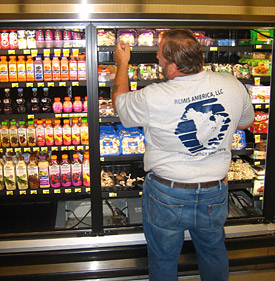
| Contractors should have experience in performing case retrofits and refrigeration system reconfigurations. |
With initial evaluation, system modeling, and equipment procurement complete, the next step in the retrofit process of an open refrigerated display case is to proceed with the action of physically retrofitting the cases with doors. Contractors should have experience in performing case retrofits and refrigeration system reconfigurations. All equipment should be installed per the guidance of the door manufacturer, retrofit kit provider, or other applicable equipment supplier.
Case Preparation
In preparation for the installation of doors and other work performed as part of the retrofit, merchandise housed in the affected cases should, if necessary, be removed and transferred to other cases, walk-in coolers, or other refrigerated storage spaces in a manner so as to mitigate product loss. Electrical supply to the affected cases and systems should be interrupted per the instructions of the supervising engineer so as to ensure a safe working environment. Refrigerant valves should be closed, or the refrigerant supply to the case otherwise interrupted to lower the potential for refrigerant leakage should the sealed system components accidentally be punctured.
Display Door Installation
Display door installation should be performed in accordance with the instructions provided by the door manufacturer, retrofit kit provider, or case original equipment manufacturer (OEM). Installation generally begins with the removal of the existing bumpers, sheet metal façade, and other exterior components on the front of the case and canopy. Doors will be coupled to the case frame using mounts or brackets intended for compatible use with the given case model, following the instructions of the retrofit kit or door provider.
Gasketing and sealing of the retrofit doors and frame to the existing case structure is a function of the retrofit kit design and should have been taken into account by the retrofit kit or door designer. Gasketing materials and types can vary widely in style and design based upon the style and make of door selected. When using doors with gasketing, special care should be taken to ensure that proper materials are used to create a full seal between the retrofit doors and the body of the case. Open cases, by design, include provisions to account for the presence of some “spill air”— that is, refrigerated air that leaves the case interior and enters the ambient environment. This is not needed in a doored case, where a full seal and absolute minimization of infiltration is desired. If steps are not taken to create an airtight seal between the door and case body, a significant amount of infiltration could still occur, reducing the energy savings potential of the retrofit. Installers should take care to ensure that the retrofit kit is properly matched to the existing equipment and should follow all instructions given by the kit provider regarding the mounting of the doors on the case structure.
Additionally, DOE suggests that all display doors selected be designed to swing or slide closed if not locked open for stocking, in order to avoid instances of case doors being left open, leading to excessive energy usage and possible product loss. Doors that are designed to swing closed may need to be adjusted to ensure that they close by themselves from a position of being only a few inches open in order to prevent them from being inadvertently left ajar.
If the initial system analysis and design concluded that the use of anti-condensate heaters was warranted in the specific application, the heaters included in the door and frame package should be connected to the electrical supply by an electrician. The power level should, if possible, be adjusted to the level suggested by design calculations. If anti-condensate heater controllers have been specified in the work plan, the controllers should be installed, configured, and calibrated according to the manufacturer’s instructions.
Lighting Modification
Generally, the installation of retrofit display doors will also involve changes to the lighting system. While retailers sometimes may wish to keep existing shelf and/or canopy lighting, in many instances store owners choose to replace the lighting to fit the new configuration with the doors in place. Most retrofit door sets, with the exception of some single-pane doors and “frameless” doors, will come paired with a frame, and lighting is usually located in the mullion of the frame and supplied by the door manufacturer. Some retrofits may incorporate shelf or canopy lighting as well as mullion lighting.
Looking for quick answers on air conditioning, heating and refrigeration topics? Try Ask ACHR NEWS, our new smart AI search tool. Ask ACHR NEWS
New lighting should be tied into the existing case wiring harness by a qualified technician, and the supervising engineer should perform the necessary calculations to ensure that the existing case electrical system is adequate to properly power the new lighting.
Fan Adjustment
If the retrofit plan calls for the upgrade of existing shaded pole motors (SPMs) to electronically commutated motors (ECMs) or permanent split capacitor (PSC) motors, the existing SPMs should be disconnected at their terminals and removed from the case. If the existing fan blades are to be reused, they should be removed from the motor shafts, cleaned, inspected for damage (e.g., nicks, bent blades), and retained. The electrical connections should be checked for integrity and for compatibility with the new motors, and the hole pattern on the existing fan blades should also be checked for compatibility. The motors and accompanying fan blades should be installed by a qualified technician.
If the initial calculations determined that a reduction in case airflow and fan power was warranted, the fan motors and/or blades should be replaced or adjusted in accordance with the results of the prior analysis and the instructions of the equipment manufacturers.
Defrost Adjustment
In open cases, defrost systems are generally designed and configured so that defrost periods occur repeatedly throughout the day. Experts consulted in the preparation of this guide stated that after the installation of doors on the cases, the number of defrost periods can generally be reduced to between one and three per day, and that these generally can be timed to coincide with periods of low door opening and shopping traffic. The need for defrost periods should be examined during the planning portion of the retrofit operation, and changes to the defrost schedule should be implemented after the installation of doors, taking into account any information provided by the case manufacturer or retrofit kit provider.
Case Temperature Adjustment
The installation of display doors on a previously open case will generally mean that a lower discharge air temperature will be needed in order to maintain the product temperatures necessary for merchandising and food safety. Industry experts stated that discharge air temperatures can often be raised on the order of 4°F while maintaining the desired product temperature. Adjustments to the discharge air temperature and saturated evaporator temperature should be made in accordance with the guidance of the case manufacturer, retrofit kit provider, and other equipment suppliers.
EDITOR’S NOTE: This work was accomplished with the guidance of Brian Holuj, Jason Komen, and Kristen Taddonio of the U.S. Department of Energy, and through the contributions of many Better Buildings Alliance retail members and representatives of industry. The U.S. Department of Energy wishes to particularly acknowledge the efforts of the following parties for providing technical information and assistance during the development of this document: DC Engineering, Hillphoenix, Hussmann Corp., REMIS America LLC and REMIS GmbH, and Zero Zone Inc.
This report should be viewed as a general guide to best practices and factors for consideration by end users who are planning or evaluating a retrofit operation, rather than a comprehensive and exhaustive set of specific steps to perform when retrofitting display cases. A qualified refrigeration engineer or firm should always be contracted to oversee any retrofit project. This report was prepared as an account of work sponsored by an agency of the United States government. Neither the United States government, nor any agency thereof, nor any of their employees, nor any of their contractors, subcontractors, or their employees, makes any warranty, express or implied, or assumes any legal liability or responsibility for the accuracy, completeness, or usefulness of any information, apparatus, product, or process disclosed, or represents that its use would not infringe privately owned rights. Reference herein to any specific commercial product, process, or service by trade name, trademark, manufacturer, or otherwise, does not necessarily constitute or imply its endorsement, recommendation, or favoring by the United States government or any agency, contractor, or subcontractor thereof. The views and opinions of authors expressed herein do not necessarily state or reflect those of the United States government or any agency thereof.
Publication date: 6/24/2013
Looking for a reprint of this article?
From high-res PDFs to custom plaques, order your copy today!


