Industry Questions DOE’s Standard Work Specifications
|
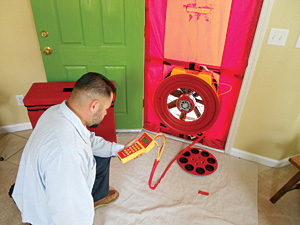
| Building Performance Institute Inc. (BPI) certified building analyst Richard Perez, ABC Cooling & Heating, Fresno, Calif., studies his meter in hopes of a successful reading. The U.S. Department of Energy (DOE) chose BPI as the body to provide energy auditor, installer, crew leader, and quality control inspector certifications to the home performance marketplace through its Standard Work Specifications guidelines. |
Where to Begin
In 2009, the DOE invested nearly $139 million in American Recovery and Reinvestment Act (ARRA) funds to lay the foundation for high-quality residential energy upgrades. The formulation of the SWS guidelines is one of the DOE’s major ARRA-funded endeavors.
The DOE’s National Renewable Energy Laboratory (NREL) tasked weatherization and home performance industry representatives to complete Job Task Analyses for four job classifications: Energy auditor, retrofit installer technician, crew leader, and quality control inspector. Their research produced the necessary steps to complete a given job, and the knowledge, skills, and abilities a worker should possess to adequately perform each task.
The SWS guidelines were first presented for public comment in November 2010. Since that time, four separate review periods have been staged, with more than 2,000 unique comments and criticisms received.
“The growing interest of the HVACR industry in home performance is a very exciting development and the DOE Building Technologies program stands ready to work with the industry constructively to support this new direction,” said Benjamin Goldstein, Office of Energy Efficiency and Renewable Energy, DOE.
In addition to the SWS Single Family Energy Upgrades, the DOE is currently composing similar guidelines for mobile home and multifamily housing retrofits.
Industry Concerns
In discussing the matter with The NEWS, numerous HVAC industry leaders expressed discontent with how the standards were developed and how difficult it was to participate in the process. Of the 2,000-plus submitted comments, hundreds stemmed from the HVAC industry.
Donald B. Prather, technical services manager, Air Conditioning Contractors of America (ACCA), said organizations including RESNET, the Refrigeration Service Engineers Society (RSES), ACCA, and others submitted 208 comments to the most recent public review session, which ended May 15, 2012. He claims the DOE failed to resolve any of their concerns before recently announcing that the initiative was “moving into production.”
Looking for quick answers on air conditioning, heating and refrigeration topics? Try Ask ACHR NEWS, our new smart AI search tool. Ask ACHR NEWS
“This most recent notice is the first that the HVAC industry has received indicating that the DOE considers the single-family SWS document complete,” said Prather. “However, how can it be complete when industry comments since 2010 have been consistently ignored and promised NREL and DOE interactions and follow-ups have never occurred?”
Rather than build the guidelines under the common practices of the American National Standards Institute (ANSI) process, DOE opted to collect comments through a newly developed online commenting tool. Because the DOE did not follow the ANSI process, they weren’t required to respond to submitted comments or concerns, which many in the HVACR industry said was extremely burdensome.
“None of their recommended changes were listed in the NREL interactive web page that advises on comment action. It’s as if these comments were never addressed,” said Prather. “The release of the SWS for single-family homes still contains flawed sections, especially regarding HVAC requirements. We feel this document is premature and will do irreparable harm to existing HVAC industry programs.”
Prather said it seems counterproductive that leading HVAC industry organizations were not granted representation on a committee that decided what relevant standard workforce specification training is needed for HVAC technicians and managers.
“ACCA has asked for, and never received, a list of who is on the committee that decides what to accept and what not to accept,” he said. “ACCA would like to be informed how the industry recommendations were reviewed by the committee, and who the members on that committee were.”
Prather said rushing these SWS through could prove very damaging to HVAC’s reputation.
“If the real intent was to improve home performance, why were electrical, mechanical, HVACR, and plumbing contractors left out of the program’s planning? Essentially kids straight out of high school could be certified to do this work, which involves the expertise of all the involved trades,” he said. “The sad part is when confronted with what they were missing, and what needed to be addressed, NREL and the DOE decided that it was more important to complete the SWS on time, rather than correct their wrongs. I sure would like to see where the money was spent because it sure wasn’t used on the review process.”
Monopolizing Certification
Through their Job Task Analysis, the DOE insisted the contracted certifying body hold ANSI 17024 certification. ANSI 17024 is an international standard that provides a globally accepted benchmark measuring achievement and promotion for bodies managing the certification of persons.
The DOE ultimately awarded the certification contract to Building Performance Institute Inc. (BPI).
“NREL selected BPI through a competitive solicitation to bring four new professional certifications to the home performance marketplace,” said Larry Zarker, CEO, BPI. “The delivery of these certifications will recognize and distinguish the professional skills of energy upgrade professionals as quickly as possible.
“In the current economic climate, the sooner this can happen, the better. There is a real sense of urgency to support these workers, and this is why DOE enlisted NREL to develop the certification schemes and select a certification body to deliver the certifications as quickly as possible,” said Zarker. “NREL issued a competitive request for proposal to nine organizations to bring the four new professional certifications to the home performance marketplace and received several responses. BPI was one response, and was selected based on technical qualifications as the certifying body.”
While the DOE did not require that the certifying body hold ANSI 17024 certification as a prerequisite, it was noted by the DOE’s NREL that the organization awarded the project must ultimately achieve the accreditation. Several HVAC professionals pointed out that BPI did not hold ANSI 17024 certification when the contract was awarded. Because the contract was awarded to BPI before they received formal ANSI 17024 certification, many believe the DOE was breaking its own rules.
“The DOE was looking for someone with ANSI 17024 certification and we’re told they never issued an open request for proposals, and rather invited nine or 10 organizations,” said Charlie McCrudden, vice president of government relations, ACCA. “At that time, only 33 organizations held the 17024 accreditation and nearly all were in fields not associated with HVAC or weatherization. However, BPI does not have the 17024 certification, and they were granted the contract. NATE [North American Technician Excellence] was also an applicant, and was much further along in the 17024 certification process at that time, but it appears BPI leapfrogged NATE without having the necessary qualifications.”
BPI formally announced it had received ANSI 17024 accreditation on Aug. 31, 2012.
Prather also questioned if BPI has the workforce to service the entire nation. “This is a national program. Currently 22 states lack BPI accredited companies. Of the 613 accredited contracting companies, 233 reside in New York, and 183 are in New Jersey,” he said. “That’s more than two-thirds of their fleet based in two states.”
Patrick Murphy, director of training and testing, RSES, has over 45 years experience in the HVAC industry, including spending more than 12 years with NATE. He was one of the many testing industry specialists who helped develop the protocols that ANSI 17024 certification utilizes to accredit certification bodies.
“During the preliminary stages of these SWS guidelines, I pushed for NATE to be considered. I was later told that NATE wasn’t offered the gig because they didn’t do weatherization work,” he said. “Yet, BPI wasn’t 17024 certified, had to hire a psychometrician — which NATE has had on staff for 10 years — and they got the job.
“If the federal government spent all this money to create these SWS guidelines and is not likely to let everyone who is 17024 accredited grant certifications, they’ve purposely created a monopoly. I didn’t think our government was in the business of creating monopolies on purpose.”
Murphy said the government is doing the HVACR industry a disservice by lumping the heating and cooling industry into these weatherization-based guidelines.
“I believe HVAC shouldn’t be a part of this specification in any way, shape, or form,” he said. “There should be a disclaimer attached in this that states that once a building is sealed, an HVAC specialist should be brought in to ensure no issues are created with the combustion air and the heating systems. But, instead, this is being ramrodded through without people considering the HVAC industry’s concerns. They are disregarding any common sense from an HVAC perspective.”
Creating a Hybrid Industry
Warren Lupson, director of education, Air-Conditioning, Heating & Refrigeration Institute (AHRI), said the DOE is essentially creating a hybrid industry that will feature a number of unskilled technicians taking on tasks they are ill-equipped to perform.
“Who is the DOE favoring by creating this? I feel they are causing more harm than help,” he said. “A weatherization person should understand weatherization. If a weatherization technician seals up a house too tight, they could be eliminating necessary combustion air. When the ground is frozen, will that lead to less combustion air? What happens if I replace my dryer with a larger dryer? Or, what if I need a larger water heater? I’ll bet these weatherization technicians will never consider the ratios needed for combustion, fuel, and flue.”
Murphy added that he fears for personal safety when weatherization techs start toying around with furnace flames.
“The technical expertise of weatherization technicians is not at the same level as the HVACR industry. Weatherization is part of the overall process, but the weatherization industry constantly causes issues with HVAC systems whenever they tighten up a home,” he said. “They don’t bring in the specialists to properly check the effects on the HVAC system and when they do the checks they are not covering the entire system. This process should have started with the HVACR industry, and then we could have properly rolled the weatherization industry in.”
While the guidelines are technically “voluntary,” contractors interested in landing federal jobs may want to pay close attention.
“This is a new certification, and if you are a contractor and want access to federal dollars, you will likely have to gain this certification,” he said. “Throughout this whole process, we’re simply saying it hasn’t been done properly.”
BPI has released handbooks for pilot tests in each of the four certifications. The handbooks will provide an overview of the subject matter covered in each exam. For more information on the pilot exams, visit www.bpi.org/pilot.
Publication date: 10/1/2012
Looking for a reprint of this article?
From high-res PDFs to custom plaques, order your copy today!