ACHR News
search
Ask ACHR NEWS AI
cart
facebook twitter instagram linkedin youtube
  • Sign In
  • Subscribe
  • Sign Out
  • My Account
ACHR News
  • NEWS
    • Breaking News
    • New HVAC Products
    • Featured Products
    • Manufacturer Reports
    • HVAC Data
    • Legislation
    • ACHR NEWS Centennial
  • RESIDENTIAL
    • Air Conditioners
    • Furnaces
    • Residential Heat Pumps
    • Ductless
    • Residential IAQ
    • Testing, Monitoring, Tools
    • Components & Accessories
  • COMMERCIAL
    • Air Handlers
    • Rooftop Units
    • Chillers and Cooling Towers
    • Commercial Heat Pumps
    • Boilers and Hydronics
    • VRF/Ductless
    • Commercial IAQ
  • REFRIGERATION
    • Refrigerants
    • Refrigerant Regulations
    • Leak Management
  • CONTRACTOR PRO
    • Geothermal
    • Homeowner Study
    • VRF and VRV Ductless
    • Unitary Trends
  • EDUCATION
    • Training and Education
    • Business Management
    • Service and Maintenance
    • Continuing Education
    • Market Research >
      • HVAC Brand Awareness Report
      • VRV, VRF, VRVZ Report
      • Unitary Trends Report
      • Water Heat Professionals Report
    • Webinars
    • Sponsor Insights
    • eProducts Info
    • White Papers
  • EVENTS
    • HVAC Contractor Forum
    • Industry Events and Webinars
  • MEDIA
    • Videos
    • AHR Expo 2025 Videos
    • Podcasts >
      • ACHR News Podcast
      • HARDI Podcasts
      • AHR Expo Podcasts
      • ACCA Podcasts
    • Interactive Spotlights
    • Quizzes
    • eBooks
    • HVAC Talkback
  • HVAC GROUP
    • ACHR NEWS >
      • Current Issue
      • Digital Edition
      • Subscribe
    • Distribution Trends
    • SNIPS NEWS >
      • Join SNIPS NEWS
    • Engineered Systems News >
      • Join ES News
    • HVACR Directory
    • Contests
    • Newsletters
    • Contact
    • Advertise
    • My Account
RefrigerationRefrigerants

What to Do If You Have a Noncondensable Gas in Your Condenser
May 28, 2012
pulling a vacuum
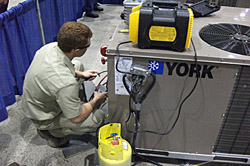
After a system has been opened, or if gas has been introduced during service, the best way to remove noncondensable gas is to pull a good vacuum, as shown in this photo taken at a previous SkillsUSA competition.

Noncondensable gases (NCGs), as the name implies, are not able to condense inside a condenser, unlike refrigerant gases. This can have a serious impact on system operating conditions, energy efficiency, and the lifetime of a system.

What Is an NCG?

The most common NCGs you will find in our trade are air, nitrogen, argon, and maybe carbon dioxide. These gases have boiling points so low that, for any practical condition you can experience in a system, they will remain in the gas phase.

Air enters a system from the surrounding atmosphere when a system is open. Air may also be drawn into a system through a low-side leak if the suction pressure drops below 0 psig. (Air should never be pressurized into a system on purpose since the oxygen in air might create a combustible mixture at higher pressures with refrigerants that contain hydrogen such as HCFCs and HFCs.)

When a system needs to be pressurized — for example, to perform leak checking — nitrogen or argon is commonly used. These inert gases are also purged through lines when brazing in order to reduce oxidation buildup inside tubing.

What Are the Effects of NCGs?

Refrigerant vapor is supposed to condense in the condenser. The process of condensation requires the refrigerant to get close to the walls of the tubing, transfer its heat to the copper, which then flows out to the fins and gets lost in the airstream outside.

Looking for quick answers on air conditioning, heating and refrigeration topics? Try Ask ACHR NEWS, our new smart AI search tool. Ask ACHR NEWS →

Considering the basic heat transfer equation Q = U x A x Delta T, the condenser area (A) has been selected to reject the proper amount of heat (Q) based on the heat transfer coefficient of the refrigerant (U) and the difference in temperature between the air and the refrigerant (Delta T).

A noncondensable gas will remain as vapor in the condenser. It will not flow to the outlet like liquid refrigerant does, but instead it will remain trapped inside the condenser tubing. This will do two things:

1. The surface area taken up by the NCG will not be available for the refrigerant to use for heat transfer (A goes down), and

2. The air will reduce the overall heat transfer coefficient of the vapor inside the tube (U goes down).

In order to get the same total heat rejected, the heat transfer equation shows that if A and U go down, then Delta T has to go up. In other words, the refrigerant temperature has to go higher compared to the air temperature, which means higher discharge pressures.

With the system operating at a higher pressure, the extra work done by the compressor will decrease overall energy efficiency for the system. Discharge temperatures will also go up accordingly, which can lead to increased lubricant breakdown and shorter compressor lifetime. In addition, air contains oxygen, which promotes bad chemistry in the system.

How Do You Know You Have NCGs?

You should not automatically assume that high head pressure means NCGs. Other potential causes for high head pressure should be checked first. They include:

• Reduced airflow over the condenser coil;

• Dirty or blocked condenser coil;

• Hot air from the discharge side of the coil recirculated back into the inlet; and

• Too much refrigerant charge (verify by checking the subcool temperature).

If these have been ruled out, it is possible to check for the presence of NCGs in the condenser. So isolate the refrigerant in the condenser, take the compressor offline, and run the condenser fan. When the refrigerant in the coil has come to air temperature, measure the air temperature and the pressure of the refrigerant inside the condenser. If the measured pressure matches up with the pressure indicated on a pressure-temperature chart, then there are no NCGs in the coil. If the pressure is more than a few psi higher than the chart, then NCGs are probably to blame.

How to Avoid NCGs

After a system has been opened, or if gas has been introduced during service, the best way to remove NCGs is to pull a good vacuum. Evacuation is also needed to remove any moisture that may have entered the system while it was open. Be sure to purge air from charging hoses before opening system valves.

Removing NCGs

To remove NCGs from refrigerant in smaller systems, recover the entire charge and recharge with fresh refrigerant. It is hard to get to the vapor space in the condenser without tapping a line.

To remove NCGs from refrigerant in larger systems, use the nearest access valve to the vapor inlet to the condenser. Recover the vapor from the system for a long enough period to make sure that most of the vapor has been removed from the condenser. This will be a judgment call based on the size of the condenser, the amount of tubing between the condenser and the access point, and the vapor recovery rate of the recovery machine.

To remove NCGs from refrigerant in a recovery cylinder, given the density of refrigerant vapor and typical recovery rates of small recovery machines, it should take about two minutes to pull the air-filled vapor from a half-full 50-pound recovery cylinder. Adjust the time for cylinder size and fill level. The process should be repeated three or four times, shaking the cylinder around after each withdrawal. This will reduce the air by at least one order of magnitude (10 percent down to 1 percent). NOTE: Along with the removed air, there may be three or four pounds of vapor refrigerant also transferred to the new cylinder.

This material was prepared by National Refrigerants Inc. and based on material published in its newsletter, National News. For more information on the company, go to www.refrigerants.com.

Publication date: 05/28/2012

Share This Story

Looking for a reprint of this article?
From high-res PDFs to custom plaques, order your copy today!


Recommended Content

JOIN TODAY
To unlock your recommendations.

Already have an account? Sign In

  • HVAC-enrollment

    The Trades Are Back: HVACR Programs See Nearly 30% Enrollment Spike

    A new wave of future technicians is entering the pipeline.  
    Training and Education
    By: Matt Jachman
  • 2025 Top 40 Under 40

    2025 Top 40 Under 40 HVACR Professionals List

    The 11th annual Top 40 Under 40 list highlights those...
    HVAC Residential Market
    By: Hannah Belloli-Oster
  • LG Ductless Mini-Split Systems

    The 9 Types of Heat Pumps

    As the U.S. moves toward electrification, heat pumps are...
    News
    By: Joanna R. Turpin
Subscription Center
  • Create an Account
  • Start a Subscription
  • Manage My Account
  • Sign Up for Newsletters
  • Visit Customer Service
  • Update Preferences

More Videos

Sponsored Content

Sponsored Content is a special paid section where industry companies provide high quality, objective, non-commercial content around topics of interest to The News audience. All Sponsored Content is supplied by the advertising company and any opinions expressed in this article are those of the author and not necessarily reflect the views of The News or its parent company, BNP Media. Interested in participating in our Sponsored Content section? Contact your local rep!

close
  • Piggy Bank
    Sponsored byWatercress Financial

    Energy Prices, Inflation, and HVAC: What Today’s Homeowners Care About

  • Refrigerated Food
    Sponsored bySolstice Advanced Materials

    R-455A Refrigeration: A Cold Storage Solution for the Future

  • Airex Rooftop Units
    Sponsored byAirex Manufacturing Inc

    Consolidating Roof Penetrations: A Growing Trend in Multifamily HVAC Design

Popular Stories

HVAC-Price-Increase-graphic

HVAC Price Increase List: June 2026

Trump-Section-232.jpg

Trump Reduces Section 232 Tariffs on HVAC Equipment to 15%

R410A-Refrigerant-Cylinder.jpg

Refrigerant Recovery is a Revenue Opportunity

Heat-pump-cutaway.jpg

PFAS Rules and A2L Building Codes Continue to Evolve

Kroger.jpg

Kroger to Spend $100 Million to Reduce Refrigerant Leaks

View The ACHR NEWS
Centennial Anniversary Timeline

The ACHR News Timeline Chart
Submit a Letter
Submit a letter to our editors.

Events

November 6, 2025

Next-Gen Data Center Cooling: HVAC Innovation and Real-World Solutions

On Demand As AI workloads and high-density computing push traditional cooling methods to their limits, the data center industry is accelerating the adoption of next-generation HVAC technologies.

June 9, 2026

Before You Go All In on AI: Set Up Your Business to Actually Win

In this webinar, we'll walk you through exactly what to get in place before you add AI to your business. You'll leave with a clear picture of where you stand today and a practical action plan to set yourself up for real results.

View All Submit An Event

Poll

Summer Staff

Are you fully staffed for the summer season?
View Results Poll Archive

Products

BNI Mechanical/Electrical Square Foot Costbook, 2026 Edition

BNI Mechanical/Electrical Square Foot Costbook, 2026 Edition

See More Products
A2L Refrigerants - Free Webinar - May 21, 2026

Related Articles

  • What to Do if Your Website Needs Surgery

    See More
  • Low ice production: What to do if your unit just won't keep up

    See More
  • What to do if ESPN Calls Out Your Business

    See More

Related Products

See More Products
  • Lessons Learned in a Boiler Room: A common sense approach to servicing and installing commercial boilers

  • new cover.jpg

    Profit is An Attitude: The Strategies You Need to Optimize Profits

  • The ACHR NEWS - March 16, 2026

    ACHR NEWS March 16, 2026, Issue

See More Products

Events

View AllSubmit An Event
  • November 13, 2025

    4 Lead Generation Mistakes You Might Be Making in Your Business & How to Fix Them

    On Demand From website gaps to follow-up breakdowns, you’ll walk away with practical tips to improve your lead flow process and turn your marketing investment into actual revenue results.
View AllSubmit An Event

Related Directories

  • Your Bargain Mart

    We are a MRCOOL Dealer and carry contractor-grade HVAC equipment, air handlers, condensers, heat pumps, gas furnaces, evaporator coils and heat pumps, gas, and electric packaged units.
  • A-Gas

    A global leader in the supply and lifecycle management of refrigerants, offering a range of products and services, including recovery, buyback, reclamation, separation, and destruction.
×

Sign Up. Stay Informed.

The #1 trusted source for the HVACR industry since 1926

SUBSCRIBE
  • RESOURCES
    • Advertise
    • Contact Us
    • Advisory Board
    • Classifieds
    • Submit a Letter
    • Directories
    • Store
  • ACCOUNT CENTER
    • Create an Account
    • Start a Subscription
    • Manage My Account
    • Sign Up for Newsletters
    • Visit Customer Service
    • Update Preferences
  • SERVICES
    • Marketing Services
    • Reprints
    • Market Research
    • List Rental
    • Survey/Respondent Access
  • STAY CONNECTED
    • LinkedIn
    • Facebook
    • Instagram
    • YouTube
    • X (Twitter)
  • PRIVACY
    • PRIVACY POLICY
    • TERMS & CONDITIONS
    • DO NOT SELL MY PERSONAL INFORMATION
    • PRIVACY REQUEST
    • ACCESSIBILITY

Copyright ©2026. All Rights Reserved BNP Media, Inc. and BNP Media II, LLC.

Design, CMS, Hosting & Web Development :: ePublishing