What Lies Beneath
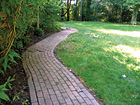
The brick paver walkway shown here became distorted due to frost heave from the underlying loop lines. (Courtesy, Geo Source One, Inc.)
While geothermal heat pumps can be installed just about anywhere in the United States, some contractors may not be aware of how important it is to first understand the soil composition and subsurface conditions in their area before taking on any job. That is because the performance of the geothermal system is dependent on the contact between the loop pipe and the soil; the better the contact, the greater the rate of heat transfer.
IDEAL CONDITIONS
With over 30 years of experience in the industry, Jeff Persons, president, Geo Source One Inc., Dublin, Ohio, is a hydrogeologist and geothermal system specialist who is acutely aware of the need to know about soil composition and subsurface conditions before bidding any project.“Most customers want to see fixed rate pricing and may be reluctant to sign a contract where the loop installation cost may vary by a factor of three if conditions do not prove to be ideal,” said Persons. “However, the contractor who simply plows ahead and installs the minimum loop regardless of the soil condition will likely not remain in business. With the level of social networking we see, those bad installations will likely follow him to his grave.”
So what are ideal conditions for a geothermal system? According to Robert Sycks, director of sales, Heat Controller, Inc., Jackson, Mich., all soil types can generally be used for geothermal loop applications, but the type of soil will determine the amount of loop piping that is required to transfer heat from the geothermal unit to the earth. This affects the bidding process, because the more loops that are needed, the higher the cost of the project.
“Solid rock has a greater rate of transfer than sand, which means less loop piping can be used,” said Sycks. “Sand consists of individual grains, so heat is only transferred where the grains are touching each other. The space between the grains is air, which is a poor heat transfer media, and the same can be said for gravel installations. Sand and gravel cannot transfer heat as well as a heavy loam soil.”
Areas that are saturated with water may have a positive effect on the loop performance, noted Sycks, because water is a good heat transfer material that fills in the gaps between sand grains or gravel. “However, the contractor designing that loop system needs to ensure that the saturated condition is permanent. If it is possible for the water level to drop during a dry period, the loop condition totally changes. In those cases, the loop field must be designed for the dry condition, and the homeowner will enjoy improved performance during the wetter periods.”
Persons agreed that when loops must operate in dry or well-drained soils the loop design needs to be expanded to accommodate the reduced heat transfer. In some cases, this may mean installing three times as much loop pipe as would be used for a heavy, damp, or saturated soil. “A heavy, damp, or saturated soil - such as wet clay soil - provides the best heat transfer, because dry, loose, or well-drained soils act as insulators and have poor heat transfer.”
It is not difficult for contractors to ascertain soil conditions, as most can be readily observed in foundation excavations and utility trenches. In addition, most states and/or water departments maintain geological surveys that include water wells and even foundation boring records that can provide an indication of subsurface soil conditions. “When in doubt, contractors should test the soil conditions by making a small diameter boring to sample soil at the design loop depth,” said Persons. “For loops designed for a 5-foot. depth, an electrician’s 4- to 5-foot. flexible drill bit works quite well but requires several fully charged batteries if using a portable drill to sample to 5 feet.”
For larger projects, a vertical test well is usually a good idea, said Sycks. “The test well allows the engineer to determine the actual rate of heat transfer for that location. From that data, it is possible to calculate the exact amount of bore that is required for the project. Depending on the size of the project, it may be necessary to test several wells over a wider area, since the rates of transfer may change depending on the soil in different areas. The test wells are used as part of the project, so the cost of installing them is not wasted.”
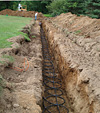
The performance of a geothermal system is dependent on the contact between the loop pipe and the soil; the better the contact, the greater the rate of heat transfer. (Courtesy, Heat Controller)
SUBSURFACE CHALLENGES
Besides soil composition, contractors need to find out if there are any other subsurface conditions that could potentially affect a geothermal installation. For example, subsurface caverns can make grouting and retaining grout in the loop bore very difficult, stated Persons. In fact, highly fractured and cavernous formations may dictate that a geothermal installation be redesigned to use a different method.Saltwater is another factor to contend with in coastal areas, as well as in inland areas where wells are drilled below the freshwater horizon, noted Persons. Saltwater has no effect on the geothermal loops but can create an environmental hazard if discharged at the surface. “Of equal or greater concern is a situation where salt brine under artesian pressure may rise upward in a well bore and contaminate an overlying freshwater aquifer. This phenomenon is well documented in areas with long established oil and gas well activity and could become an issue when geothermal wells are extended to depths below the freshwater horizon.”
Another issue to consider is natural gas that is held or trapped below a denser rock formation, which prevents its upward movement to the surface, said Persons. “Any well that penetrates this overlying layer of low permeability will likely encounter pressurized natural gas. Gas wells do not need to be deep, and in some areas, small plays may be encountered within 150 feet of the surface.” When this happens, drilling operations must cease until the gas pressure is relieved and equipment can be safely turned back on.
When a gas pocket is discovered, advised Persons, it is prudent to provide a venting means to relieve any residual gas at the geothermal well bore rather than chance the possibility that it might trace back alongside the loop lines and enter a building along the foundation. Typical venting is achieved using flexible field tile wrapped with a filter sock, sanded in along the well bores, and vented to the atmosphere, he noted.
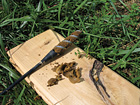
When in doubt, contractors should test the soil conditions before starting a job. The saturated silty sand soil found at this installation provides excellent moisture for loop lines. (Courtesy, Geo Source One, Inc.)
CONSEQUENCES
Contractors who do not consider soil composition and subsurface conditions when designing a geothermal system do so at their own peril, as homeowners generally find out that their system has not been designed correctly when the weather is at its coldest or warmest. This makes for cranky, short-tempered customers.“When it’s hot, a short dry loop is likely to cause the air conditioning side of the system to cycle off and stop cooling because the loop has overheated to 120°F-plus,” said Persons. “When it’s cold, that short dry loop will create low flow and low pressure lockouts as the system temperature drops below the recommended operation range. When forced to operate for long periods of time at temperatures well below freezing, short loops can create ground frost heave of 18 inches and retain snow and ice on the surface long after the spring thaw has melted away the winter snow.”
Fixing a loop that performs poorly due to soil conditions typically means adding a circuit or extending the length of the manifold lines. Persons prefers the latter choice, as the manifold supply and return lines are easier to locate and fuse onto in order to create the needed additional heat transfer. “In some instances it may be less costly to abandon the old loop and install a new properly designed loop.”
In the end, though, you usually can’t change the soil conditions, said Sycks. “This is why it is critical to know what the soil conditions are at the beginning of the job. With that knowledge, contractors can design the loop appropriately and not have to worry about poor performance due to soil-related heat transfer issues.”
Sidebar: A Jolting Surprise
As a hydrogeologist, Jeff Persons is pretty in-tune with almost every kind of soil and subsurface condition that could affect a geothermal installation. Surprises are very rare when he’s in the field, but Persons does recall one situation that just about knocked his socks off - literally.“We discovered a buried high tension line at the very edge of a series of six geothermal bores. The line was missed by the utility location service, which presumed electric, cable, and phone had all been buried in the same trench. This situation taught me the value of owning our own cable and pipe locator to double check on both utility and private subsurface wiring and pipe.”
Publication date: 08/01/2011
Looking for a reprint of this article?
From high-res PDFs to custom plaques, order your copy today!